
Shalom all,
As the current conflict with Iran intensifies, a troubling pattern has emerged – one that reveals not only the brutality of modern warfare, but also the alarming silence of the international community.
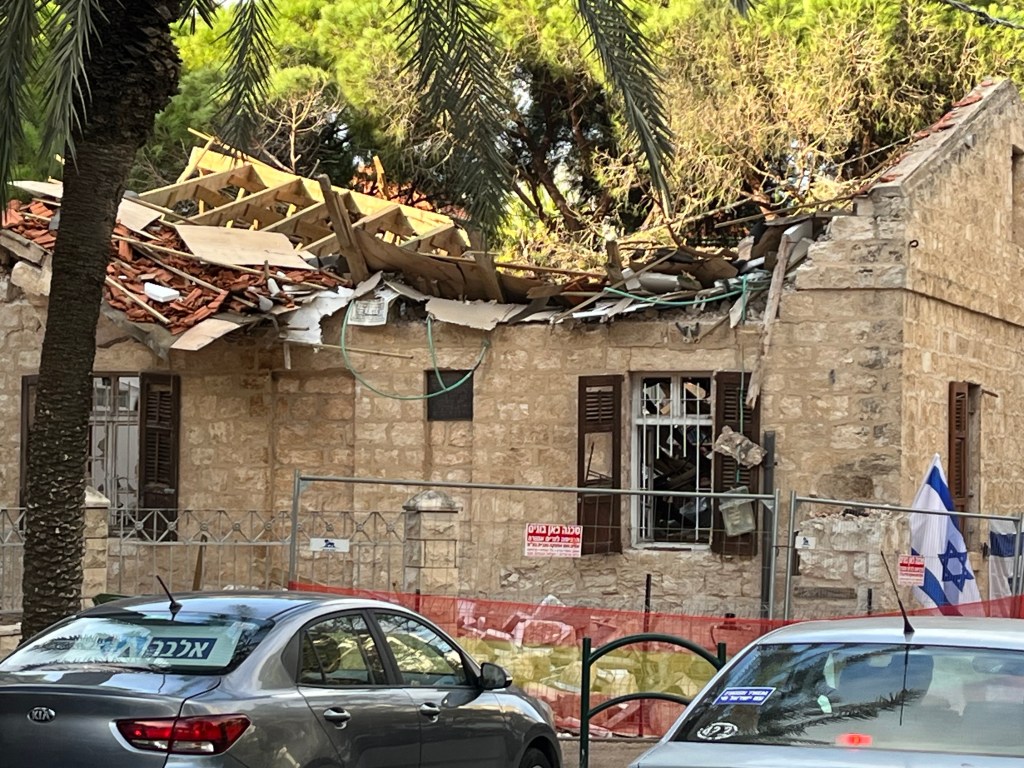
Recent developments paint a stark and unsettling picture. Iranian leadership has issued warnings of retaliation should its civilian infrastructure be targeted, positioning itself as a defender of its population. Yet, in practice, the reality unfolding on the ground tells a very different story. Civilian population centers in Israel have come under direct attack, with missiles striking residential buildings and leaving devastation in their wake. In Haifa, lives have already been lost beneath the rubble of what were once homes – ordinary spaces where families lived, worked, and found refuge.
Even more disturbing is that Iran has been deploying cluster munitions in these attacks. These weapons, by their very nature, are indiscriminate. They scatter multiple smaller explosives over a wide area, many of which fail to detonate immediately – such as happened less than two days ago in Haifa – effectively turning neighborhoods into long-term minefields. Their use in civilian areas is widely condemned under international norms, precisely because they are designed in a way that makes civilian casualties not incidental – but inevitable.
And yet, where is the outrage? Where are the emergency sessions, the strongly worded resolutions, the moral clarity that the international community so often claims to uphold?
The silence is deafening.
The United Nations, an institution ostensibly created to preserve peace and protect civilian life, has thus far failed to meaningfully condemn Iran for these actions. There have been no emergency sessions of the Security Council, no decisive resolutions, no urgent accountability measures, no unified voice calling out the specific use of cluster munitions or the deliberate targeting of civilian populations. This absence of action raises difficult, but necessary, questions about the credibility and effectiveness of global governance structures in moments of crisis and whether this international body has outworn its usefulness.
But, this silence does not exist in a vacuum. It is increasingly difficult to ignore the broader context in which it operates, namely: a global climate where anti-Israel sentiment and, in many cases, outright antisemitism have become more visible and, in some circles, more socially acceptable. Criticism of Israel, when grounded in policy or legitimate debate, is part of normal international discourse. However, when the world fails to respond to the targeting of Israeli civilians with the same urgency and moral clarity applied elsewhere, it once again raises the ugliness of a double standard at play – one for Israel and one for the rest of the world.
When Jewish lives are treated as less urgent, less worthy of protection, or less deserving of international outrage, history echoes in uncomfortable ways. The failure to act decisively in the face of clear attacks on civilians risks reinforcing the danger of that double standard – one that blurs the line between political criticism and something far more insidious.
The geopolitical situation is growing more complicated, with China adding a significant layer of strategic tension. As a major global power with strong economic and political ties to Iran, China’s stance shapes both regional dynamics and the response of international institutions. When leading powers show caution or ambiguity, it often results in inaction, or paralysis, at the multilateral level. This complexity is underscored by the situation of two Iranian ships that departed a Chinese port, reportedly carrying materials that could be used for production of missile fuel. If the United States tries to intercept them, it risks direct friction with China, which could retaliate by restricting rare earth mineral exports, a move that could potentially disrupt U.S. missile production. If the ships proceed unhindered, tensions between the U.S. and Iran are likely to persist and even escalate. Either way, China will enjoy a win-win strategic advantage.
This dynamic creates a dangerous vacuum. And in that vacuum, aggression can flourish unchecked. Norms erode. Red lines blur. And civilians – men, women, and children – become the ones who pay the price as pawns in an international play for power.
The situation is further complicated by escalating rhetoric and brinkmanship between Washington and Tehran. The United States has issued stark ultimatums, demanding that Iran reopen the Strait of Hormuz within a defined timeframe or face overwhelming military escalation, including threats to strike critical infrastructure.
Iran, for its part, has responded with equally severe warnings – promising “devastating and widespread” retaliation against various locations, particularly against Israel, if such actions are carried out, while rejecting temporary cease-fire proposals it views as coercive or strategically deceptive.
Between these competing threats lies a fragile and uncertain diplomatic space. Efforts by regional mediators to secure even a short-term cease-fire remain tenuous, with deep mistrust on both sides and ongoing military exchanges continuing to inflame the situation. The U.S. proposal for a temporary cease-fire was flatly rejected by Iran, who countered with its own 10-point proposal that included, among other things: an immediate, permanent end to the war, lifting of sanctions, ending Israeli strikes against Hezbollah in Lebanon and various financial arrangements, including tariffs for ships passing through the Strait of Hormuz. If there is no cease-fire worked out, President Trump has indicated that he would bomb the daylights out of Iran and send it back to the Stone Age.
It should be noted that although negotiations are purportedly taking place, they are between the United States and Iran through the Pakistani intermediary. Once again, Israel is not included in these negotiations because Iran doesn’t recognize Israel’s right to exist. Therefore, it would not be willing to tacitly consent to grant it such a right by agreeing to sit down and negotiatiate with it.
For Israel, this raises a critical and deeply existential question: what does a cease-fire actually mean? Israel has historically demonstrated a willingness to abide by cease-fire agreements brokered by allies, particularly the United States. However, any such agreement carries inherent risks if it leaves Iran’s military capabilities – even in a degraded state – largely intact. A pause in hostilities that allows Iran’s regime to continue, for its military – including its proxies – to regroup, rearm, and recalibrate its strategy could ultimately place Israeli civilians in even greater danger in the near future.
This is the dilemma. A cease-fire may bring temporary quiet, but it may also preserve the very threat that made war unavoidable in the first place.
From Israel’s perspective, the objective cannot simply be a return to the status quo ante. The repeated targeting of civilian centers, the use of weaponry that is indiscriminate in its operation, and the regional projection of force through proxies and direct attacks all point to a strategic reality that cannot be ignored. Leaving Iran “weakened but intact” risks ensuring that this is not the last round of conflict, but merely an intermission.
Israel’s Response in a World of Silence
In the absence of meaningful international action, Israel is left with a stark and unavoidable reality: it must defend its citizens largely on its own. No sovereign nation can tolerate sustained attacks on its civilian population without responding decisively. And when the world hesitates, when institutions fail, when outrage is selective, when diplomacy is shaped by power rather than principle, Israel’s margin for reliance on others narrows even further. While the world debates, delays, or looks away, Israel faces immediate threats that require immediate action. Its response – whether military, strategic, or defensive – will not ultimately be shaped by international approval, but by necessity.
This is the hard truth of the current moment. Israel may well support diplomatic efforts and even honor cease-fire arrangements led by its closest ally. But, it cannot afford to outsource its security to agreements that leave its enemies capable of striking again. If the international community will not ensure that those threats are removed, Israel will be compelled to act to ensure that they are.
Still, the hope is that this moment will awaken the conscience of nations, that silence will give way to clarity, and that justice will not remain selective. Until then, Israel stands not only on the front lines of a physical conflict, but also at the center of a profound test of the world’s conscience … and of its own resolve to survive.
What can you do? You can lift up your voices in prayer before the Throne of Grace, before the Holy One of Israel, Who longs to be gracious to us. We need wisdom how to navigate through difficult possible scenarios and a holy boldness to pursue what needs to be done, trusting and believing in God’s ultimate authority and recognizing that victory is ordained by God, not merely by human effort. (Prov. 21:3)
“This is what the Lord says: ‘Cursed is the one who trusts in man, who draws strength from mere flesh and whose heart turns away from the Lord…But blessed is the one who trusts in the Lord, whose confidence is in him’.” (Jeremiah 17:5, 7)
“Do not trust in princes, in mortal man, in whom there is no salvation. His spirit departs, he returns to the earth; In that very day his thoughts perish. How blessed is he whose help is the God of Jacob, whose hope is in the Lord his God, Who made heaven and earth, the sea and all that is in them; Who keeps faith forever.” (Psalm 146:3-6)
Bless, be blessed and be a blessing.
Marvin















 The Week That Was