Amalek, 2020

Shalom all.

July in Israel is usually a hot month, at least from a weather and temperature point of view. But, this is not an ordinary July. The coronavirus is in its second wave here, with alarming increases in the number of those who tested positive to the virus. The present, coronavirus-economic crisis has affected multitudes of individuals and businesses, which, in turn, has generated 11 days of demonstrations and protests in front of the residence of Prime Minister Benjamin Netanyahu and in other locations throughout Israel. The north of Israel is heating up militarily, as the Israel Defense Forces (IDF) is prepping for a possible confrontation with the Hezbollah, an extremist Shiite Muslim terrorist group supported by Iran, whose existence necessitates that the IDF is informed, determined and decisive in its actions. And, of course, Israel continues to deal with the disease of anti-semitism, sometimes disguised as anti-zionism or anti-Israel (collectively “anti-Israelism). It is a disease that cannot be studied in a medical laboratory under an electron microscope, nor is there a vaccine that will neutralize it and protect against it. Yet, it is pandemic and has been with us since we were freed from slavery to Egypt and were called as a nation.

The subject is too broad and pervasive to be dealt with in a short blog post. Still, my thoughts are to focus on one aspect of anti-Israelism that is not part of daily discourse, namely: Amalek, who reared his ugly head throughout the millenia and is doing so still today.

Many of those who subscribe to this blog may not be familiar with Amalek. A brief explanation is warranted. Amalek was the first enemy nation that the Israelites encountered after they crossed the Red Sea following their release from slavery under Pharaoh. According to the Book of Exodus (Exo. 17:6-16; 18:5), the Amalekites attacked the Israelites, but were defeated, although not totally destroyed. Moses was then instructed by the LORD to memorialize in writing that the LORD would utterly blot out memory of Amalek from under heaven. To commemorate the victory, Moses built an altar to the LORD and proclaimed that “The LORD has sworn; the LORD will have war against Amalek from generation to generation.” As Israel was about to enter the land after its wilderness wanderings, she was again instructed regarding Amalek (Deut. 25:17-19):

“Remember what Amalek did to you along the way when you came out from Egypt, how he met you along the way and attacked among you all the stragglers at your rear when you were faint and weary; and he did not fear God. Therefore it shall come about when the LORD your God has given you rest from all your surrounding enemies, in the land which the LORD your God gives you as an inheritance to possess, you shall blot out the memory of Amalek from under heaven; you must not forget.” (emphasis mine)

The passages quoted or referred to point out several things: (1) war with Amalek continues from generation to generation; (2) Amalek attacks from the rear: (3) Amalek attacks when we are faint and weary; (4) Amalek attacks “stragglers”; (5) Amalek has no fear of God and (6) the memory of Amalek needs to be blotted out. This is not intended as a Bible study, so I won’t undertake an exegesis of the above passages. Still, some historical data is important to grasp the reason why we need to remember what Amalek did when the Israelites came out from Egypt and the final instruction: “you must not forget”.

The grandfather of Amalek was Esau, who sold his birthright to Jacob for bread and a bowl of lentil soup (Gen. 25:34). Esau determined to kill Jacob, who was the father of the twelve tribes of Israel, but only after the death of their father, Isaac. He didn’t take into account that Jacob could have children before Isaac died and, therefore, nothing would be gained if he succeeded in accomplishing his goal to kill his brother, if Jacob was survived by at least one son. Centuries later, Pharaoh tried to kill every Jewish male at birth, but God intervened and allowed the life of Moses (and other Israelite male children) to be spared. Further along in our history reveals Haman’s plan to kill all the Jews (Esther 3:6), so that none survive. The Romans did their part in destroying the nation. They were followed by religious persecution over the centuries and mass murder of Jews by the Crusaders, followed ultimately by pogroms and ultimately Hitler’s attempt at the “final solution” to rid the world of Jews. 

The goal of Amalek is the annihilation of the Jews (Psalm 83:7). A major theme in the Passover Hagaddah (the retelling of the story of the exodus from Egypt) is: “In each and every generation they rise up against us to destroy us. And the Holy One, blessed be He, rescues us from their hands.” This is the collective outcry of the Jewish people, whose history has been one long anti-semitic, anti-Jewish progrom. In every generation, there is an Amalek who rises up against the Jewish people. Even though he has been called by different names and titles, his modus operandi is always the same: Get the masses stirred up over a particular event and then blame the Jews for causing it or being behind it. Don’t confuse the masses with facts, just present the situation as being true. Hatred, prejudice, jealousy and ignorance will take over. Amalek continues to war against the Jewish people.

By whatever name he is called now, Amalek definitely exists. It is evident in the anti-semitic events taking place daily throughout the world. The mass media, politicians, anti-Israel organizations, academicians, sports personnel, news reporters, performers of all kinds, and lay people from every walk of life, rally around the call to condemn the Jew, remove any influence he may have and then eliminate him from involvement in society. Israel’s very existence is hard pill for them to swallow, so they seek ways to delegimitize Israel and accuse it of whatever wrongs they can think of. It is a very sad commentary of the times in which we live when claims of anti-semitism are being whitewashed and ignored. One scholar recently questioned: Racism is recognized as intrinsic to Western societies. Why isn’t Antisemitism?

In today’s emotionally-charged demonstrations and protests against authority and history, we turn a deaf ear and a blind eye to the hatred that is swallowing up societies around the world. Conspiracy theories abound that foster anti-semitism. There is no paucity of conspiracy theories today or the people behind them who consciously or subconsciously compete with each other to come up with the best conspiracy to lay at the feet of the Jewish people.

We are told to remember what Amalek did. This is reinforced by the command: “you must not forget”. The reason is simple: If we forget, we won’t do anything to prevent it from happening again. We won’t act against Amalek’s efforts. We won’t “love our “Jewish” neighbor as ourselves”. We’ll excuse our non-action with a statement that “The Jew’s life doesn’t matter. His situation doesn’t affect my citadel of self: I, me, mine, myself, my life, my family or my possessions.” Hatred is color blind. It is a disease that affects people of every color and language and every belief and particularly, throughout the millennia, the Jew. Amalek is the manifestation of a spiritual disease, which the eternal Word of Truth describes as a hatred for God and Israel (Psalm 83:1-5). Amalek’s end is sure. It will be destruction (Number 24:20). 

It’s the beginning of a new week. With a little help, it can turn out better than last week.

He will call upon Me, and I will answer him; I will be with him in trouble; I will rescue him and honor him. (Psalm 91:15)

Bless, be blessed and be a blessing.

Marvin

“I Take Responsibility!”

It’s hard to believe. With all that has been going on here … and there, these pages remained silent. Sometimes, we just need to take a break from the pressures of the tyranny of the urgent. The pandemic came, gave the appearance that it was leaving and then changed its mind and is now flexing its muscles again. The economic crisis that appeared to get a measure of encouragement, but was floundering at best, is again threatening to cause severe financial hardship to multitudes here. The plan of annexation that was supposed to go into effect at the beginning of July has been delayed and there is no determinative date for its implication. Anti-semitism has found new avenues of expression. Dissatisfaction with politicians, demonstrators and even riots and the diminution of respect for governmental authority and decisions have all continued during the past two months. And, for the most part, they have only gotten worse. 

During this time, the media hasn’t learned the lesson that those behind the headlines who condemn government, politics and “the left” or “the right”, “the liberals” or “the conservatives” are, for the most part, affected by the consequences of the same venomous rhetoric that they spew forth in both the public media and social media in an attempt to convince the mass multitudes that their ideology is the correct one. We’ve been inundated with reports of demonstrations against police brutality in various countries and have seen the consequences of some the riots that have broken out as a result – a phenomenon that expanded nationally and internationally. And, with all that has been said and done, more has been said than has been done and very little forward progress has been made.

It’s been four months since the coronavirus became a serious issue in Israel and was quickly categorized as a pandemic. The economic consequences that followed of dealing with the pandemic quickly became a financial crisis. During this time, there was no shortage of doomsday prognosticators who voiced their opinions, both in Israel and abroad, that were, and still are, designed to sway the multitudes to accepting that authority needs to be challenged and governments need to be toppled and replaced by those whose worldview is more in tune with the movers and the shakers. It’s easy to criticize and condemn, particularly when no viable alternative is offered with a plan to “make right the things that are wrong”. So, we are often left with accusations against local, regional and national leaders made with a desire to replace them with so-and-so. But, there are no guarantees. Political promises made before elections are intended to garner votes at election time. They are not unconditional commitments to carry out a particular plan for the good of society as a whole. They are more like expressions “I would hope to be able to do this that and the other” when you, the voter, elect me to office because you want to believe that I might actually be able to do what I am telling you I would like to do.” Countries that consider themselves to be democracies tend to have balance-of-power systems that help to prevent them from becoming autocratic and dictatorial. As a result, political opposition often prevents the fulfilment of campaign promises.

So, in the midst of a multitude of crises, great and small, it is actually refreshing that a national leader publicly acknowledges that he accepts responsibility for mistakes that were made, as well as the responsibility to remedy them.

Case in point: When the coronavirus pandemic hit, Israel faced it head-on and went to war against it. It took major steps to deal with a serious problem and we saw the flattening of the curve. Severe health restrictions and limitations on social gathering went into effect. Lockdown was widespread. The distance that one could walk from home was limited to 100 meters. The country was divided between following the government’s guidelines and wanting to resist them.

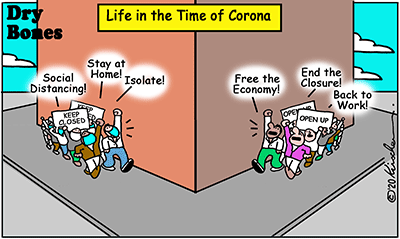
The Dry Bones Blog30:04:2020
The Dry Bones Blog 30/04/2020.png

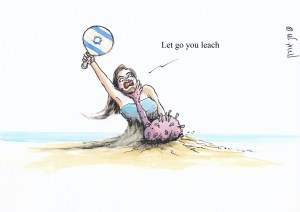
After two and a half months, officialdom believed that the virus packed its bags and was ready to leave. But, because  of travel restrictions, the virus couldn’t find a flight out, so it decided to stay as an unwelcomed guest.

Israel Today:Roni Gordon-14:06:2020
Israel Today/Roni Gordon-14/06/2020.jpg

And now, we are facing round two, which has begun with a vengeance.

Towards the end of May, beginning of June, the numbers who were testing positive were decreasing and the restrictions on gatherings imposed on the population began to be lifted. Large segments of the population disregarded almost all of the instructions of the Ministry of Health, thinking that the worst in behind us, the summer arrived, the sun is shining, time to return to the old normal and move on. During the past week, Israel saw a steady increase in those who tested positive to alarming numbers. 

Only two days ago, Prime Minister Benjamin Netanyahu, in a televised, press conference, publicly admitted that the government re-opened parts of the economy too quickly. He took responsibility for the decision to ease the severe restrictions that were imposed early to halt the spread of Covid-19. 

“Looking back, as part of the trial and error, we can say that the last step was too early… We are in the midst of a global storm, which is growing… The second virus wave won’t skip almost any country… It requires fateful decisions every day, balancing between trial and error. You try, err and fix. That’s how all leaders are operating… In the first wave we had amazing success. The death toll was and remains very low. But the lockdown exacted a heavy toll on the economy.”

Netanyahu took responsibility for the decision to reopen the country a month ago after severe, early restrictions were put in place to halt its spread. I take responsibility for this step, and I take responsibility for fixing it“.  As of 1:00 p.m. yesterday (Friday), parts of 5 communities, including Jerusalem and Beit Shemesh, became “restricted zones” for a week

We may not have the same numbers as other countries, but for a country with a relatively small population, having 5,000 people who tested positive during the past week is significant and the complications resulting from those who caught the virus are serious. Everyone who came in contact with someone who tested positive had to self-quarantine for a full two weeks. After being in extended lockdown (including Passover, Feast of Weeks [Pentecost] and Independence Day) for the better part of two months, an additional period of quarantine was almost too much to bear. The major concern, of course, was and continues to be the health crisis. But, the economic crisis that followed in its wake is still ongoing, with almost no end in sight. Travel and tourism have taken the biggest hit, but unemployment went from around 4% to over 25% and is now still around 21% of the work force. Multitudes were laid off on forced vacations without pay and needed to apply for unemployment benefits. Many may not be able to return to theirs former jobs. Businesses of all kinds have been affected and many have closed their doors, with no intention, or ability, to reopen. The coronavirus health crisis generated a coronavirus economic crisis. So, in the same “I take responsibility” speech, P.M. Netanyahu and Finance Minister Israel Katz revealed an economic aid program that is to go into effect immediately this coming week. Parts of the plan will remain in effect for a year – a move that reflects a reality that the economic crisis could continue to last that long. 

Prime Minister Netanyahu has become the bulls-eye on the target of condemnation. In a short period of time, he went from hero to zero, as he failed to undergird the successes that were achieved during the first wave of the coronavirus. The public did its part in failing to adhere to health department regulations, thinking that because the numbers were down, the danger of becoming infected was no longer a matter of concern. When push came to shove, the public looked to blame someone – other than itself, of course, for the re-emergence of the pandemic, this time even more forcefully that during the months of March through May. The finger pointing was directed at Netanyahu and the cabinet ministers dealing with the coronavirus crisis. Justifiable? Yes and no.

During the first wave, Netanyahu and his cabinet fought against the virus as though fighting a war – a health war, and it achieved a significant and commendable degree of success. A war should be fought to defeat the enemy, not to wound it and give it time to regroup and become another health or security risk. In this regard, Israel claimed premature victory, only to find itself in the midst of a second wave of fighting against a microbe that is disabling and, in some situations, crippling parts of our socio-economic infrastructure. Now, it is faced with the formidable task of increasing its efforts to combat – and this time, defeat – the health crisis, while insuring that the economic crisis does not become worse. 

We live in an age when the usual response to being accused of failure or wrongdoing is to try to pass the buck and accuse someone else. This type of response finds its origin in antiquity, back in the Garden of Eden (Genesis 3:12-13). Thus, it is commendable that the Prime Minister of Israel acknowledges that the ultimate responsibility lies with him. It is regrettable, however, that such an acknowledgment followed the decrease in the public trust of the government’s handling of the health and economic crises. Such an admission is not without its consequences and the public can express its approval or dissatisfaction at the polls at the next election, whenever it takes place, soon or not so soon. It also places the consequences of failure to combat the health and economic crises squarely on Netanyahu’s shoulders. 

Victory in war requires a combined effort of government and population. Both need to fulfil their respective obligations. May God hear our prayer and grant that we will press on to victory and that, in the process, a spirit of unity would control our actions and our behavior. 

And He said, “If you will give earnest heed to the voice of the LORD your God, and do what is right in His sight, and give ear to His commandments, and keep all His statutes, I will put none of the diseases on you which I have put on the Egyptians; for I, the LORD , am your healer.” (Exodus 15:26)

So the LORD heard Hezekiah and healed the people. (2 Chronicles 30:20)

Heal me, O LORD , and I will be healed; Save me and I will be saved, For You are my praise. (Jeremiah 17:14)

Bless, be blessed and be a blessing.

With prayers for your good health and for a great week,

Marvin


When Justice Collides with Politics

“Now the LORD saw, and it was displeasing in His sight that there was no justice.” (Isaiah 59:15)

Pre-meditated murder. Rape. Aggravated Assault. We’re all familiar with the terms, some from a distance and some, to their great sorrow, from personal experience or up close. As we listen or read of the stories, we are all too often left with a sense of injustice. The perpetrator was found “not guilty” and afterwards proudly confessed to having committed the crime. A criminal was found guilty, but the punishment was too lenient  and in a short period of time, the criminal was permitted to go free. Or, the criminal is released early, or doesn’t spend time in jail at all, because of executive pardon. Or, because of legal maneuvering, the perpetrator doesn’t even stand trial for his crimes. 

We’re not talking about someone who was innocent, who was wrongly accused, legally tried, found guilty and even executed for a crime that he didn’t commit. Such a situation truly generates a gnawing anger that an irreversible wrong has been done. Indeed, according to what has come to be known as “Blackstone’s ratio”, expressed by the famous English jurist William Blackstone, is the idea that “It is better that ten guilty persons escape than that one innocent suffer.”  This is also in line with the centuries earlier perspective of the renowned Jewish legal theorist referred to as “The Rambam” (Moses Maimonides), who wrote that “it is better and more satisfactory to acquit a thousand guilty persons than to put a single innocent one to death.” 

On the contrary. The focus of attention is on one who openly, wilfully and wantonly plans and carries out, directly and/or through one or more accomplices, murder. We are a very diverse people and we have very different perspectives on punishment of criminal behavior. Some emphasize that the primary goal is rehabilitation, while others advocate that the best deterrent to criminal activity is the ultimate punishment of the convicted criminal, namely: capital punishment. In this regard, the oft-repeated line from Gilbert and Sullivan’s “The Mikado” finds necessary application: “Let the punishment fit the crime.”

The question of the day is: What is the appropriate punishment for a terrorist, who plotted, together with others, to carry out the murder of innocent men, women and children, and, particularly, religious people, and who rejoiced without any regrets at the success of her efforts? Most people would answer that the “system” should throw the book at the terrorist and impose the death penalty or life imprison. The last thought to enter our minds would be to allow the terrorist to be released on a prisoner-exchange deal, allowing that terrorist to be cheered as a hero, be admired by, and be an exemple for, children, be blessed and praised by ruler and commoner alike, and be given freedom to move about and spout hatred and generate incitement of others to follow and commit similar acts of terrorism.

We personally know people who suffered through a personal act of terrorism that included child rape, others who lost a child in the prime of life and who didn’t even make it to high school, another who survived a stabbing incident, as well as a colleague who was killed when a terrorist blew himself up on a bus. My family was only five minutes away from a restaurant that was blown up by a female terrorist, destroying families and maiming others for life. Of course, there are other incidents. Some of the terrorists died while carrying out their acts of terrorism. Others survived. Some were captured, tried and convicted and put in jail, with the surviving victims and/or their families hoping that after the terrorists are locked away, the key to their prison cell would be thrown away.

On the morning of August 9, 2001, Ahlam Tamimi, a 21-year-old Jordanian journalism student at a university located in the region of Judea and Samaria, worked as a newsreader at an Islamist TV station. She was a former Fatah (PLO) activist, who later joined Hamas.

Izz al-Din Shuheil al-Masri, 22, was the son of a successful “Palestinian” restaurateur. The two met up in Ramallah, traveled by taxi to a military checkpoint north of Jerusalem, then walked across into Israel. Their dress and appearance gave the impression that they were just some young Israelis or tourists and they did not arouse the suspicion of the border soldiers, even though al-Masri was carrying a guitar case that was not examined. They took another taxi to a busy center of Jerusalem and separated just before 2 p.m. Tamimi took a bus back to Ramallah. Al-Masri walked into a crowded Sbarro pizza restaurant and detonated the bomb that was hidden in his guitar case. The devastation was not easily described – 15 dead, another 130 injured, one of whom remains hospitalized to this day in a permanent vegetative state. Al-Masri died along with his victims.

Tamimi was captured by Israeli security forces within weeks,  was tried and sentenced to 16 life terms for murder, with the recommendation of the trial judges that she “should never be eligible for pardon, for early parole or any other release.”

The lives of the families that suffered the loss of their loved ones in the terrorist bombing of the Sbarro pizzeria were never the same. Yet, they held on to the hope that the terrorist who remained alive would never see the light of day outside of the prison.

Still, even as the families of the victims remember the events of that day with sorrow, anguish and pain and have not recovered, the opposite is true for the terrorist who caused their irreparable loss. While in jail, Tamimi was interviewed by the media, expressed joy over the number of deaths that resulted from the bombing that she referred to as “my operation” and thrived, becoming a celebrity in the Islamic world. 

She was released as part of the prisoner exchange for Gilad Shalit, an Israeli soldier who was captured by Hamas in 2006. He was released five years later, in exchange for 1,027 prisoners held by Israel, 280 of whom had “blood on their hands”. One of them was Ahlam Tamimi. Much as I usually agree with Israel’s policy not to leave any of its sons behind, I parted company with that policy when this “deal” was announced. It was a political disaster and laid the groundwork for future negotiations, including the present ones for the return of bodies of Israeli soldiers taken into Gaza by Hamas during the war of 2014. Hamas is looking for another public relations success with the release of a large number of prisoners, many of whom, like in the Shalit “deal”, have blood on their hands.

Since being released from prison, Tamimi’s life has been on the upswing. She has been able to marry, is planning on starting a family. She is revered and praised in Islamic circles and has no regrets, other than that more people were not killed through her efforts. 

I read an article today about one of the teenage victims of the Sbarro terrorist  attack, Malki Roth, and her family’s ongoing efforts to bring Ahlam Tamimi to back before the bar of justice. Now, there is a ray of hope that Tamimi will have to stand trial for her crime in, of all places, the United States. This is because U.S. law allows for the prosecution of criminals who kill American citizens. irrespective of where the crime was committed. Some of the victims of the Sbarro explosion were American citizens. Tamimi is in Jordan. The U.S. and Jordan have an extradition agreement in force. The U.S. asked Jordan to extradite Tamimi. Jordan refused. Maybe, just maybe, the U.S. will succeed to remove the smile off of her face. But, it is easier said than done. Politics allowed Tamimi to be released and now politics, at home and abroad, have again entered into the picture to try to keep her from being extradited to the U.S. The article can be read here.

Paraphrasing Prime Minister’s 1997 book, “Fighting Terrorism: How Democracies Can Defeat Domestic and International Terrorists”, the writer of the article contends:

“[Malki’s father]  would argue that governments that seek to defeat terrorism must refuse to release convicted terrorists from prisons since this emboldens them and their colleagues. By nurturing the belief that their demands are likely to be met in the future, he would argue, you encourage terrorist blackmail of the very kind that you want to stop. Only the most unrelenting refusal to ever give in to such blackmail can prevent this.” 

The article is not an easy read, but a necessary one and I would recommend it. Terrorism affects every one of us. We need to properly understand it in order to properly deal with it. No one can say anymore, “It can’t happen here.” Israel doesn’t have the death penalty, except for Nazi war criminals. Taking into consideration the number of Israeli lives lost as a result of terrorism, it is quite possible, as one of my close friends wrote, “A judicious use of the death penalty may have prevented this mess and others similar to it.” Would you agree?

May God watch over each of you and set His protection around you to keep you safe from all harm of all kinds at all times.

“He has told you, O man, what is good; and what does the LORD require of you, but to do justice….” (Micah 6:8)

“Justice, and only justice, you shall pursue….” (Deuteronomy 16:20).

Bless, be blessed and be a blessing.

Marvin
Three Thousand Five Hundred Years Old … Seventy Two Years Young

HAPPY BIRTHDAY, ISRAEL! You are the oldest youngster among the nations. It is celebration time, but so incredibly different from all the birthday celebrations that have taken place since you returned to your ancestral homeland, after two thousand years of dispersion in the diaspora. Independence Day 2- 2020-04-29.jpeg.

The sky was blue this morning with white clouds interspersed, very symbolic of our national colors. We are a sovereign nation, whose inhabitants live in a free and democratic society. We don’t always agree on things that occur here or on how things are done, but we have the right and the freedom to express our differences, to be heard and to make a difference. Our freedom and the restoration of our national identity came at a price, a price that we continue to pay year after year. 

The day immediately preceding Israel’s Independence Day is a Memorial Day set aside to commemorate Israel’s fallen – those who were killed in the defense of the country, as well as those who died as a result of terrorist activity. Since the founding of the modern State of Israel in 1948, we fought six wars, dealt with two full-blown and extended intifadas and a multitude of terrorist attacks. From the date of our establishment, we have not had a single decade without a war. Yesterday, we honored 23,816 fallen soldiers and over 3,100 people killed in acts of terror. 

There is hardly a family in Israel today who does not personally know someone, or who does not know a family or neighbor or co-worker of someone, who was killed or injured in a war or as the result of a terrorist incident. It is a small country and every loss is treated as a family loss. I’ve attended funerals of people I knew personally, as well as funerals of people whom I didn’t know, such as the young lone soldier (who had no family in Israel), who was killed in 2014 during Operation Protective Edge. I still remember with vividness the throngs that turned out to honor someone who gave his life for this country. Year after year, we become riveted to the stories, the videos, the documentaries of the fallen, which are broadcast, so that all can see, so that all can remember. Everyone is referred to by name, often accompanied by photos from the time of birth, through school, to enlistment in the IDF, to the time and circumstances of their death. Even the most hardened, combat veterans cannot hold back tears, when they speak of their comrades, many of whom put themselves in harm’s way to protect others in their units. Truly, these stories never fail to pull tears from eyes that were dry, like a faucet that cannot be closed. Despite our many differences, we are truly a nation that unites in our losses, that mourns with those who mourn, that makes every effort to comfort those who are bereaved of  spouse, parent, child, brother or sister. 

This year, more than at any time before, when travel restrictions and lockdowns because of the Coronavirus pandemic keep us at home, we become, in a practical sense, a captive audience, sharing collective pain and suffering, as we remember not only the fallen, but the nation that they died for. 

This year, however, military cemeteries were closed to the public, as part of the ongoing efforts to minimize the health risks that would accompany the usual multitude of visitors to those cemeteries. Still, notwithstanding the government restrictions, there were a fair number of instances where family members went to the military cemeteries, only to be reminded by police units that they were in violation of the restrictions imposed on the country. Notwithstanding the blatant violation of “stay-at-home” regulations, the Israeli Police were instructed not to prevent immediate family members from visiting the graves of their loved ones, provided that they wore protective facial masks and kept a distance of two-meters between them. There was an unstated, but widespread, recognition of the importance of such visits by family members, particularly after a prolonged lockdown, the likes of which the nation has never experienced.

At then, with the going down of the sun and the beginning of the new day according to the Hebrew calendar, the nation began its celebration of our seventy-second year of national independence. If ever the country needed a break from the prolonged lockdown and restrictions on movement and contact, Independence Day was the ideal day for it to take place.

But, the yearly celebrations that normally take place throughout the country were cancelled. A portion of the special, Independence Day ceremony that takes place on Mount Herzl in Jerusalem was pre-recorded, while other aspects of it were broadcast live, such as the lighting of twelve celebration torches, symbolic of the nation’s origins from the twelve tribes of Israel. 

The official opening of the ceremony, with speeches by Prime Minister Benjamin Netanyahu and by Benny Gantz, who signed a unity government agreement with Netanyahu last week, were both pre-recorded and shown in video messages. Despite the words of encouragement by both of them, the fact remained that the feelings of celebration were somewhat muted, due to the lockdown and travel restrictions, which will remain in effect until the end of Independence Day.

With the elections behind him and the challenges of a national unity government in front of him, Benny Gantz spoke as a former IDF General, who was prepared to work with Netanyahu to guide the country to overcome the challenges and to press forward to “form a new ethos, a story of solidarity”: “We are going through difficult times, and we must prepare for even harder times. We will win this war, and form a new ethos, a story of solidarity; a story that would not be defined by strangers or enemies, but by ourselves. This should be our main mission in the national leadership.”

His speech also included reference to the fallen soldiers, whose memories were the focus of the day that had just concluded: “Nothing separates them – not where they were born, not their sexual identity and not their political stance. Under the deafening silence of death, they are all equal here. We have the responsibility to ensure we are all equal in life, too.”

There is an indomitable spirit among the people of Israel. The pandemic that has paralyzed most of the world for a season, has affected Israel as well. No enemy, national or microscopic, will succeed in diminishing that spirit. On the contrary, they spur us on to overcome the challenges and to press on to accomplishments even greater than what we were able to do until now. It is in a very real sense “built in” as part and parcel of our national being. It is “who we are and how we respond to challenges”. 

In the midst of travel restrictions and social distancing, communities join together and sing on our balconies. Modern technologies, such as Zoom, allow multitudes to encourage multitudes of others. Physicians use the media to diagnose and provide needed treatment to multitudes of senior citizens, who are unable to leave their apartments. Young people have volunteered during this recent health crisis to deliver food packages, medical supplies and other necessary items to people all over the country. People knock on the doors of their senior-citizen neighbors, to inquire if they are well and if they need anything. Telecommunications flourish, teaching “online” came into its own, multi-person “online” meetings may well re-arrange our schedules, without having to face traffic jams, and there is a major push to develop vaccines and medications to deal with Covid-19, as well as a wide variety of other illnesses. In the midst of difficulties, we look for ways that our lives would be improved when the difficulties are over. 

We are three thousand five hundred years old and, by God’s grace, we still yield fruit despite our age. (Psalm 92:14). We have learned a few things during that time that enable us to live amid difficulties and enjoy being seventy-two years young. Some of them are “to sing for joy to the LORD [to] shout joyfully to the rock of our salvation” (Psalm 91:1), “for the joy of the LORD is [our] strength” (Nehemiah 8:10) and a “joyful heart is good medicine” (Proverbs 15;13 – loose translation), particularly when facing the microscopic giant.

Happy Birthday, Israel. L’Chaim! To Life!

Independence Day 1- 2020-04-29

Bless, be blessed and be a blessing,

Marvin

We WILL remember and WILL NOT forget!

Shalom all,

There are dates and events in history that become etched in our memory banks. They are brought forth from time to time to remind us to remember them. Some events are international in their scope, such as September 11, 2001 (i.e., 9/11) and the Coronavirus Pandemic of 2020. Some are national, such as the Exodus from Egypt on Passover and the giving of the Law to Moses on Mount Sinai; December 7, 1941 – the bombing of the U.S. Naval Base in Pearl Harbor, “… a day that will live in infimy forever”. Some events are regional, such as 70 A.D. – the destruction of the Temple in Jerusalem by the Roman General Titus. Some relate to individuals – the death of Messiah Yeshua as the Passover Lamb and His resurrection, both according to the Scriptures. But, there are other events that relate to a specific people, and the attempts to eliminate them from the face of the earth – Psalm 83:4 – “Come, and let us wipe them out as a nation, that the name of Israel be remembered no more.” This is actually a series of events and attempts by those who hate God, who have exalted themselves and who made and make shrewd plans against “Your people” (Psalm 83:2-3; Deuteronomy 7:7; see the Scroll of Esther).

The Passover Haggadah (the telling of the Passover story at the annual Seder meal, the night of the Passover) contains the following statement (translation from Hebrew): “In every generation they rise up against us to destroy us.” A reading of Biblical history confirms this – Pharaoh’s command to kill all newborn, Jewish males and Herod’s command to kill all Jewish males under the age of two years old. Persecution under the Romans – You cannot live here as a Jew; convert or die. The slaughter of over a million Jews during the time of the Crusades; the expulsion of Jews from Spain and Portugal – You cannot live here. The pogroms in Russia and Eastern Europe and, eventually, to the Holocaust, the planned “final solution” to rid the world of the Jewish people – You cannot live!

But, WE DO LIVE. God has declared that He would always leave a remnant to Himself (Genesis 45:7; 50:20; 1 Kings 19:18; 2 Kings 19:4; Isaiah 37:4; 2 Chronicles 34:9; Jeremiah 42:2; 43:5; Ezra 9:8, 13, and many others, among them Isaiah 10:22 – “For though your people, O Israel, may be like the sand of the sea, only a remnant within them will return; a destruction is determined , overflowing with righteousness.” Those who receive this blog are of many different nations, peoples, languages and beliefs. Some believe in the God of the Bible and what is written in its pages and others who do not. The fact remains: What was intended for bad, God intended for good (Genesis 50:20).

Today is a national day of remembrance. A short while ago, sirens sounded throughout the land, piercing the relative silence and reminding people to stop whatever they are doing, wherever they are – at home, on the street, in the office and even on the highway. We paused for two-minutes in silent remembrance of the satanic, systematic plot designed to destroy us as a people, “so that the name of Israel would be no more.” Some remember the loss of family and friends, who were victims of the Nazi regime, even as some of them remember their personal experiences of having lived through the nightmare of the Holocaust. They don’t forget and we cannot allow ourselves to forget. 

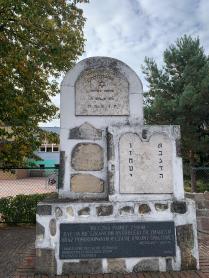
Each year at this time, emotions well up within me that are difficult to suppress. Stories told by survivors of a dark night in the history of mankind that will always remain as a cancerous wart on the hide of society. As one survivor, now 92 years of age and living in Israel, said; “I cannot forget. I live with it year after year, month after month, day after day.” Tears flow freely, with no attempt on my part to stop them. A few months ago, I wrote of some of the events of the trip to Poland that my wife and I made back in September, 2019, and my hope to find traces of my family, who had lived in a small village north of Warsaw, whose entire Jewish population, with the exception of about two dozen, were murdered in the Holocaust. I remember our visit to the site of the one and only Jewish cemetery that had existed for hundreds of years, with tens of thousands of graves, that was entirely destroyed by the Nazis within a few weeks following their invasion of Poland on September 1, 1939. A portion of my family’s history has been wiped out, as if it never existed.” How would you feel, if this was your family?

It is difficult to express, in words, the sense of loss of knowing that I had aunts, uncles, cousins, grandparents and generations of family who preceded them, who lived and raised families, who worked, who died and were buried there. Yet their names, once etched on concrete gravestones, were erased in a moment by a tank and/or bulldozer that swept through the centuries-old cemetery. My parents are both gone, the last generation of our family from that village to leave and never to return. “There is something that is built into the fabric of our being that longs for permanence, for an existence that continues beyond our days.”

By God’s abundant grace, I found life in Israel, where my wife and children were born. They all served in the I.D.F. and our youngest son continues to do so, as an officer. He  visited Poland two months after we returned, as part of a special program of the I.D.F.  and wrote, as part of his experience there: “It is my privilege as a Messianic Jewish Officer, a free man and one who belongs to the Messiah, to be a representative here, not only on behalf of the army but as the representative of our whole family!

Attached is a moving, 2-minute video, with translation, but no link, of a special meeting between an 89-year-old Holocaust survivor and her grandson, that speaks for itself. For Hebrew speakers, the link to the same video from the IDF website, but without translation, can be seen here.

The spirit of freedom – to live, to protect and defend are part of the warp and woof of those who are the remnant of the Jewish people today. In a directive issued yesterday by Lt. General Aviv Kochavi, to all I.D.F. personnel, he wrote, in part: 

“When the soldiers of the Jewish Brigade went into the concentration camps with the Allies, the survivors couldn’t believe their eyes – soldiers were wearing the Star of David. They saw a Jewish solider as a contradiction in terms … something that could not be.”

Time after time, Kochavi wrote: “We remember. . . . They all shared the hope that one day, a generation would arise out of the blood and ashes that would have the privilege of living in its own nation – the State of Israel. That is what came to pass. . . . The Star of David is no longer a badge of shame, but the symbol of the IDF which expresses the power to defend, time after time, the people and the nation. . . . At this time, our mission is to protect them. We will always remember them . . . We will follow in their path and remain vigilant, so that we need never depend on someone else’s kindness. We will continue to tell their stories and ensure that their testimonies continue to echo forever, and we will keep in our hearts those who fell victim to the Nazi evil. Memory is a source of strength, of spirit, and of values. (my emphasis)

But memories will fade, particularly as the generation that survived the Holocaust slowly passes from the scene. More and more voices are heard denying the fact of the Nazi Holocaust and, sadly, the degree of historical ignorance concerning it among millennials is appalling. The late Prime Minister Menachem Begin wanted all Jews to imagine themselves as having gone through the horror of the Holocaust, to make it a collective experience, similar to the deliverance from slavery in Egypt, the giving of the Ten Commandments, the destruction of the Second Temple and even the expulsion to the diaspora. But, the memory of the Holocaust does not need to be confined to Jewish people.

The number of Holocaust survivors in Israel is 189,500. Almost 15,000 survivors passed away in Israel in 2019, prior to the onset of the Coronavirus pandemic. If this rate continues, in the short space of 14 years, there will be no survivors left. Who will continue to speak and keep the memory of it alive, if not you and me?

If you’ve read this far, then this post speaks to your heart. Please remember not only the victims and their families, but those who put their lives on the line to save Jewish people from the Nazi scourge. The Israeli non-profit organization, “From the Depths” (“Me’ma’amakim”), is assisting those whose actions during the Holocaust saved the lives of Jewish people in Poland, who were recognized as “Righteous Among the the Nations” and were awarded a Certificate of Honor by the State of Israel. During this time of the Coronavirus Pandemic, they are locked away in their homes and only this organization is reaching out to assist them. They helped us in our time of need and they will not be forgotten at this time of their need.

We ALL have a responsibility to remember, to relate and to repeat for generations to come that an evil so incomprehensible was allowed to exist and that, in the midst of what was claimed to be an enlightened society. Even more so, we need to remember that God will preserve the remnant of His people and what was and is meant for evil, God will use for good, even as out of the ashes of the Holocaust, the nation of Israel was re-established in our ancestral land.

A remnant is alive. Some have returned to Israel! Others are still in the Diaspora. Wherever we are, we WILL remember and WILL NOT forget!

Remember also: Bless, be blessed and be a blessing.

Marvin
Inching our way out of lockdown and into Spring

Shalom all,

At the outbreak of the coronavirus crisis, Israel was quick to see the handwriting on the wall and acted accordingly. From the beginning of March, the government imposed strong restrictions on the general public including social distancing, lockdowns and holiday curfews, which undoubtedly resulted in saving a multitude of lives. In the process, more than 25% of our entire work force has been laid off. Small businesses that were not deemed to provide “essential” services were required to be closed. The government’s concern was, rightly, to restrict the spread of the coronavirus and protect, to the extent possible, the general population from  becoming infected.

There is no doubt that if the government had delayed in its response, the number of people who would be affected by the pandemic would have been vastly greater, creating an overload to, and breakdown of, the health system. In this regard, Israel is to be commended for taking bold action, even if many here disagreed with its measures. If other countries had acted in the same way, the number of victims of the coronavirus could have been reduced substantially, some even estimating by as much as 90 percent.

Although the number of those in Israel who contract the virus, as well as the deaths that result from it, continue to grow, the exponential growth that was expected is no longer being reported. The “curve” still exists and it is far from being flat. Containment will continue to take a long time and there is no guarantee that the outbreak will not re-occur. Nor is there any guarantee that people who were once affected by it and survived would not become re-infected. We are still in the throes of the pandemic of our times, which has generated problems of different kinds and issues that will need to be dealt with long after the “coronavirus crisis of 2020” becomes an historical, socio-economic study. Science Magazine of 14 April, 2020, reports: “[A] key metric for the success of social distancing is whether critical care capacities are exceeded. To avoid this, prolonged or intermittent social distancing may be necessary into 2022.” This is not exactly the best-case scenario to warm the cockles of our hearts.

As much as Israel is to be praised for its prompt action at the beginning of this health crisis, it now faces another crisis, an economic one. Its response to the economic fallout from prolonged social distancing, closures and lockdowns did not run on a parallel course with its response to the health crisis.  Government assistance programs are admirable, but they fall short in helping hard-hit businesses, particularly small businesses that are the backbone of our economy. Moreover, the aid packages extended by the government are not geared for the long haul and, admittedly, they shouldn’t be. So, different government ministries met to try to come up with an “exit plan”, that would get the economy back on track. 

What is missing at the moment is a clear, agreed-upon plan to end social distancing and re-open the Israeli economy, a plan that includes, at the very least, a verifiable, sustained reduction in the number of new cases of people infected with Covid-19. Even though this is missing right now,  its absence is not stopping the country from trying to inject new life into the economy by getting people back to work, or at least some of the work force, subject to guidelines of the Health Department. 

Tomorrow night, at the end of Shabbat, Prime Minister Netanyahu is supposed to reveal the government’s plans to gradually end the lockdown and get the life of the country to return to “normal”, whatever that may be. But, an honest appraisal of the situation is that what was “normal” before the coronavirus pandemic will no longer be the “norm”. 

Everyone wants the health crisis and the economic crisis to end. But, in looking for a way to end the economic crisis, will we act in a way that will aggravate the health crisis? This is an open question and one that will be answered only after people begin to go back to work, assuming of course, that they still have a job to return to. The proposed outline leaves a percentage of the population still at home, due to their age and health history. Everyone 65 and over needs to remain in lockdown. For small business owners, this would be devastating.

Memorial Day for Israel’s fallen is on the 21st of April. Holocaust Remembrance Day is one week after that, followed immediately by Israel’s 72nd Independence Day celebration. Could these be factors that entered into the decision whether to begin to restore the economy this coming Sunday, notwithstanding that the coronavirus continues its sweep across the country like the wave of a tsunami? There is no question that not being able to participate in these national events would have a long-term psychological impact upon our citizens. A celebration of the day of our national independence might be just the thing that the doctor ordered, as we look forward to being freed from the consequences of the pandemic. But, public celebrations would allow for multitudes to assemble together – the exact opposite of what we tried to avoid during the past month and a half. The government will be taking a calculated risk in allowing people to return to work and participate in public celebrations. Still, we need the release from the pressure of the prolonged lockdown. The question is whether the release would generate an explosion of contagion that will be difficult to contain? Let us pray that it won’t.

May we keep one hand on the work that is before us and the other hand on the sword to keep danger away, so that we can build a wall of safety around us and an economy that would be even stronger than what we had before.

A final note: Today was a beautiful day in Israel, at least it was all morning. It is Spring time now – a time when the desert blooms and the flamingo comes for a visit. So, I’m attaching a link to some of the beautiful moments in Israel at this time. The link is to a site in Hebrew, but the pictures speak in a language that everyone can understand. It opens with a 18 second introductory commercial. After that, click on the box and there will be a 2 minute, 19 second video segment. When that finishes, scroll down on the website to see the photos. The photo array starts with blue flowers on Mount Hermon. The coral reefs and turtle (last photos) are from the Red Sea in Eilat, where our oldest son is doing his research for his doctorate in marine biology.  There is incredible beauty and amazement in God’s creation. We just to take time to look at it, in order to appreciate it. If you want to know any of the areas depicted in the photos, ask me. I’m sorry that I couldn’t get rid of the additional articles and advertisements that follow the photo array. 

The wilderness and the desert will be glad, And the Arabah will rejoice and blossom. Like the crocus, it will burst into bloom; it will rejoice greatly and shout for joy. The glory of Lebanon will be given to it, the splendor of Carmel and Sharon; they will see the glory of the LORD, the splendor of our God. (Isaiah 35:1-2)

Then the lame will leap like a deer, And the tongue of the mute will shout for joy. For waters will break forth in the wilderness And streams in the Arabah. (Isaiah 35:6)

Shabbat Shalom. Bless, be blessed and be a blessing.

Marvin

Is a Coronavirus “Breakthrough” on its way? Maybe.

Shalom all,

May this find you and yours all healthy and hanging in there during this unique time in our modern history. The coronavirus pandemic continues to spread far and wide with attendant health and economic consequences for many. All are looking for an end to the crisis. If we look at the glass half full, a potential cure may not be that far away.

The Haifa-based, Israeli company, Pluristem Therapeutics Inc., reports that preliminary testing of COVID-19 treatment on six critically-ill coronavirus patients showed a 100% survival rate, with four of them showing respiratory improvement. The company also treated its first American patient suffering from COVID-19 complications. The latter was carried out in a hospital in New Jersey. the US. trial was run under the U.S. Food and Drug Administration’s Single Patient Expanded Access Program, which is part of the US. Coronoavirus Treatment Acceleration Program – an emergency program aimed at moving new treatments to corona patients as quickly as possible.

According to the Company, “Pluristem has made the strategic decision to work only with adult stem cells, purified from the placenta after birth and, therefore, not subject to ethical or religious controversy.”

The six Israeli patients were treated at three different hospitals here for one week, under a compassionate use program. All suffered from acute respiratory failure and COVID-19 related complications. Four of them had other severe medical issues.

Not only had all the patients survived one week later, According to Pluristem, all of the six patients not only survived the week, but four of them showed respiratory improvement, with three of them being weaned off of ventilators. 

This comes as a breath of fresh air, particularly as the number of Israel’s dead has climbed about 20% in the last two days, with over 12,000 having tested positive for the coronavirus so far, including an 8-day-old infant, who was diagnosed today and hospitalized. It seems that the virus is not listening to what the medical authorities have to say, namely, that it afflicts mostly the elderly and, particularly, those with pre-existing medical conditions. 

If that wasn’t enough, the government authorized a nation-wide restriction about traveling between different community, which went into effect at 5:00 p.m. today and will remain in effect until 5:00 a.m. on Thursday morning. This is the second time in one week that there is a nationwise lockdown, the first being on the eve of Passover and now, at the end of the last day of Passover, which is also a national day of celebration here. The restriction will continue and include the festivities that usually take place during the Mimuna, a non-Biblical event that is celebrated by many in Israel to mark the end of the Feast of Unleavened Bread and allows for the eating of regular bread again. All normal celebrations for these two days are cancelled. 

The political on-again, off-again, negotiations between Prime Minister Benjamin Netanyahu and Benny Gantz to form an emergency, unity government continue, with the latest round of meetings taking place this morning and afternoon, without success.  They are scheduled to continue right after the holiday, that is, not before Wednesday evening. The joint statement released by the Likud (Netanyahu’s party) and Blue and White (Gantz’s party) was to the effect that the intended goal of Wednesday evening’s meeting is “to reach agreement on the establishment of a national emergency government”. For all intents and purposes, the mandate given to Benny Gantz to form a government expired last night. Israeli President, Reuven (Ruvi) Rivlin can give Netanyahu the mandate, or he can turn it over to the Knesset. But, one thing is clear – if the leaders of the two major parties do not reach agreement by tomorrow night, we will go back to politicking and in a worse-case scenario, we will be on our way to a fourth election. 

Hard to believe. In two days, I’ll have been in lockdown for a month. Could be worse…I could have written these lines after two months! Looking at it from the bright side, I’m thankful that my family and I are healthy, I didn’t have to shave during this entire period, I had more time to pray, read and write and to be be in contact with folks, near and far. So, there are positive things to dwell on.

For those who are able to celebrate the last day of Passover/Feast of Unleavened Bread, enjoy … in good health! L’chaim!

Remember: Bless, be blessed and be a blessing!

Marvin

Negotiations for Unity are Cancelled! The Breakthrough Broke Down.

Negotiations to form a Unity Government between the two front-runners of the last three elections, Prime Minister Benjamin Netanyahu (Likud) and Benny Gantz (Kahol Lavan = Blue and White) came to an abrupt halt this afternoon, due to a disagreement regarding the Committee for the Appointment of Judges. Really!

One would think that after jumping over difficult hurdles and issues regarding sovereignty and security, the two politicians were well on their way to reaching agreement on the formation of a Unity Government that would be able to focus attention the national health crisis and the economic crisis. But, no! There was another bug that caused not only social, but political, distancing between the two men who were supposed to take turns being the shepherds of the sheep and return us once again to enjoy greener pastures. 

They were close. It was almost a done deal. But, the Likud party wanted to re-negotiate the issue of being able to veto judicial appointments, an issue that the Blue and White party said it would not allow and then promptly announced the cessation of negotiations to set up an emergency government. According to Blue and White, “After reaching understanding in all matters, the Like requeste to re-open discussions regarding the activity of the Committee for the Appointment of Judges. As a result of that, negotiations were discontinued. We won’t allow any change in the function of the Committee for the Appointment of Judges and injury to democracy.” 

It appears that the Likud had earlier waived a demand for a veto in the Committee appointing judges. This is no small matter, given the fact that the Ministry of Justice was conceded to the Blue and White party. What the Likud wanted is a mechanism that would allow the rightist bloc to cancel or approve judges. Blue and White refuses to permit this and contends that what is really in issue is a change in the constitution – an interesting contention given the fact that Israel does not have a written constitution, but a number of Basic Laws, which taken together are treated as a constitution. When the demand was made, the talking stopped. When I first heard the news, I thought for a moment that it was talking about the appointment of a judge to the U.S. Supreme Court. But, reality took resurfaced a moment later. 

After reaching agreement on a major issue like Israel being able to impose sovereignty over Judea and Samaria (after redrawing borders in line with the Deal of the Century), are we going to regress to where we were a month ago following the third round of elections because of an inability to agree how a judicial appointment committee is to function? Amazing. 

Like the rest of the world, Israel is dealing with a health crisis the likes of which we having seen since Biblical times and economy that is trying to stay afloat. It needs an injection is wisdom and courage, working together, to get us back on our feet, physically and economically. The last thing we need two days before the celebration of the Feast of Passover is the continuation of an interim government. Cautious optimism dwindled to renewed pessimism over the inability to agree how judges – who should be impartial in their decisions – are to be appointed.

Both parties should be ashamed of themselves. The apparent last-minute breakdown in negotiations leaves the country with neither an emergency government, nor a unity government. Gantz turned his back on those who ran the political gauntlet with him (except for former General Gabi Ashkenazi), purportedly for the very purpose of avoiding a fourth round of elections. If anything was clear following the elections, it was that he would not be able to form a majority government, because of defections from different parties, including from his own. Netanyahu, for his part, conducted negotiations for an emergency, unity government to the almost virtual exclusion of those individuals and smaller parties who made up the rightist bloc and who backed and supported him during the past year and a half through three difficult and very costly and less than honoring elections. In the process, he alienated many from within his own party and others over a number of disastrous concessions relating to not only Judea dn Samaria, but also the Jordan Valley.

Both men made promises to the nation. Both men reneged on their promises. Both ran on platforms supported by a coalition of parties, as political blocs. Both left their colleagues in the lurch. Both are back to playing politics. A fourth election looms large on the horizon. But, if we go that route, Gantz will not have the backing that he had for the last year and a half. Netanyahu’s trial will have begun and how that will end is still an open question.

Netanyahu just addressed the nation and announced a tightening of restrictions. A general lockdown will go into effect from tomorrow at 4:00 p.m. until 07:00 Friday morning, both Israel time. This Feast of Passover will not be like the Festival of Purim. When we ask: “Why is this night different from all other nights?” The answer will be: “Because Elijah had to stay home due to the lockdown.” This is the first Passover since the Exodus from Egypt that the nation of Israel is commanded to stay in their homes!

Yes, there is a time for everything under heaven (Ecclesiastes 3:1), including a time to embrace and a time to [practice social distancing – 3:5]; a time to open the gates (doors) – Isaiah 26:2) and a time to close them and not go outside (Exodus 12:2).  It’s at times like these that we need to remember that we face temporary, physical confinement. But, spiritually, we are not confined.  

“Lord, You have been our dwelling place in all generations. Before the mountains were born, or You gave birth to the earth, even from everlasting to everlasting You are God.” (Psalm 90:1-2)

“He who dwells in the shelter of the Most High will abide in the shadow of the Almighty. I will say to the LORD, ‘My refuge and my fortress, My God, in Whom I trust!’ For it is He Who delivers you from the snare of the trapper and from the deadly pestilence.” (Psalm 91:1-3)

“[You] shall rejoice in all the good which the LORD your God has given you and your household.” (Deuteronomy 26:11)

Celebrate, be well, bless, be blessed and be a blessing!

Marvin

Be anxious for nothing. It won’t help.

No matter where we turn, somebody is talking or writing about the Coronavirus, a pandemic that has affected everyone, everywhere. If we pay attention to the media, which is almost impossible to avoid unless we “lock down” our computers, televisions and cell phones, then we start and end our day accumulating statistics, how many are sick, how many died, how many made it through and were released from quarantine. And, in the process, no small amount of anxiety is generated, if not for ourselves, then for relatives, friends, neighbors and co-workers who are over a certain age, have a certain medical history that puts them at risk, or are alone in their homes. It’s amazing how a tiny bug, unseen except under a microscope, has turned the world on its head. It’s amazing how, in what appears to be almost an overnight phenomena, everything that was part and parcel of our daily, normal routine has been put on “hold”. Well, almost everything. There is still the arena or circus of politics that seems to be on an endless struggle for power and supremacy. Even though most of the verbal assaults have now diminished, they have been replaced by in-fighting. But, that’s another story. It will continue long after the Coronavirus becomes a history lesson.

Still, we are now all facing a common enemy, small and ruthless, crossing national barriers with ease, seeking whom to devour. In the process of the battle, many have been sidelined in different ways. Some were laid off from work, with or without pay. Some were fired from their jobs. Some businesses closed their doors and may not be able to open them again. Some have becomes victims of the tiny virus, or are related or close to someone who has. Others have been killed. We don’t all experience the battle the same way. Some stand out and take risks to protect others – the heroes on the front lines: medical personnel, ambulance drivers, hospital support staff. Others continue to process daily needs like food, medicines and other essential services, such as police and firemen. Then there are those in uniform, who serve 24/7, so that we can have one less anxiety in the midst of many and so that we can sleep at night, because they remain alert and “on the walls” to protect us. There are those who use the media to continue to teach, so that their students would continue to learn. There are those who entertain from their homes the children who are stuck at home. Still others try to cope by keeping themselves as busy as possible without leaving home – catching up on correspondence, Skyping or Zooming with others, organizing (I know that for some this is an almost forgotten word!), reading, catching up on movies that they wanted to see, but never made time to do so. 

We tend to fall into different categories of responders: those who are anxious, those who are semi-anxious, those who simply don’t know how to get a handle on what’s going on and those who make every effort to be in control, or at least give the appearance that they are in control. But, the reality of the situation is that we are learning, some quickly, some more slowly, that we are definitely not in control. And for some, this is the major source of their anxiety. 

It’s time to realize that we have been given an opportunity to consider, or reconsider, priorities in our lives – the things that will matter today, tomorrow and ten years from now. For example, things that are true will always remain true. Undoubtedly, some might say that truth is relative. But, relative to what or to whom? What is the standard by which we measure truth? If someone says that there is no absolute standard, then we could rightly question whether or not that is a true statement. We should have the same perspective regarding things that are honorable, or right, or pure. We can reflect on things that are lovely – things that we enjoy seeing, people that we enjoy being with (even though they may be at a distance from us). Or, things that are of a good repute – people or things concerning which we have a high opinion. We have an opportunity to strive to do the best with what we have, to leave the mania and mentality of mediocrity and strive for excellence in whatever we are doing. We have an opportunity to commend, rather than to condemn. While not being exclusive, these things will help us to deal with anxiety (Proverbs 12:25 – “Anxiety in a man’s heart weighs it down, but a good word makes it glad.”; 2 Samuel 22:31 – “The Word of the LORD is tested; He is a shield to all who take refuge in Him.”)

This coming week we will be celebrating the Feast of Passover where the question is asked: “Why is this night different from all other nights?” Well, there’s certainly a lot to say about this, particular Passover being different! I’ll deal with that in a separate post. But, the point to remember for now is that the Israelites were slaves to a ruthless taskmaster. Still, no matter how ruthless he was, he was no match for the God of all creation. They were kept safe and were freed from slavery by faith expressed in action.

We don’t have to be slaves to fear, to our governments or to the Cononavirus. We have not been given spirits of fear, but of boldness and a sound mind. Like the Israelites of old, when the plague passes, we will open our doors and experience freedom from slavery. But, our freedom should not mean that we are free to do whatever we want, or that each one can do what is right in his own eyes. Our lives will forever be changed and we will reflect on things as pre-Coronavirus and post-Coronavirus. Will we go back to doing the same things we did before, with the same attitudes and for the same, self-centered reasons? Has v’halilah! (May it never be!)

Social distancing may still be the norm of the day, but in the midst of confinement, we have an opportunity to experience things that are beyond what we can ask or think. Call upon Me and I will answer you and I will tell you great and mighty things, which you do not know.” (Jeremiah 33:3) “Therefore the LORD longs to be gracious to you, And therefore He waits on high to have compassion on you.” (Isaiah 30:18)

In these days of turmoil and uncertainty, may we learn that we don’t have to let anxiety weigh us down and we CAN experience victory over it. Hear a Sabbath prayer: “The LORD lift up His countenance on you, And give you peace.” (Numbers 6:26) He’s the only One who can.

Be well, bless, be blessed and be a blessing.

Have a great week.

Marvin

There has to be a better way.

Shalom all,

Modern technology allows us to zoom in from outer space to an individual walking the street. But, sometimes, we need to take a bird’s-eye view of a situation to see it in its entirety. By failing to see the whole picture, we often miss seeing the forest through the trees. We can be so close to a particular problem, and focus all of our attention and energy to dealing with it, that we can fail to recognize the accompanying development of another, potential disaster that is inseparable from the primary one. Or, while we do pay attention to a secondary problem, we don’t attach to it the seriousness that we attach to the main one. 

Such is the situation with the present Covid-19 pandemic that has caused the world to slow down, to talk with one another, and even to put down weapons of warfare (not exclusively, but on the whole), in an effort to cooperate with each other to fight a common enemy, one that is tiny and unseen, until it attacks our health. The Coronavirus is no respecter of persons. It attacks people of every race, every color, every language and every religion. Its victims tend to be mainly older in age, but as the pandemic spreads, younger and even young people are affected, as well. There is no difference between rich and poor. A person wealthy in the things of the world has no defense against the plague any more than a person who is without means. In Israel, some who have survived the horrors of the Holocaust, who have survived the devastations of war and the nightmares of terrorism became victims to a tiny microbe. Stopping the spread of the disease and bringing it under “control” is the focus and concerted efforts of nations and governments around the globe. And rightly so. 

What about the developing problem that is recognized, but is not receiving the attention that it deserves? The world is slowly stopping, figuratively, of course, so that it can take care of its health. And, as part of the plan of how to deal with the problem, we are generating another problem, potentially more widespread and more complicated.

Stay home! Practice social distancing! Don’t go to work, unless you are involved in what society considers to be “essential”. These can be and certainly are practical and reasonable guidelines in the circumstances in an effort to “flatten the curve” and slow down the contagion, so that the health-care system doesn’t collapse under the strain. Of course, social distancing is really another term for physical distancing – keeping ourselves removed from physical contact that could result in the spread of the virus and has already claimed the lives of thousands around the world. Most countries started to put this into effect too late. They tried to close the barn door after the cow had already escaped. By God’s grace, Israel started relatively early and by doing so, it undoubtedly saved the lives of dozens, if not hundreds of our citizens.

Still, let’s start with the presumption that this was and still is the correct procedure to follow. Besides the isolation and the social problems that have already developed from prolonged lockdown, another, immediate consequence is the potential economic collapse that has already begun in earnest in some places. Israel is not immune to such a consequence any more than any other country.

At the present time, within the last month, almost a million Israelis have lost their jobs and registered for unemployment benefits. Approximately 24% of the total work force is now without jobs. The government – such as it is – is working to enact emergency legislation to help alleviate some of the economic distress and is prepared to provide an 80 Billion Shekel bailout. Local governments can join in and ease the burden of monthly or bi-monthly payments. The tax authorities can join in and allow a deferment for a few months. Landlords can be involved in helping to minimize the economic burden and delay or even cancel rents for a certain period of time. One Israeli Member of Knesset said that he was willing to forego one-third of his salary to help those who lost their jobs and encouraged his colleagues in the Knesset to do likewise (link to Hebrew site only). But, these measures cannot go on for an extended period of time without the economy collapsing. If it does, God forbid, we will be facing another depression, perhaps even greater than the Great Depression of the 20th century.

This is not a doomsday prediction. It is a realistic appraisal of what could happen when businesses close, when demand exceeds not only supply, but is accompanied by the inability to pay for the supply when it is available. If people don’t work, they don’t pay tax. If they don’t pay tax, there is less money available to the government, state or local, to pay for social programs and provide assistance where and when needed. Whatever saving were accumulated over the years of employment will be utilized to stay afloat. There will be a need for governments to print more money to distribute to people who cannot generate active income because they are stuck at home, and in the process cause a severe inflation of the economy and a diminution in the value of the local currency. 

If the economy suffers, services provided by public health facilities could become unavailable to any, except for the very wealthy. In the end, the health-care system that we want to protect from becoming overburdened and from collapsing will end up failing to provide the needed health assistance to those who can least afford it.

What choice do we have? We need to stop the spread of the virus and the only way to do that right now is to slow it down. OK. Understood. But, after about twenty-five percent of the work force is unemployed, and an even larger percentage can be generated over a relatively short period of time, the two questions that need to be asked and need to be answered are: “Is lockdown the best option to deal with the pandemic?” and “What happens when the Corona crisis ends?”

Businesses are already failing. Bankruptcies will undoubtedly increase. Some people may no longer have a job to return to when the pandemic ends. The disruption in the lives of the multitudes can create widespread fear, panic and pandemonium. The long-term effects of a prolonged lockdown, including, but not limited to, domestic violence and the traumatic impact not only on children, but adults, as well, could be devastating. And, the disheartening point is that we don’t know how long the physical distancing is going to last, or how long the economic “recovery” will take.  The ones who will be hardest hit will not be those who are on a 6-month vacation twice a year, but those who put in their 8 to 4 or 9 to 5, with one or two days off at the end of the week for a bit of a break. 

There has to be a better way. 

Until then, we need to keep in mind that physical distancing does not have to mean social distancing. We can still reach out an touch someone! And while we’re considering how to stay in touch, we are given a golden opportunity to reflect, as one person did, on the things that are really important to him. As he stated:

“[This] period has allowed me some time to reflect on my life. I have offered personal prayers for those who are currently ill with the virus or with other infirmities as I wish them good health and well-being. I have thought about those who are chronically ill or disabled who have to spend most, if not all their time, indoors without experiencing the freedom to move about and take advantage of the beauties of nature and the pleasures of good health. I have a new appreciation for those who had no choice but needed to isolate themselves so they could live – the thousands of Jews who hid themselves during the Holocaust for weeks, months or even years, sometimes helped by good and righteous people, and did not see the light of day or experience the presence of another human being. And I marvel at the strength and courage of the Prisoners of Conscience – the Refuseniks – many of whom were ostracized by their communities or sat in prison and in solitary confinement for no other reason than they wanted to immigrate to the State of Israel….

It will take some time but everyone admits Gam Ze Yaavor – this too shall pass. Hopefully we will find a vaccine, we will save those who are ill so they can return to good health, and we can get back to living the lives that we did before the onset of this pandemic. However, life will have changed for us all and will never be the same. Let us hope that those of us who have lived through this period of human history will never again take life for granted but will be grateful for each breath we take, each friend we make, each love we share, and each community to which we belong.

And along with the temporal, to reflect on the eternal: “Taste and see that the LORD is good.” (Psalm 34:9). “God is our refuge and strength, A very present help in trouble.” (Psalm 46:1) “When I am afraid, I will put my trust in You.” (Psalm 56:3)

You’ll never know that God is all you need until God is all you have. This is the better way.

Be well, bless, be blessed and be a blessing.

Marvin

A Time to Unite – Turning Enemyship into Friendship

Shalom all. May this find each of you healthy and encouraged, notwithstanding the events shaking the world at this time.

On our end, things are never boring. There are rays of light in the midst of clouds of darkness. And with the events of this day, the question is asked: Is a unity government on our doorstep? From the looks of things, the time is ripe and is now here.

The Blue and White Party under former IDF General Benny Gantz (head of the Hosen L’Yisrael faction of that party) is splitting up. Another former General is remaining with him, while the third General that made up the coalition (from the Telem Party) of the Blue and White Party will now be part of the opposition. Yair Lapid, the fourth leg that made up Gantz’s center-left party and head of the Yesh Atid Party, accused the party leader of crawling into the government with Netanyahu. 

Everyone who can think rationally recognized that in the back drop of the coronavirus pandemic that affected the entire country, an emergency coalition government was not only desirable, but absolutely necessary.

The forward progress in this regard came following the action of Benny Gantz, who promoted himself to the position of Knesset Speaker (replacing Yuli Edelstein, who resigned yesterday, Wednesday). This followed extensive negotiations with the Likud, which culminated in forming a unity with a “political rival”, while causing disunity among “political friends”. The decision by Gantz to appoint himself as the Knesset Speaker was explained as an attempt to unlock the stalled unity talks with the Likud. It accomplished its stated purpose and received full support by Netanyahu’s Like Party. 

There is “a time for war and a time for peace” (Ecclesiastes 3:8). Political warfare took place before, during and after three national elections, which resulted no winners. The big losers were the people of the State of Israel. The country was splitting apart, politically and ideologically. Just before the third round of election, we were beset with the coronavirus pandemic. Indeed, within the space of a month, the number of those who tested positive went from single digits to almost 2,700, with 6 deaths, as of this writing. The last thing we needed was continued political rivalries and inability to make decisions. The country needed a government made up of people who could and would work together for the sake of the nation as a whole. The time had come, indeed, it was long overdue, to stop fighting each other and join together to fight against the growing health crisis and against a looming economic crisis. 

How will the face of the new, unity government look: Benjamin Netanyahu will continue to serve as Prime Minister, his fifth term in office, for a year and a half. During this time, Benny Gantz will serve as Foreign Minister, after which he will replace Netanyahu. Former General Gabi Ashkenazi will serve as Defense Minister. Other ministers will be agreed upon. Can it work? It has to. 

Not everyone is happy with the new developments. The Yesh Atid (Yair Lapid) and Telem (Moshe Yaalon) parties felt betrayed and broke away from Gantz after he moved to appoint himself Knesset Speaker. According to an agreement between the different factions that made up the Blue and White Party, this position was to be held by a nominee of the Yesh Atid Party. Both of these parties will now be part of the “Opposition” to the Netanyahu-Gantz unity government, although they will retain the name “Blue and White”. In all likelihood, Yair Lapid will be designated as the head of the Opposition.

If all of the kinks are worked out and the “peace process” between Netanyahu and Gantz comes to fruition, including ministerial portfolios, the government will come into being and will have at least 73 Knesset Members – a significant majority to be able to move things forward. And when the government is finally established and in place, it will leave Avigdor Lieberman out in the cold, along with the Joint List of primarily Arab parties. 

There are still procedural matters that need to be completed. Technically, Gantz still has an additional two weeks to complete his mandate of trying to put together a government. The likelihood of his being able to do so is almost nil, even before today’s events. If, and when, Gantz will join a Netanyahu-led government, he will have to return the mandate to the President of Israel, who would then give Netanyahu a renewed opportunity to form a government. So, while things look promising, we should keep in mind, as has often been said, that “it’ ain’t over till it’s over”.

Still, the immediate need of the moment is for the emergency government to deal with the national health crisis and the economic fallout of some 20% of the entire labor force being out of work, not to mention the multitude of small businesses that will close up shop due to absence of business and sufficient income to keep them afloat.

Today’s events are a temporary breath of fresh air, in the midst of reports of gloom and doom that follow in the wake of the coronavirus pandemic. We must always remember, this is Israel, a land of miracles. God has tasked us to be a blessing to the world (Genesis 12:3). As Tevye said in “A Fiddler on the Roof”, I know, I know. We are Your chosen people. But, once in a while, can’t You choose someone else?. He has called us, not because of who we are, but because of who He is. In His way, in His time, He will bring forth the results. 

Be healthy, bless, be blessed and be a blessing.

Marvin

A tale of two crises

Oy! As if the political crisis were not enough, along comes the Covid-19 (coronavirus) health crisis. And, along with the coronavirus comes an aggravation of the political crisis, because of efforts designed to deal with the coronavirus crisis. Sometimes, it seems as though we don’t see the forest through the trees. 

The third national election in one year took place on March 2nd. Neither of the two major parties achieved a majority to form a government. Netanyahu’s right-wing bloc gained more votes, but the center-left block, which received backing from Avigdor Lieberman’s Yisrael Beitenu Party, with support from Joint List of Arab Parties succeeded in getting a bare majority of 61 recommendations, allowing Benny Gantz to try to set up the next government. In the meantime, the coronavirus crisis made its presence real in Israel. This, in turn, resulted in a number of decisions that were taken by the interim government of Benjamin Netanyahu that were designed to deal with the health crisis. One of them affected the functioning of the court system, which resulted in delaying Netanyahu’s trial on three counts of corruption and breach of public trust, which was moved from last week and re-scheduled for May. Cyber monitoring of telephones, used primarily by Israeli security forces, was put into force to track the locations of people affected by the disease and to identify people who may have been exposed to it. The Knesset (Israel’s Parliament) was disbanded for a week, with no new committees being formed and no government oversight of electronic invasion of people’s privacy. This created a crisis in our democracy in addition to the political crisis of still not having a government. The Supreme Court of Israel ruled that the Knesset needs to get back in business by Monday,  that there can be proper supervision of electronic invasion of privacy, or the phone tracking – used for the sake of the public health – would stop. Political crisis and health crisis!

Which crisis is worse? If we need to choose between health and politics, it doesn’t appear to be a brain twister. Obviously, dealing with a pandemic should take precedence. What good is having a democratic, rights-protecting government, if it is not allowed to function in an effort to keep the voting public alive? Even in the midst of the health crisis, we still have the right to protest and demonstrate, as long as we keep a safe distance from one another. We can challenge the government’s behavior, but we need to be alive to do so.

Shabbat here is almost over. It is a day that we are to cease from our labors and regular involvements of the past week and rest. That’s essentially what we have been told that we need to do for the last six days. We are supposed to cause this day to be separate from the rest of the days of the week. Separation, isolation, seclusion and quarantine, terms that have been used to express how we are supposed to respond to the coronavirus pandemic. Along with those terms comes a new one: social distancing. As if we haven’t already done this during the last one or two decades. 

We are social beings by nature and by design. Some of us live in the concrete jungle. Others in community settings of many different kinds. We used to relate to one another face-to-face, physically. We would arrange to “do” a meal together, meet for coffee, go to the mall, the beach, for a picnic, a hike, a movie, sports, and a host of other things – together. And then, along comes the coronavirus. Our lives are turned upside down. We’re told to stay put. All places of recreation and normal social gathering are now closed. Don’t leave home, except for a health-related reason, to purchase food or other necessity, or in case of an emergency. If we do go out, we’re told to stay at least 6-1/2 feet away from someone else, don’t be in a car with more than two people, wear a facial mask, don’t touch anyone else and don’t even to touch our faces. While we are told not to go out, we often allow confusion, frustration, panic and depression to gain an easy entry. 

Social distancing is not new to our generation. Long before the coronavirus pandemic reared its ugly head, we have been physically separating from one another more and more with each new digital and electronic devise that entered the realm of what has been coined “social media”, which has done more to generate social distancing than the coronavirus. The social media revolution has affected our mental health. Technology surpassing human interacationWhat we caused to happen slowly over time for physical convenience, we are now compelled to do as a means to save our physical lives. What a turn around! Don’t get me wrong. I’m as much a product of technological social distancing as anyone reading this. Some aspects of technology are good, others are anything but good. We truly need to have discernment to know what is beneficial and what is destructive, socially, mentally, ethically, morally and even physically.

How can we redeem the time? How can we remain “social beings”, while being compelled to exercise “social distancing”? It’s clear that our way of thinking and viewing the situation needs to be reversed. Instead of thinking that we are confined, we should find creative, innovative ways to reach out. Many have written and suggested solutions how to deal with the disease and the negative affects of isolation. We need to get out of our rooms of gloom and recognize that “this, too, shall pass”. One struck a chord with me:

“Every hand that we don’t shake must become a phone call that we place. Every embrace that we avoid must become a verbal expression of warmth and concern. Every inch and every foot that we physically place between ourselves and another, must become a thought as to how we might be of help to that other, should the need arise.” In other words, being separated from one another doesn’t have to mean being cut off from one another. A burden shared is a burden half lifted. Be in touch … from a distance!

When both of these crises are over, we may well be facing new realities in all areas of government, business and social involvement. We’ll have to deal with each one in its time. We made it through Pharaoh, we’ll make it through this.

“But let all who take refuge in You be glad; let them ever sing for joy; and may You shelter them, that those who Love Your name may exult in You.” (Psalm 5:11)

“…I, the LORD am your healer.” (Exodus 15:26)

Keep looking up. Have a great week. 

Bless, be blessed and be a blessing.

Marvin

Shutting down the Country, one notice at a time

It’s difficult these days to discuss almost anything of importance other than the expansion and handling of the coronavirus pandemic. As of this writing, 427 Israelis have tested positive for the novel coronavirus, known as COVID-19, an increase of 90 cases since yesterday. While some of them are severe, most of the cases were said to be mild. To date, there have been a handful of recoveries. Thousands have been placed in isolation.

The latest Guidelines from the Ministry of Health, that were last updated this morning, set forth the “dos and don’ts” for the moment, as part of a mandatory lockdown. 

No sector remains unaffected, including the IDF, which announced that there have been half a dozen cases of soldiers, who were diagnosed with the disease. Almost 4,300 soldiers and civilian employees of the IDF are in quarantine.  Two government Ministers and an additional two members of the Knesset are also presently in quarantine. And, notwithstanding the steps taken by Prime Minister Netanyahu, that are designed to curtail activities in both the government and private sectors during the present health crisis, emergency regulations still have not been signed and government employees were directed to report to work today as usual. There is still considerable confusion over how the new guidelines are to be implemented and the economic consequences resulting from them. It is estimated that some 70 percent of employees in the private sector are remaining at home. A violation of directives of the Ministry of Health can result in receiving a fine of NIS 5,000 (approx. US $1,335).

In addition, the present interim government approved the taking of cyber measures that would allow the General Security Service (Sha”bak) to track people who came in contact with the virus, in order to track and, hopefully, prevent its spread. The clear purpose and goal of the emergency regulations that allow for the gathering cell phone data is two-fold: to locate and warn potential victims of the virus and also to enforce quarantine orders. Both are designed to curtail the time that a person who was exposed to the virus can continue to walk about freely and potentially endanger others. The hope is that this would ultimately help to reduce the spread of the virus. The regulations (for those who read Hebrew🙂 explain who will be tracked, how surveillance will be carried out, who will manage it, how long the information can be kept and who will have access to it. 

Considerable upset and serious concern have been voiced within the political system and by experts dealing with the protection of privacy over the use of technological means to track civilian members of the population. The primary argument is that at least for the present, there is no oversight by the Knesset or the public. Obviously, applying sophisticated “spyware” against private individuals, something that is usually kept for use against the war against terror, increases the risk that sensitive information might fall into the wrong hands. The right of privacy is a protected, fundamental right in Israel and a violation of that right should only be allowed first and foremost for the benefit and protection of the public and, to the extent possible, in a limited fashion. The thought that immediately arises is that such “invasion of privacy” might continue after the cessation of the emergency, or worse, that the information gathered during the coronavirus crisis would be used for other purposes. There is also no provisions for imposing sanctions for wrongful use of the information, even by those entrusted with the responsibility to gather it. This is a continuing issue and will need to be followed. The situation is constantly changing. 

From the present looks of things, we could well be facing a total, mandatory lockdown. It could be later today, or tomorrow. It depends on the speed of the spread of the coronavirus. If it continues in its present course, there will be a need for a call-up of reservists, and, particularly, those serving in the Home Front Command, to help enforce the lockdown and to help the Police and Health Ministry in different ways.

Original estimates from the Ministry of Health were that we would be facing the crest of the wave of coronavirus illnesses in mid-to-end April. Now, the “guesstimates” are end of May or June. This is a potential nightmare from almost every perspective. May it be that it will pass sooner than expected, rather than later.

Attitude definitely makes the difference in how Israelis (and non-Israelis alike) are responding to the health crisis. Some panic, other are somewhat more relaxed. And, while the coronavirus is definitely not a laughing matter, some try to overcome the increasingly problematic situation with humor. We can take all the precautions that are prescribed by the authorities, but there is one thing that has proven effective over the millenia: “A joyful heart is good medicine….” (Prov. 17:22)  Watch a movie that makes you laugh. Read a book with a happy ending. Try to be innovative, without being insulting.

Attached are If you need 144 rolls of toilet paper...three examples of humor found on the internet. There are multitudes of them around. Corona LisaFind some that Me seeing hand soap shelves empty in stores...make you laugh out loud.


You’ll be surprised how it takes the edge off. Try to help and encourage someone else that is struggling with the situation (Isaiah 35:3; Prov. 16:24).

As for the politicking in the midst of
the coronavirus crisis, that is a joke of a different sort, but no one is laughing. It will be dealt with separately.

Smiling is Infectious

Give someone a smile😄, by email, WhatsApp, Skype, even telephone (remember what that is?). It can go a looooong way. It can even become (you should forgive the expression) viral! 

[Give] attention to my words; incline your ear to my sayings. Do not let them depart from your sight; keep them in the midst of your heart. For they are life to those who find them and health to all their body. (Prov. 4:20-22)

Seek the welfare of the city where [you now live], and pray to the LORD on its behalf; for in its welfare you will have welfare. (Jeremiah 29:7)

Bless, be blessed and be a blessing.

Marvin

Even the wind and the sea obey Him.

Shalom all,

This post is a bit different from the things I usually write. I am sharing something my oldest son wrote regarding the coronavirus. This is translated from Hebrew and was shared originally in a young adults group.

Red Sea Corals-image-2020-03-16-at-19.21.21

Sadly, this past weekend’s hard storm in Eilat left massive destruction in the coral reef. Not only did it damage scientific projects, but it damaged the beauty and richness of the animals dependent on the reefs for their lives.

“For we know that the whole creation groans and suffers the pains of childbirth together until now” (Romans 8:22). This is a harsh and painful reminder of the consequences of sin that has entered the world. Like creation, we too, await the day when we will be free from destruction, illnesses and death in the world.


“…’Who then is this, that even the wind and the sea obey Him?’” (Mark 4:41). The Lord Yeshua is in control of everything, over natural and supernatural forces, including coronavirus.

He has the power to restrain and stop and on the other hand, do nothing if He chooses so. “The counsel of the Lord stands forever, The plans of His heart from generation to generation.” (Psalm 33:11), and as Job said: “‘I know that You can do all things, And that no purpose of Yours can be thwarted’ (Job 42:2).

We love to be in control and know what is going on. I think that somewhere the coronavirus shattered this illusion and reveals to us the reality that we aren’t really in control…We can’t go wherever we want. For some of us, work and studies are stopped, there is a lot of sadness, anxiety and so forth. No doubt the year 2020 is both very interesting and challenging! I believe the coronavirus is also teaching us to view life in proportion, at things that really matter.

How interesting that at the first young adults’ meeting this year, we spoke about how our faith is expressed in the most challenging and difficult times of our lives. Is it not during difficult times that we should place our trust in the Lord Yeshua? As you noticed, we don’t have fellowship gatherings now and we have heard countless times how the Congregation is not just a building. We don’t need a special place to have fellowship, to pray, to read or even to worship! Let’s remember to be a light in this dark time: to allow others to pass us in line at the supermarket, to be with self restraint and patience with everyone, to ask others in the faith (and also not in the faith) how they are doing and to seek opportunities to show God’s love.

Have a blessed week and remember: “Cleanse your hands, you sinners” (James 4:8)  

 © Nati Kramer

Underwater photo by Nati

Can Coronavirus bring healing to the government crisis in Israel?

Touching elbows, instead of shaking hands. Saluting one another, instead of greeting with a hug. Now, we are told that we need try to keep a “reasonable” distance between us, with “reasonable” being at least one and a half meters (4.9 feet). All of these are contrary to the norms and culture of our society. Slowly, slowly, little by little (or, as we say in Yiddish, “Yiddle by Yiddle”), we are facing increasing restrictions, limitations and interruptions in our daily life. All because of a microbe gone wild.

There are some 69 species of the family of viruses known to the medical community as coronaviruses, only seven of which are said to affect humans. The virus has been referred to SARS Covid-2 (Severe Acute Respiratory Syndrome) and the disease that follows being infected by it was labeled Covid-19 (coronavirus disease-2019). We are 73 days after the first disclosures of the disease and, as of this writing, 143 people in Israel have tested Coronavirus positive, with more than two dozen being added daily. About a thousand medical personnel are now in quarantine because of exposure to the virus. The Ministry of Health does not have a projected date for conquering the virus, although serious efforts are under way to find a solution. Even if a vaccine is developed to prevent contracting the disease, its commercial manufacture and distribute could well take a year or more. According to the statistics listed in Worldometer’s Coronavirus update, 137 countries and territories have been affected to date.

Israel is low on the list of countries affected, but has instituted protective measures early on. Restrictions imposed on traveling to and from affecting countries; mandatory quarantine for persons entering Israel from certain specified countries, which has had a major impact on the airline and tourist industry; restriction the number of people who can congregate in certain places, which restriction is now not to exceed 100; restrictions in public transportation and closures of educational institutions, among others. On the drawing board is the closure of government offices and having employees work from home (to the extent possible) and gradual closure of non-essential businesses, among other measures. The population is been encouraged to remain at home, with the exception of those in essential services. In short, we are gradually approaching a nationwide shut down, which has already occurred in other countries. 

Being in the presence of someone with the sniffles causes knee-jerk reactions in people, who immediately distance themselves. Someone who coughs while at a supermarket check-out counter can cause angry responses and accusations of wilfully endangering other customers. Panic buying has become the norm of the day and supermarket shelves are quickly emptied of basic items. Fear and anxiety are seen, and expressed, in almost all locations. As one person put it, “I’m afraid of being afraid.”

With the Covid-19 being official labeled as a “Pandemic” by the World Health Organization and the possibility of additional, even more severe restrictions being imposed by the Department of Health and by Prime Minister Benjamin Netanyahu, there has been a stirring that the crisis of the Coronavirus could bring about a healing, although temporarily, to our political crisis.

As the Coronavirus crisis was elevated to a national health emergency, Prime Minister Benjamin Netanyahu called on Blue and White leader Benny Gantz to form an emergency unity government to combat the pandemic.  In the process, Netanyahu made it clear that the emergency government would be under his leadership and that the Joint Arab List would not be invited to participate in the government. He was pushing for an affirmative response from Gantz, as he called for “the formation now, even this evening, of a national emergency government”, while pointing out that it would be “an emergency government for a limited period … [to] fight to save the lives of citizens.” Although previously ruling out any partnership with Netanyahu, he nevertheless expressed a willingness to discuss the possibility of a national unity government, adding that the Blue and White Party would do “everything in our power to see it move forward.” However, this remains to be seen.

Whether or not Netanyahu’s offer is eventually accepted or rejected, there is a ray of hope, at least on the surface of things, that the two main political rivals are willing to work together to combat a powerful microbe that is bringing this country to its knees. Such cooperation, if it happens, could result in the healing of a government that has, essentially, been in a shut down mode for the past year and a half.

Draw near to God and He will draw near to you. Cleanse your hands, you sinners; and purify your hearts… (James 4:8)

Shabbat Shalom.

Bless, be blessed and be a blessing. Happy Purim!

Marvin

Mordechai, Where Are You? Please Stand Up.

I was asked (strongly encouraged) to republish my blog post on Purim, that was originally posted on 20 March, 2019. It appears below, with minor modifications.

Despite the clouds of political uncertainty that continue to hover over the nation, the fear of a national health emergency and a looming financial crisis, among other things, there is always a reason to be thankful. Even if there is forced quarantine, we don’t need to sit in rooms of gloom. How we view our circumstances can make or break us. Are we mindful of the fact that God is mindful of us?

Some stories, like true vintage wine, become better with age. One of them is the story of the exodus of the children of Israel from Egypt. We are commanded to tell the story from generation to generation. It reveals the presence of God, His might, His power and His holiness and ability to save the people whom He has chosen (Deut. 7:7-8). These attributes of God are also present, and He remains mighty to save, even when He is not in the forefront of the action, but in the background and even when He is not referred to or mentioned by name. This is the situation in the Scroll of Esther (Megillat Esther). It reveals the presence of Him Who is invisible.

We know the story and it is a great one. It is a story of absence – absence from the country where the sons of Jacob were to shine, to prosper, to worship God in the majesty of His holiness, to be blessed and to be a blessing. It is a story of the absence of a national leadership amongst the captives from Judea and Samaria who were taken first to Babylon during the reign of King Nebuchadnezzar, some of whom were later brought to Persia (modern-day Iran) and who were living during the reign of King Ahashverush (Ahasuerus). It is a story where the absence of God in the lives of the captives stands out by the failure to refer to Him. It is a story that serves as the background for the complaint of the people, as revealed in the explanation of the vision of the dry bones in Ezekiel, namely, an absence of hope: “Then He said to me, ‘Son of man, these bones are the whole house of Israel; behold, they say, “Our bones are dried up and our hope has perished. We are completely cut off”.'” (Ezekiel. 37:11) But, even in the blatant absence of specific reference to Him, still, the Holy One of Israel continues to exercise His sovereign control over all the fortunes and misfortunes of the people, whom He referred to as “the apple of His eye” (Zechariah 2:8).

This comment is being written in the Hebrew month of Adar. It was on the 13th day of this month, “when the king’s command and edict were about to be executed, on the day when the enemies of the Jews hoped to gain the mastery over them, it was turned to the contrary so that the Jews themselves gained the mastery over those who hated them”. (Esther 9:1)

We look at the story with the benefit of hindsight. It is written for us and we can see how the pieces that seem disjointed all fit together and reveal the Hand of God and His unseen presence among His people, during one of the lowest times in the history of the nation of Israel. The major players are Mordechai, his niece Hadassah (whose name in exile was changed to Esther), King Ahashverush, who ruled over 127 provinces from India to Ethiopia and Haman, to whom the king gave exceedingly great authority. The king commanded that all of his servants, who were at the king’s gate, were to bow down and pay homage to Haman. But, Mordechai did neither.

From a political perspective, we see a “situation developing”. One man, who was at the king’s gate (i.e., was part of those who were close to the seat of power and who were able to come in and go out of the court without a special permit), defied the command of the king and would not bow down before Haman. It is recorded for us that Mordechai was living in the citadel of Susa. He was a descendant of Kish, who was a Benjamite and part of the upper class families who were taken captive and exiled along with King Jeconiah of Judah. (Esther 1:5-6) Another famous descendant of Kish was Saul, Israel’s first king, who disobeyed the Lord’s instructions given through Samuel the prophet, to strike and totally destroy Amalek. King Saul defeated the Amalekites, but allowed their king, Agag, to live – an act of disobedience that resulted in the Lord rejecting Saul from being king. Ultimately, the prophet Samuel killed Agag.

Haman was said to be “the son of Hammedatha the Agagite”. So, the consequences of Saul’s disobedience had future consequences for the nation of Israel. The descendants of Agag came to distant lands and some of them, like Haman, ended up in the service of the king of Persia. And so, once again, a descendant of Kish meets up with a powerful Amalekite.

However, as mentioned above, not only is Mordechai a descendant of Kish, he is also a Benjamite. Benjamin was the last son of Jacob. He was born after Jacob’s name was changed to Israel, after Jacob crossed the Jabbok and after he and all of his household bowed down before Esau. (Gen. 32-33, 35:16-18) Therefore, Benjamin, who was the only son of Jacob who was born in the land of Israel, did not bow down before Esau. And, his descendant, Mordechai, stood his ground, as well, and did not bow down before Haman. When questioned by the king’s servants why he refused to bow, his answer was that “he was a Jew”. (Esther 3:4)  The refusal of Mordechai to bow down before Haman “filled [Haman] with rage”. When he was told “who the people of Mordechai were … Haman sought to destroy all the Jews, the people of Mordechai, who were throughout the whole kingdom of Ahashverush (Ahasuerus)”. (Esther 3:5-6) Lots (Purim) were cast to determine the day that this would take place.

Haman’s understanding went beyond the simple fact that there are a people under the king’s rule who have a different religion. The issue was not the existence of a different religious belief, which could be tolerated, but rather, the Jewish people, whose existence would not be tolerated by the descendant of Agag, the Amalekite. Even though only Mordechai refused to bow down, the entire nation was going to suffer the consequences of his act of defiance.

The rest of the story continues, with Haman convincing the king to issue an edict that the Jewish people be destroyed. Haman was even willing to pay money into the king’s treasury if the king would agree to his request. Mordechai publicly demonstrated against the king’s edict and enlisted his niece, Hadassah (i.e., Esther, after whom the Scroll is named) to appeal to the king. Esther was chosen to replace the deposed Queen Vashti, when the latter refused to appear before the king and his drunken friends, who had been partying for seven days. Esther explained to Mordechai that her life would be endangered if she came into the presence of the king without being summoned. Mordechai wisely explained the situation in a clear and unequivocal manner: “Do not imagine that you in the king’s palace can escape any more than all the Jews. For if you remain silent at this time, relief and deliverance will arise for the Jews from another place and you and your father’s house will perish. And who knows whether you have not attained royalty for such a time as this?” (Esther 4:13-14) Things don’t get much clearer than that. Esther understood the gravity of the situation and that it was not her life only that was at risk, but those of the Jewish people who were under the rule and reign and authority of the king – her husband.

She requested that all of the Jews in Susa fast (and impliedly, pray) for her and not eat or drink for three days. She and her maidens would do the same and afterwards, she would go to the king, contrary to law, and, as she said: “If I perish, I perish” (Esther 4:16) And she and they did so and on the third day, the fate of Esther and the Jewish people was decided. The sentence of death had already been passed. Now, would the sentence of death be carried out, or will there be life? The golden scepter was extended to her and with it, life for her and eventually, life for the Jewish people. She chose the manner of presenting her petition to the king and the timing of it. In the meantime, the king had a bout of insomnia and instructed that the chronicles of the kingdom be read to him. It was then that he learned that Mordechai discovered and informed about a plot to kill the king, who now decided to publicly honor and reward Mordechai by dressing him in royal garments and having him paraded through the city square on a horse, on which the king himself had ridden. Haman was appointed to do this for Mordechai and to proclaim before all the people: “Thus it shall be done to the man whom the king desire to honor.” (Esther 6:10-11) This further enraged Haman.

When Esther revealed to the king what Haman had done, the king issued another edict that allowed the Jews to defend themselves, inasmuch as by law, he could not cancel his own decree. Haman was the recipient of the king’s wrath, as he and his ten sons were hanged on the gallows and what had been meant for evil was turned around for good. (Esther chpt. 9) Mordechai recorded the events and sent letters to all the Jews in all the provinces under the authority and rule of King Ahasverush (Ahasuerus), obliging them to annually celebrate the 14th (today) and 15th days of the Hebrew month of Adar, “because on those days the Jews rid themselves of their enemies and it was a month which was turned for them from sorrow into gladness and from mourning into a holiday … for Haman the son of Hammedatha, the Agagite, the adversary of all the Jews, had schemed against the Jews to destroy them and had cast Pur, that is the lot, to disturb them and destroy them…Therefore they called these days Purim after the name Pur…So these days were to be remembered and celebrated throughout every generation, every family, every province and every city; and these days of Purim were not to fail from among the Jews, or their memory fade from their descendants…The command of Esther established these customs for Purim and it was written in the book.” (Esther 9:20-32)

At the end of the story, Mordechai was exalted to a position of power and authority, second only to the king himself. He was “great among the Jews and in favor with his many kinsmen, one who sought the good of his people and one who spoke for the welfare of his whole nation.” (Esther 10:3)

There is much that this story reveals and many aspects of it have significant, and indeed, eternal ramifications and applications for those within the Messianic community, as well as for the whole world. We see how the Hand of God was moving behind the scene, using the drunken feast of the king to embarrass the then queen, who was removed because of her disobedience to the command of the king (by the way, there was significant reason for that refusal); the choosing of Esther to replace her; the positioning of Mordechai as one who was at the king’s gate and his overhearing the plot to kill the king; his being of the descendants of the tribe of Benjamin; his refusal to bow before Haman the Agagite; the unsuccessful attempt to destroy the Jewish people and Mordechai’s being exalted with power and authority, second only to the king himself.

Our God reigns! “The lot is cast into the lap, but its every decision is from the LORD.” (Prov. 16:33) What the enemy of our souls meant for bad, God used for good.

Israel sorely needs men like Mordechai today. He was the godly remnant amongst a people who believed that God had forsaken them. He represented the hope of a national restoration, when there had not yet been any experience with exile. Living outside the land, away from the Temple service, away from the place where God commanded the blessing, was all that the people knew. Yet, one man stood in the gap. He said “no”. He would not bow down to man and certainly not to a descendant of those who sought to destroy the Jewish people. Today, we see and experience that once again, the nations conspire together against God and against His people, saying, “Come, and let us wipe them out as a nation that the name of Israel be remembered no more” (Psalm 83:4). The Lord God of the universe, creator of heaven and earth, knows if you and I are alive “for such a time as this”.

Looking at the situation today in Europe, in Asia, in the Middle East and in North America, we cannot fail to see that the Hamans of this world abound and have multiplied. Some have even been elevated to positions of power, giving them a platform from which to curse and condemn the Jewish people. Indeed, Israel is not exempt from their presence. We see some of them emerging from the shadows in Israel right under our noses. They accuse us, insult us and want to bring us before the International Criminal Court, while giving support and encouragement to our enemies, some of whom are only a stone’s throw away (literally). They would be thrilled if the State of Israel would cease to exist. Despite this, some of our political leaders are prepared to bow down to them, figuratively, and willingly consent to allowing them to be informed on matters of national security and involved in making decisions on a national level that will affect our entire country. Where are the Mordechais? We need to be people who are willing to proclaim who we are, as we face the plans and pursuits of nations around and enemies within, who seek to divide this land and scatter God’s people. God doesn’t change. He remains the same yesterday, today and forever! A little faith can move mountains. And God is not removed from us, even though we do not see Him physically, but only with the eyes of faith. He is “our refuge and strength, a very present help in trouble.” (Psalm 46:1) “As the mountains surround Jerusalem, so the LORD surrounds His people from this time forth and forever.” (Psalm 125:2)

“I will bless those who bless you and the one who curses you I will curse.” (Gen. 12:3)

So Bless, be blessed and be a blessing. Happy Purim!

Marvin

©️

Purim, Politics and the Plague of Coronavirus

Shalom all.

It’s a holiday in Israel, starting tonight. It is the Festival of Purim. Time to take a bit of a break from double-Excedrin headache politics, even though politics doesn’t want to leave us alone. Three former army generals, two of whom made public statements about not being in a government with those who want to see the elimination of the State of Israel, are now willing to ignore what they said and join hands with the Joint List of predominantly Arab parties, some of whose members openly praise terrorists and want to see the elimination of the State of Israel. 

Hey, it’s Purim – a joyful, Biblical festival that commemorates and celebrates God’s intervention and salvation of the Jewish people, who were taken into exile in Persia (the Biblical name of what is now Iran). It is the story told in the Scroll of Esther and reveals God’s working behind the scenes to save the Jewish exiles from a ruthless enemy, who sought to annihilate us (so, what has changed over the last 2,500 years?). But, the holiday today is marred by the outbreak of the coronavirus, which Israel is now referring to as the Plague of Corona.

As of this writing, we have 42 cases of people who tested coronavirus positive. The Israel Ministry of Health has issued a number of guidelines and restrictions, each new one a little more stringent than the preceding one. Tourism has been seriously affected. Airlines have cancelled or limited flights to and from different countries, creating financial crises said to be unparalleled in our short history. The Tel Aviv stock exchange experienced a sharp decline, particularly energy and tourism shares. The IDF has imposed travel restrictions on its personnel and is setting up field hospitals to accommodate soldiers who returned to Israel, who were exposed to the virus while abroad. Passengers on a bus cannot sit in the seat immediately behind the driver and no one is allowed to stand on a bus. If there are no more seats, passengers will not be allowed to get into the bus. 

Only a few minutes prior to the writing of this post, Prime Minister Benjamin Netanyahu declared that all Israelis returning from abroad will need to be quarantined for 14 days. Starting this Thursday, non-Israelis who were in “affected” countries during the last 14 days will have to prove that they are able to self-quarantine, otherwise they will be denied entry. The consequences of such a declaration are far-reaching and unprecedented. It is estimated that some 300,000 people will need to be quarantined. How will such an enormous task be carried out? How will it be enforced? How will it impact on an economy that is already beginning to feel the effects of a slowly increasing awareness of a potential national health crisis? Will the people accept or reject increasing governmental restrictions due to the virus? Will fear over being “exposed” to the virus and the possibility of quarantine cause increased panic buying? 

These and other questions do not have easy answers and we’ll have to see how things are played out. In the meantime, Israel is third highest coronavirus testing countries in the world, surpassed only by South Korea and Italy. Lowest on the list appearing on the data website Worldometer is the United States. Along with the high rate of testing, Israeli medical scientists are working diligently to try to come up with an appropriate remedy.

Oh yeah, we need to remember that we are now at the start of the joyful festival of Purim. It doesn’t matter that the coronavirus has caused public celebrations to be cancelled throughout most of the country. It doesn’t matter that we are told not to congregate in places that have more than 500 people. It doesn’t matter that we are cautioned not to shake hands with anyone, but to keep them almost sterilized. It’s a time to celebrate, as we remember what God has done for us in the past and to recognize that He is more than able to do the same for us today. He helped us to overcome Pharaoh, He can help us to overcome the Hamans of today, whether they are external, dwell among us, or both. 

It’s Purim. Read, remember, rejoice.

Bless, be blessed and be a blessing,

Marvin

Win Some, Lose Some – Balancing Power Politics

Shalom all.

With the major focus these days being on the spread of the Coronavirus in Israel and elsewhere, the political establishment continues to play its games of power politics. Does it matter that people are testing positive to the virus, or that multitudes are being quarantined, or that the economy here is facing a potential major crisis? Yes and no. Yes, it matters. But, no, it is not a priority. The only thing that is important for politicians is how to undo what the voice of the people determined in a democratic election. 

How can a small political party, that has only seven seats out of a parliament of one hundred and twenty, determine who can be or will be the Prime Minister of Israel? The question almost boggles the mind, when it has been asked in each of the last three elections here. And the answer is that it is always the same party, headed by the same person, who has come to be labeled as the king maker of Israeli politics.

Well, it didn’t take long for Avigdor Lieberman, the head of the Yisrael Beitenu (Israel is Our Home) Party to follow up his endorsement of the proposed legislation to set a term limit for the Prime Minister and to curtail a P.M.’s ability to form a government if he is under indictment. That endorsement was like a re-invigorating shot in the arm for Benny Gantz and his Blue and White Party, as well as for the leftist conglomerate of parties. This morning, Sunday, Lieberman blew wind to his sails as he came out with his five basic terms for joining the next coalition government that he would support Gantz to head up.

The points: (1) minimum income, based on the minimum wage, for pensioners living on supported income and old-age pension; (2) transferring to local governments authority regarding public transportation and operation of businesses on Shabbat; (3) completing the passage of the Draft Law that passed its first reading in mid-2018, that would, in part, cancel exemptions of Yeshiva students, set recruitment targets and impose economic sanctions on Yeshivot that don’t meet those targets; (4) passage of a law allowing for civil marriage [yes, there is no legitimate civil marriage possibility in Israel and such ceremonies can only be performed abroad and then can be registered here]; (5) changing the laws relating to conversion, allowing local rabbis to carry them out [instead of the orthodox, religious establishment]. These are starting points, not final ones.

Within the space of a few short hours, Gantz accepted Lieberman’s conditions, saying: “Agreed. We must move forward.” But, in the language of politics, “moving forward” often means moving backwards, attempting to undo what has been done and to negate the voice of the people that was expressed in the elections that took place last week. So, if Lieberman’s assistance will help to push Gantz over the threshhold to enable him to get the nod from the President to form a government, then one must ask whether Gantz is the one who will really be in charge, or whether the strings of the country will be pulled and manipulated in the background by Lieberman.

What is it that motivates Lieberman, who was once a close associate of Netanyahu, to pull out all the stops to unseat the Prime Minister? According to a report in the Times of Israel, Lieberman claims that Netanyahu was responsible for multiple complaints filed against him and his family with police, prosecutors and tax authorities. Some of the “complaints” were made anonymously while others were said to be made by persons close to Netanyahu. Lieberman was quoted as saying: “It’s clear to me that behind this move are Netanyahu and his lawyer ….”, adding that efforts were made to dig up dirt on him. “By my code this is a sin for which there is no forgiveness, even on Yom Kippur” (i.e., the Jewish Day of Atonement, the holiest day of the Jewish calendar). “They should stop sending messengers to me on behalf of Likud — the thought that I will sit with Netanyahu is a fantasy with no chances.” Obviously, the Likud denied any validity to Lieberman’s claim.

For a secularist, Lieberman’s reference to Yom Kippur and saying that Netanyahu cannot be forgiven of his sins against Lieberman, is nothing short of hypocritical. Even though there are some differences in political ideologies between Lieberman and Netanyahu, Lieberman’s own statements reveal that his primary reason for opposing Netanyahu is personal, not political. For him, “The most important thing right now is to ensure [Blue and White party chief Benny] Gantz gets the mandate [to form a government].” 

How exactly Gantz, with Lieberman’s help, is planning to set up a government without the help of the Joint List of predominantly Arab parties remains to be seen. But, as we have seen time and time again, politics makes for strange bedfellows. Still, the possibility of getting support from the Joint List has generated opposition within the ranks of Gantz’s Blue and White Party.

The world continues to turn and power politics of misaligned players continue to try to overturn, while the Coronavirus continues to spread in its not so petty pace from day to day and impacts more and more of our population and our national life. National health should take precedence over national prominence. Our priority should be the welfare of the population, not the whims of the political establishment. We are a first-world nation with a third-world mentality. Hatred will not bring about healing. We need an injection of common sense and a spirit of camaraderie. With God, nothing is impossible.

“Come now, and let us reason together,” Says the LORD, “Though your sins are as scarlet, They will be as white as snow; Though they are red like crimson, They will be like wool.” (Isaiah 1:18)

Bless, be blessed and be a blessing,

Marvin

The Election is Over, But No One is Smiling

“Still, he has pledged that there will not be a fourth election, although the reasons for making such a statement are anything but clear. He has, however, said that there will be “surprises”, which is not a word that is looked upon favorably in political circles. Lieberman has consistently vowed that he would not help form a government that is dependent upon religious parties (right) or the support of the Joint List of Arab partiers (left). He cannot now back-track on either position, as it would spell political doom for his party and, possibly, for him personally. So, what are the surprises? We’ll have to wait and see.” (TWTW-2 March, 2020)

The statements of Avigdor Lieberman, leader of the Yisrael Beiteinu (Israel is Our Home) Party were made prior to last week’s election, the third in less than a year. When the election was over, his party received seven, presently unaligned Knesset seats, allowing him, once again, to become the king maker of Israeli politics. Only three days after the election was over, after the people of Israel made their voices heard, efforts were underway to undermine the voice of the people, as well as to jeopardize Israel’s democracy and, potentially, its security. 

The results of the election, left, right and center-left:

33 – Kahol Lavan (Blue and White) 55 – Center Left – Gantz 58 – Right – Netanyahu 36 – Likud
15 – Joint List (of Arab Parties) 9 – Shas (Orthodox)
7 – Labor-Gesher-Meretz 7 – United Torah Judaism (UTJ)
6 – Yamina (Religious-Secular Right)
7 –  Yisrael Beiteinu

Lieberman ??? Unaligned

And the surprise is now out of the bag. Lieberman’s party made the following statement this past Thursday: “At the recently ended faction meeting, [the party] decided to promote two laws. The first law proposes a term limit for the prime minister. The second law prevents an indicted MK from forming a government.” The significance of those decisions should not be missed. It would now appear that Lieberman is no longer sitting on the sidelines, but is actively taking sides in the political battle that continues to rage after the votes are in.

The proposed legislation, which can only be submitted for consideration after the new Knesset is sworn in, is alleged to be the brain child of the Blue and White Party, together with the two left parties, Labor-Gesher-Meretz and the Joint List. But, if so, then the “surprises” promised by Lieberman are still to be revealed. It is reasonable to presume this legislation is what Lieberman had in mind, but that it needed to be submitted by Gantz et al. in order for it not to be considered the personal vendetta of Lieberman against Netanyahu. It is still on the drawing board, but can become potential draft legislation in less than two weeks. 

But, getting the bill passed is another story and will require Gantz to become the favorite son of the soon-to-be-sworn-in politicos, then to have his chosen nominee to replace the present Speaker of the Knesset, both of which would necessitate his getting the full support of the Joint List, which is somewhat disjointed at the moment, if the three members of the Balad party in the Joint List continue to refuse to sit in a government with Gantz, whom they referred to as “racist”. That would leave the Gantz bloc of center-left and left parties with 59 potential seats, as opposed to the Netanyahu-right bloc of 58. Such a situation would again require Israel President, Reuven Rivlin, to use his discretion to determine which of the two major candidates should be given the opportunity to form a new government. Still, 59 seats would still give the Gantz bloc a potential majority in any vote in the Knesset. 

Gantz and Lieberman are determined to unseat Netanyahu. Up until now, they have not succeeded. Netanyahu is determined not to be removed by political rivals. If he will not continue to be the Prime Minister, it will be either by his own choice or by decision of the legal system.

As noted, the seven votes of Lieberman’s party, if thrown in with the Blue and White bloc, will end his fence straddling and mark his taking sides in the on-going saga and concerted efforts to unseat Israel’s longest serving Prime Minister, who originally had Lieberman’s support some two plus decades ago.

It should be noted that the proposed legislation is intended to become effective only after the “next” election, not this one. If it is so presented and passed, it could withstand a court challenge to its validity, while also constituting a legal obstacle to Netanyahu running in a fourth election – if, God forbid, a compromise is not reached soon and a fourth round becomes inevitable. At present, there is still the political stalemate. The possibility of setting up a minority government still exists, but is not the best-case scenario by any stretch of the imagination.

Enter The Coronavirus

With the spread of the Coronavirus. and its entry into Israel and the possibility of facing an unprecedented health crisis in Israel, one that looms large on the horizon despite efforts being made to curtail it, the politicians will be forced to deal with multitudes of our population being in forced isolation and with the potential nightmares facing the economy. It’s time to put personal animosities aside and make every effort to work together for the sake of the nation as a whole. The people have a long memory and if we are severely affected by stubborn political figures, whose pride and self-interest take priority over the needs of the people, they will be held accountable, in the days to come or at the next visit to the polling stations. May wisdom and compassion move them to work together.

Have a great week.

Bless, be blessed and be a blessing,

Marvin

So, who won the election?

Shalom all.

Well, this really IS the land of miracles. And miracles amaze us. Even the media moguls from all sides of the political spectrum were amazed. Why? Because Benjamin “Bibi” Netanyahu, Israel’s longest serving  Prime Minister, is again the front-runner to try to get the nod to set up the next government – for the third time in less than a year. Will he succeed the third time around after failing to succeed the first two times? He is definitely closer to making it happen this time than he was the last two times.

We are definitely a democratic country, with democratic institutions and democratically elected officials. It seems that everyone wanted to vote this time around and all of the final votes won’t be in for another day or two. How else could we explain an election victory for a serving Prime Minister who in two weeks time will be the defendant in a criminal trial where he is accused of bribery, fraud and breach of trust in three separate matters? The results of yesterday’s election was a vote of confidence for a right-wing government. But, yesterday’s numbers left Netanyahu’s Likud Party and the rightist bloc two votes short of a majority. So, although he once again pulled a rabbit out of a non-existing hat, Netanyahu still has his work cut out for him. And as for the criminal trial, the legal system has no choice but to treat him as innocent until proven guilty. 

The consequences of choosing a right-wing government will undoubtedly give impetus to the efforts to curtail the power of the Israeli Supreme Court. It is also a message sent to the government that the people, at least those who will enable such a government to be formed, are in favor of establishing sovereignty in Judea and Samaria (what the world refers to as “the West Bank”). It is on the drawing board, but will not be given serious consideration, or consideration at all, if the needed additional Knesset seats are not found at the bottom of Netanyahu’s hat.

But, as the saying goes: “It ain’t over until it’s over.” And it certainly isn’t over. This morning, the right-wing bloc woke up to 59 out of a needed 61 mandates (seats in the Knesset) for a majority. Along with the unexpected, but nevertheless clear, victory for Netanyahu over Blue and White Party’s Benny Gantz, the Joint List of Arab Parties became the third largest political party, garnering 15 seats and making its mark on the political landscape of Israel. More on that for a later post. As of this writing, with some 97% of the votes counted, the rightist bloc lost one seat (from the Likud Party), dropping its total to 58 and the Joint List gained another seat, giving it a total of 16. Netanyahu needs 3 more seats and he needs to get them from the camps of those who fought tooth and nail to unseat him. He will need all of his experience in negotiation to approach political rivals and attempt to turn enemyship into friendship. All of the political contenders are aware of the fact that Netanyahu will have to make it to the finish line, if we the nation is to avoid a fourth round of very costly elections.

Defection from the Center-Left camp, if it comes, will not come cheaply. Position and power will be the starting price and ideological compromise may follow in its wake. Netanyahu needs to come up with his own “Deal of the Century” in order to make it happen.

There are still some three percent of the votes that need to be counted. So far, Netanyahu is still holding the reins of government, even though it is an interim government. He needs to solidify his position before his trial starts in two weeks. Three times the people of Israel have given him a victory at the polls, although an incomplete victory. God forbid that we would have to go through this a fourth time, as there is absolutely no reason to think that the results would be different from what they were up until now. This is the time for the members of the “other” political parties to do some soul-searching and consider making some compromises of their own for the sake of the nation as a whole. We can’t act properly as a nation if we don’t have a functioning government.

Despite it all, the sun will come out tomorrow. “After all … tomorrow is another day.” (Scarlett O’Hara, in “Gone With the Wind”).

When a man’s ways are pleasing to the Lord, He makes even his enemies to be at peace with him. (Prov. 16:7) How much more would this be true of a nation, our nation?

Bless, be blessed and be a blessing.

Marvin

It’s Election Day in Israel … Again!

Shalom all.

Some of you may recall or be familiar with the lines from the song “Both Sides Now” (Joni Mitchell, 1966): I’ve looked at clouds from both sides now, from up and down and still somehow, it’s cloud’s illusions I recall. I really don’t know clouds at all“.  Having undergone two cataract operations in the last few weeks, I can definitely relate to seeing “clouds” from both sides, from up and down, and illusions flowing from seeing people like trees walking. Maybe the fuzziness and haze that continued for about a week in each eye helped to avoid my reading all the nonsense that was published in the tabloids about the political rivalries leading up to Israel’s election today. 

Yes, the rumours are true. Israel is having national elections today, for the third time in less than a year. In a few hours time, reporters will be scrambling to put out a story about the election and write about the “anticipated” and “unexpected” results. Eleven months ago, neither of the front-runners – Benjamin “Bibi” Netanyahu of the Likud Party and retired army General, Benny Gantz of the Blue and White Party – was able to gain a majority of 61 seats and, therefore, neither one was able to form a government, in line with the way things work here.

Accusations continued to fly across the political spectrum, with finger pointing and accusations of wrong-doing on “the other side”. It is the way of politics, oftentimes focusing more on the dirt of the opponent than on the merits of one pointing the finger.

תנועה
Shlomo Cohen, appearing in Israel Hayom Newspaper     2 March, 2020

The public is tired, frustrated and even angry that we are in round three of elections, with a tinge of anxiety that we may possibly be in for round four.


Unless there is a major shift in the party faithful (for whatever party it may be), it is not “expected” that the results of round three will be significantly different from the outcomes of rounds one and two. But, then again, this IS the land of miracles. So, we’ll soon know.

Notwithstanding that two weeks after the election Prime Minister Benjamin Netanyahu will be facing the beginning of a criminal trial on charges of alleged bribery, fraud and breach of public trust, he remains confident that the voting public will give him another vote of confidence and allow him to remain Prime Minister, a position that he now holds longer than any P.M. who preceded him.

Benny Gantz is hoping for a large voter turnout, similar to what happened in September, when his supporters turned out in greater numbers than the supporters of Netanyahu. A significant voter turnout will undoubtedly shift the scales of the results one way or another.  Gantz has contended that it would be improper for an indicted Prime Minister to form a new government, a move which would weaken democratic institutions and undermine public confidence in the legal system that would allow this to happen.

And then, there is Avigdor Lieberman, the head of the Yisrael Beytenu (“Israel Home”) Party, who had been referred to as the “king pin” in the last two elections, who could have helped Netanyahu to form a right-wing government. Lieberman is the one blamed for the ongoing political crisis. He was the former Minister of Defense under Netanyahu, who resigned following a major flare-up with the Hamas terror organization two years back. The seats that his party won could have supported Netanyahu or Gantz, but he withheld endorsing either of them because of ideological conflicts. Still, he has pledged that there will not be a fourth election, although the reasons for making such a statement are anything but clear. He has, however, said that there will be “surprises”, which is not a word that is looked upon favorably in political circles. Lieberman has consistently vowed that he would not help form a government that is dependent upon religious parties (right) or the support of the Joint List of Arab partiers (left). He cannot now back-track on either position, as it would spell political doom for his party and, possibly, for him personally. So, what are the surprises? We’ll have to wait and see.

What are the possibilities that will emerge in the next few hours? 

1. Neither Netanyahu nor Gantz will succeed to garner enough votes to enable their respects politcal blocs to form a new government. And, in short order, after another few months of unsuccessful attempts to form a coalition government, we would be headed for a fourth round of elections. In such an event, Netanyahu would continue as the interim Prime Minister, while Gantz would be hard-pressed to go back on his campaign promise not to sit in a government with a Prime Minister under indictment. While not winning the election, Netanyahu will not have lost either. With the possibility of still another election in less than six months and a possible serious health crisis because of the coronavirus, Gantz would be pressed to compromise and fulfil one of his campaign slogans of putting the country first.

2. Netanyahu and the right-wing bloc (Likud, Shas, United Torah Judaism and Yamina Parties) could together generate enough votes to have a majority. But, he would probably face legal challenges that would cause the victory to be short-lived, unless he can somehow stymie the legal establishment and prevent his ouster.

3. Gantz and a left-wing coalition of parties (Blue and White, Labor, Gesher and Meretz) could gain the most votes, but not enough to form a majority government. Gantz might choose to form a minority government (fewer than 61 seats) without the Joint Arab List of Parties, whose existence will constantly be threatened by Likud and the right. However, this possibility would not appear very likely.

4. Blue and White (Gantz) become the largest party, short of a majority, but the need to form a government to avert another election will press Gantz to compromise with Netanyahu and for a unity government – not ideal for either of the front-runners, but workable. The open question would be whether Netanyahu can remain a member of the Knesset if he is convicted, or if the legal manoeuvring will allow him to keep his position until the next, regularly-scheduled election.

There are, of course, other possible outcomes. We’ve seen them happen in the past, notwithstanding campaign pledges and ideologies “etched in stone”. But, we are not yet at the point when the lion will lie down with the lamb. For now, we continue to pray for wisdom and for a resolution to the political stalemate that has caused our government to be in a holding pattern until one side runs out of gas or we’re given a clear runway for us to get back on track. With the polls set to close shortly, it may be a long night before we know whether we will wake up to another Groundhog Day.

‘Choose wise and discerning and experienced men from your tribes, and I will appoint them as your heads.’ (Deuteronomy 1:13)

“Now it shall come about when he sits on the throne of his kingdom, he shall write for himself a copy of this law on a scroll [a]in the presence of the Levitical priests. It shall be with him and he shall read it all the days of his life, that he may learn to fear the Lord his God, by carefully observing all the words of this law and these statutes, 20 that his heart may not be lifted up above his [c]countrymen and that he may not turn aside from the commandment, to the right or the left, so that he and his sons may continue long in his kingdom in the midst of Israel.” (Deuteronomy 17:18-20)

Bless, be blessed and be a blessing.

Marvin

The “Deal of the Century”

Shalom all,

The long-awaited Peace Plan (“the Plan) of President Donald Trump was revealed this evening (7:00 p.m. Israel time). President Trump was accompanied by Israeli Prime Minister Benjamin Netanyahu, as both men entered the hall and delivered their presentations to repeated applause and standing ovations. There was a lot of name recognition, position recognition and nation recognition, as part and parcel of the introductory and closing remarks of both President Trump and Prime Minister Benjamin Netanyahu. During the course of his presentation, Trump stated to a very receptive audience: I was not elected to do small things or shy away from big problems.”  

The Plan itself is a multi-page document, which is attached. It appears to be presented in the form of a business agreement, stating how each side would benefit from it and what are the requirements, particularly from the “Palestinian” side, to establishing statehood and receiving recognition and support from the United States. It contains territorial division maps and a lot of historical and social explanation, as well as what could pass for an economic business plan. The essential content and terms, referred to by both Trump and Netanyahu in their speeches, are to be found in different locations and some of them are expressed plainly. That does not mean that all that glitters is gold. In the rush to “make a deal”, we may not fully apprehend what are the short-term and long-term pitfalls that are hidden in the document.Trump’s Peace Plan

Trump expressed that it is the best plan that was ever presented in an attempt to bring about an end to the Israeli-“Palestinian” conflict. Netanyahu said he is willing to embrace it and enter into peace negotiations with the “Palestinians” on the basis of that Plan.

A lot was said, some points were laid out, others remain to be read, interpreted, argued over and worked out. The aspects of the plan that were expressed are clear. The written language will take some time to understand, to digest and, if accepted, to implement. Acceptance and implementation are the two problem areas. Opposition has already been expressed by Mahmoud Abbas (Abu Mazen), the President of the “Palestinian” Authority (P.A.), as well as by the leadership of Hamas. Within an hour of the conclusion of the Plan’s presentation, Abu Mazen said to his advisors: “I never pushed myself to die, but I am prepared to die for my nation.” Earlier, he said that “Jerusalem is not for sale, the conspiracy will fail.” In one of Israel’s Hebrew dailies today, Abu Mazen was quoted as saying that in the few remaining years of his life, he would not want to be considered a traitor. That is, he would not depart from the ways of his predecessors, who refused to come to terms with the State of Israel that would necessitate a recognition of it. He would rather die as a martyr than be remembered as a traitor. In typical fashion, his threats are like clouds without water. However, there is widespread outrage within the P.A. over the terms and conditions of the Plan, which was rejected by the P.A. long before the details were released. Demonstrations have already started in the streets of Gaza and Ramallah, and ambulances arrived at different places to treat some of those who were injured while taking part in the demonstrations. In addition, before the television broadcast was over, the U.S. Embassy in Jerusalem issued a security alert and travel advisory.

The major points include some of the following, that is part of the proposed two-state resolution of the conflict:

1. Jerusalem will continue to be the undivided (emphasized by Trump) capital of the State of Israel;

2. Israel will agree to the establishment of a “Palestinian” state, whose capital will be in parts of East Jerusalem and whose area size will be approximately double its present size;

3. Establishment of the “Palestinian” state is conditioned on guarantees of security conditions for Israel;

4. The various parts of the “Palestinian” state will be connected by roads, bridges and tunnels;

5. The establishment of the “Palestinian” state is conditioned on the “Palestinians” ending their terrorist activities and taking steps towards self-government, including recognising man’s dignity and human rights, freedom of the press and setting up reliable institutions without corruption;

6. The Hamas terrorist organization is to be disarmed and Gaza is to be completely demilitarized. This is a non-starter, as the very basis of its existence is to eliminate the State of Israel;

7. The “Palestinian” refugee problem is to be resolved “outside the State of Israel”;

8. The P.A. is to cease brain-washing school children and teaching them to hate. This is like asking the leopard to change its spots;

9. All of the settlements in Judea and Samaria will be annexed by, and made part of, Israel;

10. Israel will freeze new, settlement construction for a period of four years, in exchange for the U.S. recognizing all of the settlements in Judea and Samaria;

11. The Jordan Valley will be annexed by Israel, giving the country complete security control west of the Jordan River. This will not sit well with the Hashemite Kingdom of Jordan and could jeopardise the “peace treaty” that exists between Israel and Jordan;

12. Religious sites are to remain accessible to all faiths;

13. The status quo is to remain regarding the Temple Mount.

There are, of course, other aspects to the Plan, which will not be discussed at this time, including financial considerations that are intended to be beneficial to the “Palestinians”.

The Hamas terrorist organization in Gaza, one of Iran’s proxies, wasted no time in denouncing the Plan, calling it both “aggressive” and “nonsense”, adding: “The ‘Palestinians’ will confront this deal and Jerusalem will remain a ‘Palestinian’ land.” 

The Israeli cabinet will also meet this coming Sunday to vote on applying Israeli sovereignty over the settlements in Judea and Samaria.

There is no denying that President Trump’s presentation was very pro-Israel. This was clear when he stated, in part: “It is time for the Muslim world to correct the mistake they made in 1948 when they chose to attack and not recognize the State of Israel.” However, he took time to express concern for the “Palestinian” people and indicated that the Plan is designed to help them achieve their potential. The Plan and the way it was presented goes far to remove the incentive of the “Palestinians” to refuse its terms. But, as in the past, the likelihood is that the “Palestinians” will pull out all the stops to cause the Plan to fail. Somewhere along the line, there will be an attempt to twist what was offered to them into an accusation against Israel.

There is reaction to the Plan on the Israel side, as well. Some ministers object to the establishment of a terror state in the heart of the country and to the giving away of Israeli territory. One Member of Knesset said that the Plan is “light and darkness mixed up”.

When it was Netanyahu’s turn to speak, he was all smiles and thankful to Trump and everyone else who was involved in the preparation of the Plan. His presentation was overly “schmaltzy” (excessively complimentary) and he bent over backwards to say how much he was in favor of the Plan and would work to implement some of it immediately. His statement that he was willing to negotiate with the ‘Palestinians” on the basis of that Plan goes contrary to his earlier promises that a “Palestinian” state would not be established on his watch.

What is clear is that the “Deal of the Century” needs to be carefully studied and its implications fully understood. This will not be an easy task. In the final analysis, I am doubtful that the Plan in its present form will be fully acceptable to any of the parties involved. For Israel, there are dangers in allowing a “Palestinian” state, or any enemy state, to exist in its midst. A simple glance at the map of Israel and the proposed division should speak for itself. Some things are so evident that trying to make the obvious explicit will only confuse matters.

Then there is the aspect of Prime Minister Netanyahu being willing to give away what has been entrusted to the nation of Israel by the One who has established us as a people. (Genesis 15:18; Genesis 17:7-8; Deut. 1:8). There will be a serious accounting for dividing God’s land (see Joel 3:2).

When a man’s ways are pleasing to the LORD, He makes even his enemies to be at peace with him. (Proverbs 16:7) If this is true on an individual level, how much more true would it be on a national level? Woe to us if our ways are NOT pleasing to the LORD. A piece of paper, however lengthy and detailed it may be, will not create the conditions for a lasting peace. Only a changed heart will accomplish that.

Bless, be blessed and be a blessing.

Marvin

Seventy-five years ago…

Shalom all.

Seventy-five years ago, the Auschwitz-Birkenau death camp was liberated. With each passing year, the number of Holocaust survivors dwindles. In a handful of years, there will be no more survivors. Our responsibility to the future: Remember the past and learn from it!

Last week, an impressive list of world leaders gathered at the Yad Vashem Holocaust Memorial, in Jerusalem, as part of the Fifth World Holocaust Forum. In addition to representatives from Israel, the participants included U.S. Vice-President, Mike Pence, and Speaker of the House, Nancy Pelosi, Russian President Vladimir Putin, Prince Charles of Great Britain, French President Emmanuel Macron, German President Frank-Walter Steinmeier and European Council President Charles Michelas, as well as the presidents of Bulgaria, Romania, Finland, Georgia, Cyprus and Bosnia and Herzegovina, just to name a few.

Israel’s President, Reuven Rivlin, spoke to the world leaders at a special reception and urged them to “stand united in the fight against racism, anti-Semitism and extremism, in defending democracy and democratic values. This is the call of our time. This is our challenge. This is our choice.” The words are inspiring and the encouragement is absolutely necessary. Is our generation able to learn from the past? Does it want to learn from the past? Or will we put our hands over our ears, our mouths and our eyes, symbolically saying we will “hear no evil, speak no evil and see no evil”? When our hands are removed, will we again allow evil to reign supreme and continue to tear our world apart?

During the past year, so-called “hate crimes” have increased world-wide. Incidents of anti-semitism have become daily events. The historical record exists. The Holocaust happened. Six million Jews were killed as part of the Nazi plan to rid the world of all Jews. Amazingly, in our day, some still try to blame the Jew for every evil under the sun. And along with that, hatred increases, anti-Semitism increases, violence increases and there are widespread attempts to deny that the Holocaust happened. For others who acknowledge the Holocaust, there is an attempt to downplay the role that nations played in cooperating with the Nazis. Poland enacted laws making it a crime to accuse that country of active involvement in the murder of Jews during World War II. That created a political rift between Israel and Poland – a rift that still exists and is not easily healed. 

Nevertheless, at a ceremony at the notorious Auschwitz Concentration Camp marking the 75th anniversary of its liberation, Israeli President Rivlin made it very clear that while many Poles fought against the Nazis, it is also true that “many … aided in the murder of Jews.” Polish President Andrzej Duda also spoke, stating, in part: “Distorting the history of World War II, denying the crimes of genocide and the Holocaust as well as an instrumental use of Auschwitz to attain any given goal is tantamount to desecration of the memory of the victims whose ashes are scattered here…The truth about the Holocaust must not die.” He did not try to deny what happened, but he did try to avoid Poland’s responsibility for it, keeping with the present Polish narrative that the genocide against the Jewish people was “perpetrated here [in Poland] by the functionaries of the Nazi Third Reich”, which also targeted Poles, as well as Jews and others and that Poles were forced by the Nazis to carry out crimes against the Jews. 

Respectfully addressing the responsibility of Poland during the war, Rivlin appropriately said: “Nazi Germany was the one who initiated, planned and carried out the genocide of the Jewish people in Poland, as well as in other places, and it bears full responsibility for its actions … [adding] We also remember, in great horror, that it received significant aid in its murderous actions throughout all of Europe, and this too requires accepting responsibility.”

During my recent trip to Poland this past September, I was specifically asked whether I blieved that Poland also bore responsibility for the deaths of Jews during the Holocaust. When I answered “yes”, it generated a number of discussions and attempts by locals to negate that many Poles acted voluntarily and wilfully in aiding the Nazis. I mentioned, as a case in point, what the Poles did to the Jews in Jedwabne  including the incidents mentioned in the book “Neighbors“, which is also available on Amazon.

Speaking at the gathering at Yad Vashem last week, Germany’s President, Frank-Walter Steinmeier again publicly acknowledged Germany’s responsibility for the Holocaust, stating, in part: “Germany’s historical responsibility will not expire…We want to live up to it — and you should judge us on it.” He added: “I wish I could say that we Germans have learned from our history once and for all, but I cannot say that when hatred is spreading…I stand before you and wish I could say that our remembrance has made us immune to evil…Yes, we Germans remember. But sometimes it seems as if we understand the past better than the present.” 

His admission and confession gave impetus to the historic apology yesterday (Sunday) of Dutch Prime Minister, Mark Rutte, on behalf of the Dutch government, saying “Too little protection. Too little help. Too little acknowledgement.” He was referring to Holland’s failure to protect her Jewish citizens from Nazi persecution. He added that officials of the Dutch government willingly carried out orders of the German occupiers and failed to act when “a group of fellow citizens was singled out, excluded, and dehumanized under a murderous regime.”

I am all in favor of apologies for wrongs committed. If one messes up in public, he should “fess up” in public. But, if the apology is not followed by action and behavior that gives meaning and significance to the apology, then it is nothing more than a verbal attempt at public appeasement. Countries and organizations have apologized for their actions and shortcomings towards the Jews, both during and after WWII. And now, we are seeing, and experiencing, an ugly re-emergence of Jew hatred and anti-Semitism (which never disappeared), even within the halls of different governments. Their mouths remain unchecked. Their behavior remains unpunished and their deadly poison continues to spread. How much is “enough”?  History is being perverted by individuals and organizations that deny the Holocaust, an effort that is “a vile assault on the memory of the six million Jews murdered by Nazi Germany and its accomplices, a depraved twisting of the anti-Semitic knife. We must be unstinting in our efforts to keep the memory of our lost relatives – and the historical record – alive.”

If you are offended by what appears in the social media, say so. But, first ask yourself why you are offended by it. If you are offended by gross distortions of facts by public officials, whose salaries are paid by the public, say so. If historical truth is important to you, say so. But, make the effort not to offend in return.

The classic text attributed to Martin Niemöller is still valid today:  

First they came for the socialists, and I did not speak out—

     Because I was not a socialist.

Then they came for the trade unionists, and I did not speak out—

     Because I was not a trade unionist.

Then they came for the Jews, and I did not speak out—

     Because I was not a Jew.

Then they came for me—and there was no one left to speak for me.

Thus says the LORD, Who gives the sun for light by day and the fixed order of the moon and the stars for light by night, who stirs up the sea so that its waves roar; The LORD of hosts is His name: “If this fixed order departs from before Me”, declares the LORD, “then the offspring of Israel also will cease from being a nation before Me forever.” (Jeremiah 31:35-36)

Bless, be blessed and be a blessing.

Marvin

Can one missile change a nation’s thinking over night?

Shalom all.

Can a country change its “national perspective” overnight? On the surface, it appears that it can happen, at least in part. Take Iran, for example. Less than a week ago, the multitudes poured out in the streets of Kerman, where Qasem Soleimani was buried. Countless others filled the streets of Tehran and other cities of Iran, revering him, mourning his death and shouting “Death to the United States” and “Death to Israel”. 

And then, almost as if the curtain to Act One was coming down, the curtain to Act Two was beginning to rise. Ukrainian International Airlines flight PS752, en route to Kyiv, was shot down near Imam Khamenei Airport, in Tehran, shortly after take-off, killing all 176 passengers and crew members aboard. The incident took place a few short hours after Iran fired missiles at two bases in Iraq that housed U.S. forces, in response to the assassination of Soleimani. The plane carried Iranians, Canadians, Ukrainians, Swedes, Britons, Germans and Afghanis. Iranian officials claimed that the cause of the crash was engine failure. The downward flight of the plane from the time it began to be in trouble until it crashed was captured on film. The Ukraine originally accepted Iran’s explanation that the plane crashed due to engine failure, but later said that it was too early to determine the actual cause of the crash, expecting that Iran would cooperate in the investigation. Difficulties began to emerge when Iran’s civil aviation authority refused to turn over the “black boxes” to the investigators from Boeing, who would usually be the one to examine and analyze the data, or to any other investigative body. The initial refusal of Iran to cooperate with others in the investigation of the plane crash fostered widespread speculation that the plane was shot down by Iran. Only several hours prior to the crash, the Ukraine withdrew its membership in the U.N. Committee on the Exercise of the Inalienable Rights of the “Palestinian” People, which committee was established in 1975 and which, historically, supported anti-Israel resolutions. Of course, that move was applauded by the Israel Foreign Ministry and it urged other committee members to follow the Ukraine’s lead in this regard.

Supreme Mistake-11Jan20
The Dry Bones Blog 11January2020

After several days of excuses at the highest levels, and following accusations from different countries, including the U.S. and Canada, of causing the downing of the Ukrainian plane, Iran finally admitted, three days after the event, that it was responsible for the crash … by mistake! It was alleged that a missile operator acted independently and mistook the plane for a “cruise missile”. Almost ironically, it was reported that the Iranian military fired a Russian Tor-M1 surface-to-air missile system, referred to by NATO as the Gauntlet.

And then it happened. At first, hundreds of protesters took to the street in Tehran and very vocally condemned the lies of Iran’s public officials for denying for days that Iran shot down the Ukrainian passenger plane. It started peacefully enough, with university students gathering together to pay their respects to the victims of the crash. Then, the gatherings turned into angry protests, with chants against the government leaders and even tearing up pictures and posters of Soleimani, who only a day earlier had been the reason for national mourning. The students called for the prosecution of those responsible for the downing of the plane, and for those who had covered up the action. Then they began to shout “Commander-in-Chief resign”, a clear reference to Iran’s Supreme Leader Ali Khamenei, as well as “death to liars”. This was the golden opportunity for the U.S. to step in and encourage the protesters and to warn the government of Iran that “The world is watching” and that it should not kill peaceful protesters.

The anti-government protests grew and the attitude and language of the protesters changed. “They are lying that our enemy is America, our enemy is right here” and “Death to the dictator”, again referring to Khamenei. One site stated that along with it those chants, the removal of posters of Soleimani almost became a national sport   and a sudden respect for the flags of the U.S. AND Israel. Note in the link that the university students are walking carefully in line, being sure not to walk on the flags of either country, which, apparently, had been a stomping ground for them only a day or two earlier. Now they tell the individuals who are walking on the flags to be careful where they are walking (translation from Hebrew). Another site said: “The people do not disrespect the flag of USA and Israel. They say all over Iran: We are not the enemy of the USA and Israel.  Our enemy is the people of the Islamic Republic of Iran.” See Iran Protests.

Criticism of Iranian authorities is nothing new, but such criticism usually stayed within “acceptable” boundaries. When they exceeded those boundaries, the government clamped down, resulting in the deaths of hundreds of civilian protesters, even as recently as last November. Now, the actions of the government are referred to as “shameful”,  even “unforgivable”. And, as expected, when push came to shove, the protesters were fired upon and blood was shed. Yes, the world may be watching, but Iran has done what it wanted to do in the past and there is no reason to believe that this time will be any different.

Does this signal the beginning of the end of the Islamic revolution in Iran? Far from it. Iran still has its goal of regional Shiite hegemony. It is also clear from the massive turnout for the funeral of Soleimani that considerable numbers of  Iranians continue to be supportive of the clerically-led government. Iran needs to “regain face” in the Middle East. It needs to be careful how it will do so, while staying true to its oft-repeated warnings and promises of avenging the death of Soleimani, which should not be ignored. Iran’s policy has usually been to act when its territory has been violated. It related to Soleimani’s killing, even though it took place in Iraq, as if it took place in an extension of its territory. Usually, it gives orders to one or more of its proxies to act on its behalf, so that Iran itself cannot be blamed for the dirty work performed by one of its dependent, terrorist organisations.

Not an equal footing.png
Credit:  Noam Bennett -A Window to the Renewing Middle East 12January2020

It would be foolish, indeed, for the West to think that the retaliation for Soleimani’s elimination came to an end with a soft-touch (slap) missile attack on two, almost empty U.S. bases in Iraq. His assassination, as welcome as it was, increased an already tense situation in this area of the world and it generated a new reality regarding conflict, both territorial, as well as religious, and those who are on the playing field. The difference in the military capability of the U.S., as compared with that of Iran, is aptly demonstrated in the attached illustration. The boot is a symbol of belittlement; it is something we use to walk on dirt and ground.

Sayyad Hassan Nasrallah, the leader of the Hezbollah terrorist organization based in Iran, just urged Iran’s allies to begin working to retaliate for Soleimani’s killing and, particularly, to get the U.S. out of Iraq and the Middle East. Those allies include the government of Syria, the various paramilitary groups that were established in Iraq with the support of Iran, as well as Islamic Jihad and Hamas, in Gaza. Yemen should also be included in this grouping. The Hezbollah was established by Iran’s Revolutionary Guards, that was headed up by Soleimani, and is an inseparable part of the “axis of resistance” led by Tehran. Nasrallah said that it was “time for the axis of resistance to start working”. He added that retaliation could happen in the “coming days, weeks and months”. Some things are said openly, others are spoken in closed quarters, away from listening ears. Countries in the Middle East have long memories. When an enemy has over a 100,000 missiles at its disposal and threatens to use them, we should not be foolish and ignore the threat. 

Be of sober spirit, be on the alert. Your adversary, the devil, prowls around like a roaring lion, seeking someone to devour. (1 Peter 5:8)

[My] God is my rock, in whom I take refuge, my shield and the horn of my salvation. He is my stronghold, my refuge and my savior— from violent people you save me. (2 Samuel 22:3)

Bless, be blessed and be a blessing.

Marvin

Will Iran “stand down”? Hardly!

Shalom all.

What was left of Qasem Soleimani after his assassination by the United States was buried yesterday (Tuesday) in the city of Kerman, where he was born. His was the largest funeral in the history of the Islamic Republic of Iran. U.S. Kills SoleimaniEstimates of those involved in the procession range from several hundreds of thousands to millions. The streets were too narrow to accommodate everyone and some dozens of people were reported to be trampled to death, with a multitude of others being wounded. The leader of the Revolutionary Guards, Hossein Salami, said during the funeral that Iran would take revenge and “set ablaze” places supported by the United States, which drew shouts of “Death to Israel” from the throngs who were present. He added that as a “martyr”, Soleimani represents a greater threat to Iran’s enemies now than when he was alive and that Iran would revenge and burn “their important places”. His remarks reflected the demands of Supreme Leader Ali Ayatollah Khamenei and Iran President Hassan Ruhani.

According to a report in the NY Times, Khamenei cried at the funeral service and directed that the response against the U.S. be measured and direct and not through its Islamic allies, as it usually does. The U.S. military was put on high alert and prepared for a revenge attack, in the belief that Iran would seek to retaliate against a senior military offier of the U.S., as part of  “an eye for an eye” response. According to one Hebrew media source, Washington expected a “significant” attack within a day or two.

The response came in the middle of the night (between Tuesday and Wednesday), as Iran launched around 15 missiles towards two U.S. bases in Iraq. The attack, labeled “Marytr Soleimani”, that was said to be moderate, was launched from inside Iran at 01:30 a.m., the same time that Soleimani was killed last week. US military based in Iraq attackedThe missiles were tracked by U.S. radar and because they came from Iran, instead of from Iraq, there was sufficient time for the personnel on the base to take cover before the missiles hit. When informed of the attack and that no American lives were lost, President Trump said “All is well….We have the most powerful and well equipped military anywhere in the world, by far! I will be making a statement tomorrow morning.” The missile barrage was the most direct attack by Tehran against Washington since the takeover of the American Embassy in 1979. It could be that both sides will see the attack as a sufficient reprisal to the death of Soleimani, at least for the moment. But, that is not realistic.

Khamenei said that the attack was “a success” and that it was a “slap in the face” of the United States.

Khamenei-We slapped the American on the face last night
We slapped America in the face

He said that “80 American terrorists” were killed in the attack and that the damage was “severe”, which included helicopters and military equipment. He called on the U.S. to withdraw its forces from the region and negated any possibility of discussions regarding a proposed, revised nuclear deal. In his words, “Soleimani’s killing shows that the Islamic revolution is still alive” and added that the U.S. is acting against the Hezbollah (i.e., the terrorist organization in Lebanon), whom he referred to as “the eyes and hands of Lebanon”, in order to help Israel. Tehran further reported that Iran has a “hundred additional targets”, if the U.S. chooses to respond to the attack, while a spokesman for Khamenei said that the attack on the American bases was the “weakest” in their arsenal. 

Israel didn’t reply directly to the events of last night, but Prime Minister Benjamin Netanyahu said this morning,, in response to Iran’s threats against Israel, that whoever will attack Israel will suffer a “crushing blow”. He added that Israel stands behind the U.S. and supports the decision of President Trump to eliminate Qasem Soleimani.

In his speech to the nation this morning (U.S. time), President Trump said that Iran “appears to be standing down” following the missile strikes and, contrary to the claims of Khamenei,  that the attack resulted in “no casualties”. However, the thought that Iran would “stand down” could be more “wishful thinking” than reality. According to one report, just hours after the burial of Soleimani, Khamenei stated: “Military action like this is not sufficient. What is important is ending the corrupting presence of America in the region … Today Iran is well equipped … More people will join the movement and it will spread outside Iran … The US thought they defeated Iraq … Faith allows us to move mountains … Faith and honour are as important as the military … Solemani was brave and wise, he had a vision.” In an article in the NY Times, it was reported that Khamenei said to a group of imams and others: “What matters is that the presence of America, which is a source of corruption in this region, should come to an end …This region does not accept the US. presence.” The response of the crowd to which he was speaking was “Death to America!” “Death to Israel!” 

These statements should be considered along with that of Brigadier General Esmail Ghaani, who replaced Soleimani as Commander of the Quds Force of the Iranian Revolutionary Guard Corps. following the elimination of Soleimani, who threatened: “Everyone should be patient a little to see the bodies of American soldiers all over the Middle East.”

Anyone who is familiar with the mentality of this region, and with the events of the last two to three decades that were instigated by Iran and his now-deceased right-hand man, Qasem Soleimani, could not conclude that Iran would wind down its efforts to establish Shiite hegemony over the entire Middle East. Quite the opposite is the case.

It is, or should be, clear that the next confrontation between the U.S. and Iran is just a matter of time. And when it does happen, no one in this area of the world will be immune from the potential fallout. For Iran, a time of “standing down” means it can try to catch its breath from the sudden elimination of Soleimani, to regroup, to  reevaluate its strategies and its future moves. We’ve seen it time and time again from Hamas, one of Iran’s terror proxies that Soleimani helped to establish and strengthen in Gaza, that is dedicated to the destruction and elimination of the State of Israel.

Soleimani's daughter threatens
Khamenei; Soleiman’s Daughter and Ismail Haniyeh

It should come as no surprise that Ismail Haniyeh, the senior political leader of the Hamas terrorist organization, was one of the speakers at Soleimani’s funeral, where he referred to him (at 2:36 minutes into the clip) as “the martyr of Jerusalem”. His speech followed immediately after that of Soleimani’s daughter, who continued the threats of retaliation.

And, in case it wasn’t reported on your local TV station, Iran raised a red flag over an ancient mosque, a flag that symbolizes a call for vengeance. According to Dr. Mordechai Kedar, a senior lecturer in the Department of Arabic at Bar-Ilan University, the meaning of the red flag is that Iran intends “to sink their enemies in a sea of blood.”

So, for the moment, setting the region ablaze will have to wait for a new match. But, we should keep in mind that Iran can switch hot and cold in a moment. So, we should always be prepared to expect the unexpected.

Not a word from their mouth can be trusted; their heart is filled with malice. Their throat is an open grave; with their tongues they tell lies. (Psalm 5:9)

Destruction is in her midst; oppression and deceit do not depart from her streets (Psalm 55:11)

Like flying birds so the LORD of hosts will protect Jerusalem. He will protect and deliver it; He will pass over and rescue it. (Isaiah 31:5)

Bless, be blessed and be a blessing.

Shabbat Shalom,

Marvin

Iran threatens to retaliate … against Israel

Shalom all.

A war of words, threats and counter-threats followed closely on the heels of the targeted assassination of Qassem Soleimani, the head of the Quds Force of the Iranian Revolutionary Guard. As reported two days ago, the United States rid the world of this Iranian arch-terrorist, along with the deputy commander of the Iran-backed militias, Abu Mahdi al-Muhandis and a number of others. Iran swore revenge, not just against the U.S., but against Israel as well. It doesn’t seem to matter much whether we were actively involved, passively involved, or not involved at all. Iran’s goals have always included the destruction and total elimination of Israel, a goal that Soleimani spear-headed and pursued for the Iranian Ayatollahs with cunning strategy and zeal. 

Over the last two days, the position that Soleimani held in Iran became more and more clear.  See, for example the report published by Fox News: At one stroke, the U.S. president has decapitated the Iranian regime’s chief terror arm and its most prominent extension in Iraq, where the U.S. Embassy was set on fire last week. Strategically, the killing of Osama bin Laden and, more recently, of ISIS leader Abu Bakr al-Baghdadi, pale by comparison. In addition to being responsible for killing hundreds of U.S. soldiers during the Iraq War, Soleimani directed a larger state project, which has shaped the geopolitics of the region. It is worth reading the entire article.

It also is reported that Israel was “on the verge” of assassinating Soleimani back in 2015, but its plans were thwarted when details of the plan were leaked to Iran by the administration of then President Barack Obama. The leftist-leaning newspaper, Haaretz, published a report of the leak, citing a Kuwaiti newspaper, Al-Jarida. The same news source claimed that Israel was given a green light by the Trump administration to take out Soleimani, a move that was eventually taken by the U.S. a few days ago.

In addition to leaking the information about Israel’s tracking of Soleimani and his possible elimination, the Obama administration is also reported to have transferred anywhere from $400 million to $150 billion to Iran (the exact amount, which included a cash payout, is still not clear), as part of the Iran Nuclear Deal that the U.S. signed with Iran in 2015. See this report.

As a result of the actions of the Obama administration, Soleimani was given an additional four plus years to exert Iran’s influence in the Middle East and beyond, an influence that could have continued for years to come and would only have gotten worse, if he continued to live.

There are a number of consequences that flow from Soleimani’s assassination. Some are obvious, others are not. The not-so-obvious result is the effect that his sudden removal would have on the Iranian regime. Speculation would undoubtedly be high in Iran that something went seriously wrong with its security system. The rule of the Ayatollahs is not warmly received by many Iranians and it doesn’t take much to conclude that the United States was “assisted” in its plans to assassinate Soleimani by “insiders” who were able to provide the information needed to effectuate the strike. This will cause an internal shake-up that could result in the execution of dozens of suspected informants, if not more. Protection of the powers that be will take priority over almost everything else.

An obvious consequence is that Soleimani will become a political issue in the U.S. The left will condemn the elimination of Soleimani as a dangerous move that could drag the country into another Middle East war.

The Iranian Mullahs Last Hope-05012020
The Dry Bones Blog   January 5, 2020

The right will exalt the move as being an ideal act of patriotism, intended to protect American lives. Israel will, of course, side with the Trump administration, a move that could result in a further loss of support from U.S. Democrats.

What needs to be understood here is that Iran does not act in accordance with the rational understanding of “the West”. It has over 80 million people and, in its mindset, if it loses half of its population in a war, but the other half is able to survive and continue to function, it will claim victory. If it doesn’t lose, it wins. And, it must claim victory in order to save face, which is crucial in this part of the world. This, in turn, would enable Iran to have the respect of the Islamic community, as well as to continue to pursue its goal of establishing a ruling Shiite Moslem caliphate, with the Supreme Ayatollah, Ali Khamenei, as the ruling Imam.

Another result of Soleimani’s elimination is that the world sat up and took notice of the fact that when the present U.S. administration sets a red line, the one who crosses it does so at his peril.How to Draw a Red Line.jpeg The U.S. has now shown that unlike the previous administration, the present one is not to be trifled with. But, none of this seems to have made an impact on the leadership in Iran. In a speech given in Tehran today, Muhsan Razai, a former Revolutionary Guards Commander, now a senior Iranian official, said that the response against the United States would be severe, leading to the conclusion that Iran will attack U.S. targets, both individuals and installations. Another Iranian military leader said that the U.S. doesn’t have the courage to go to war against Iran. It appears that the present leadership in Iran is not exactly the brightest star in the firmament. The number two person in Iran’s military-political system was just eliminated and leaders in Iran are ignoring America’s resolve to act against those who who attack a U.S. Embassy and pose a threat to its citizens.

Internal and external doubts regarding Iran’s ability to bounce back from Soleimani’s assassination will need to be dealt with quickly in order for Iran to portray that it is still able to act powerfully and decisively as a leader in the Middle East. Therefore, another very real consequence is that Iran would attempt to retaliate against the U.S., by attacking America’s main Middle East ally, Israel. This was already expressed immediately following Soleimani’s assassination, where Iran blamed Israel along with the U.S. If there was any doubt whether Iran was only sparring with words, today’s report out of Iran would appear to make things crystal clear. The Walla (Hebrew) news site referred to the comments of Muhsan Razai (mentioned above), who said that Iran would respond with a serious offensive against Haifa (where I happen to live) and against Israeli military bases. 

It may be that Iran intends to carry out its threat through its “affiliates” in the region, particularly the Hezbollah terrorist organization in Lebanon, which is Iran’s major proxy in the Middle East. This would appear to be the case from a broadcast address given earlier today by Sayyed Hassan Nasrallah, the leader of the Hezbollah. In his speech, he said that responding to Soleimani’s killing was not the responsibility of Iran only, but also the responsibility of Iran’s allies in the region. This is a veiled threat that needs to be considered along with the claim of an Iranian military commander that in addition to U.S. targets in the Middle East, Tel Aviv was also within range of Tehran’s missiles.

Needless to say, Israel is taking appropriate defensive measures. If there’s one thing we’ve learned over the years, it’s this: If your enemy says he’s going to kill you, the threat should be taken seriously.

May God strengthen the arms of those who serve by day and by night to protect us, as watchmen on the walls of our land.

In them the king granted the Jews who were in each and every city the right to assemble and to defend their lives, to destroy, to kill and to annihilate the entire army of any people or province which might attack them…. (The Scroll of Esther 8:11)

The LORD is my light and my salvation; whom shall I fear? The LORD is the defense of my life; whom shall I dread? When evildoers came upon me to devour my flesh, my adversaries and my enemies, they stumbled and fell. Though a host encamp against me, my heart will not fear; though war arise against me, in spite of this, I shall be confident. (Psalm 27:1-3)

“No weapon that is formed against you will prosper” (Isaiah 54:17)

Not by might, nor by power, but by My Spirit, says the LORD of hosts. (Zech. 4:6)

Bless, be blessed and be a blessing.

Shabbat Shalom,

Marvin

As we begin a new year …

Shalom all.

It’s a new year and the beginning of a new decade. It has already started off with a bang. But, before dealing with the latest event making headlines around the world, including in Israel, just a few words to consider some of the positive events that marked the last decade for Israel. The 10 items listed are not in chronological order.

1. We celebrated our 70th year of Independence. Yay!

2. The U.S. Embassy was moved from Tel Aviv to Jerusalem. It was way over due.

3. The App “Waze” that helps drivers avoid traffic jams and provides alerts to events on the road (car stalled, police ahead or speed camera), accumulated close to 50 million users worldwide.

4. Mobileye – the leader of advanced driver assistance systems and car technologies – was sold to Intel for a record-breaking 15 Billion (yes, billion!!) Dollars. Talk about making an “exit”.

5. Israeli star Gal Gadot was Wonder Woman, the highest grossing superhero film worldwide. I still haven’t seen it.

6. The “light rail” transportation system was introduced in Jerusalem. A modern addition to an ancient city.

7. Two Israeli TV series, Fauda and Shtisel, gained a worldwide audience through Netflix. On my list of things to see at some point.

8. An Israeli won the prestigious Fields Medal award for outstanding discoveries in mathematics.

9. An Israeli was awarded the Nobel Prize in Chemistry for the discovery of quasicrystals

10. Israel opened its second international airport, just north of the southern City of Eilat.

There were, of course, other matters, including a multitude of discoveries in medicine, science and technology that make our lives a little less stressful, that were generated in Israel during the past decade. Most of these discoveries and inventions are used even by our enemies and supporters of the BDS movement (but, of course, they won’t admit it).

So, we entered the year 2020 with hope and with prayers that it will be the beginning of a decade of life, peace and prosperity.

Qassem SoleimaniBut then, we had the events of last night, when the United States eliminated Qassem Soleimani, head of the Quds Force of the Iranian Revolutionary Guard Corps. It would be difficult, if not impossible, to exaggerate the considerable influence that Soleimani had in the Iranian regime and in the entire area of the Middle East. In the same vein, it may be impossible at this time to state with clarity or certainty the full repercussions of his targeted assassination, which was accomplished by a U.S. drone near the international airport in Baghdad, Iraq.

Without doubt, Soleimani’s position, power and prestige were second only to Iranian Supreme Ayatollah Ali Khamenei. He was not only the symbol of power in Iran, but very practically the guiding force of Iran’s terror machine throughout the region. 

Soleimani was the one responsible for Iran’s expansion in the Middle East over the past decade. His involvements and encouragements affected armies in Lebanon, Syria, Iraq, and Yemen. He was the one who worked to connect and turn all the Arab countries into a Shiite army. He was unquestionably the single most important political-military person in Iran and the significance of his elimination cannot, and should not, be underestimated. It raised the level of potential Middle East confrontations by several notches. He was confident of his position and did not think that his assassination was on the drawing board. So he did not take measures to protect himself.

Israeli Prime Minister Binyamin Netanyahu supported the decision of U.S. President Donald Trump to eliminate Soleimani, stating: “Trump acted swiftly, forcefully and decisively … [adding that Israel] stands by the U.S.” He further stated: “Just as Israel has the right of self-defense, the United States has exactly the same right. Qassem Soleimani is responsible for the deaths of US citizens and many other innocents. He was planning more such attacks, and President Trump deserves all the credit for acting swiftly, forcefully and decisively. Israel stands with the United States in its just struggle for peace, security and self-defense.”

The action by the U.S. followed a week of increasing tensions with Iran, which included air strikes against Hezbollah militants in Iraq, followed by Iraqi militants laying siege to the U.S. Embassy in Baghdad. President Trump blamed Iran for organizing the protests. Iran denied the charge. The U.S. sent armed troops to the the Middle East and Trump said that Iran would pay a “big price” for the attack on the embassy, although adding that he didn’t believe that a war with Iran was around the corner.

The Pentagon issued a statement following the take out of Soleimani, including: “At the direction of the President, the U.S. military has taken decisive defensive action to protect U.S. personnel abroad by killing Qassem Soleimani. This strike was aimed at deterring future Iranian attack plans.” 

Iran was quick to respond, blaming both the U.S. AND Israel for Soleimani’s death. Ahmed al-Assadi, a spokesman for Iraq’s Popular Mobilization Forces, said: “The American and Israeli enemy is responsible for killing the mujahideen Abu Mahdi al-Muhandis [deputy commander of Iran-backed militias] and Qassem Soleimani.”

Following the verification of Soleimani’s elimination, Tehran vowed a “crushing revenge” against the U.S. AND Israel.

The Ayatollah Khamenei called for three days of national mourning, stating: “All enemies should know that the jihad of resistance will continue with a doubled motivation, and a definite victory awaits the fighters in the holy war.” Iranian President Hassan Rohani referred to Soleimani’s death as martyrdom, which would result in strengthening Iran’s determination to defend its Islamic values, adding: “With no doubt, Iran and other freedom-seeking countries in the region will take his revenge.”

Indeed, there can be little doubt that Iran is considering how, when and where to carry out its retaliation for the assassinations. Soleimani was considered the king pin in Iran’s Middle East agenda. Israel has repeatedly accused him of being responsible for the deaths of Israelis and of being the instigator of regional terror. 

The issue of Iran’s response against the U.S., when, not if, it comes, is an open question. The U.S. is far from being a small country and, under its present leadership, it is not afraid of confrontation with Iran, even though it does not seek it. So, how things will develop will be initially in the ballpark of Iran. It’s a wait-and-see situation. But, the obvious goal will be to test the resolve and secondary response of the U.S. and to see how far it is willing to go. It would be foolhardy for the U.S. to think that Iran has learned a hard lesson and will not attempt to retaliate. That retaliation, however, may take a little time, as Iran needs to regroup and regain its strength in the light of its unexpected loss.

On the other hand, it is reasonable to anticipate that israel will be on Iran’s hit list. We are also in a wait-and-see kind of situation and we are already preparing for that event. Soleimani’s influence extended to Syria, Lebanon and, of course, Iraq, as well as Yemen and elsewhere. All are potential allies in any plan of retaliation that could be played out against Israel. Iran is presently reeling from the shock of Soleimani’s sudden departure and it will need to plan its strategy carefully. Right now, it is licking its wounds. Although its wounds were serious, Iran was not mortally wounded. It is geographically located close to Israel by its presence in Syria and, of course, it has been the prime mover of the actions of its Hezbollah proxy in Lebanon, as well as its proxies, Hamas and Islamic Jihad, in Gaza. Iran will pick and choose its opportunity. And then, Israel will pick and choose its response.

And so, we begin a new year and a new decade with increased tensions and the possibility of regional confrontation. Of course, we still have a third national election that is scheduled for March 2, 2020, which adds to the tension and the suspense.

May God be pleased to grant us wisdom upon wisdom and grace upon grace. “Behold, the Keeper of Israel neither slumbers nor sleeps.” (Psalm 122:4) “He is [our] defence; [we] shall not be moved.” (Psalm 62:6)

May the new civil year bring with it abundant good health for you all, with joy that overflows from deep down within you. May your going out and coming in always be in peace.

Bless, be blessed and be a blessing.

Shabbat Shalom,

Marvin

A Witness in Uniform

Shalom all,

The past month has been a seemingly never-ending series of political rhetoric, promises that politicians would be hard pressed to fulfil and attempts to create a unity government that were stymied and doomed to failure from the outset. Still, the politicos went through the motions. When it was all over, the country came to the unpleasant realization that it will soon be facing a third round of elections, with no guarantee that the end result of round three will be much different from the end results of rounds one and two. The only difference is that our Prime Minister is now facing a criminal indictment, which undoubtedly will influence some of the voting public. In the meantime, we still have an interim government that is powerless to pass needed legislation and we could be facing administrative shut down if a national budget is not passed by January, 2020 at the latest. But, that should be the subject of a separate post.

Putting politics aside for the moment, I want to share a letter that was written in the shadow of a the Auschwitz-Birkenow concentration camp in Poland last week. The writer is a young Israeli officer in the IDF. He was part of a special delegation of IDF officers to visit various places in Poland as part of a program called “Edeem b’Mahdeem” (Witnesses in Uniform).

Photo outside of Auschwitz-11:2019

Prior to the delegation leaving Israel only a week ago, the parents of the officers were asked to write a special letter of encouragement, which would be given to the soldiers before they complete the five-day tour of camps and various other places. After receiving the letters from the parents, the soldiers found a place apart from the others, where they could read what their parents wrote. From the different reports received, officers wept and did not try to hide their tears from one another. Then, while still dealing with the emotion of the moment, they were instructed to write a reply to their parents. The following is one such reply, written on IDF stationery, by someone very special to us, our youngest son (translated from Hebrew):

“Dear Family,

“How can I begin to reply to you, when I am here on the ground of Poland, less than an hour from Auschwitz, as a free Jew, an officer in the Israel Defense Forces and Messianic?

“I was exposed to horrors here that cannot be expressed and words are not enough to explain what happened here.

“I am less than an hour away from where dozens of members of our family were murdered and the question that kept coming to my mind is: “We will not forget and will not forgive. Is it so to be?”

“You have educated me on the foundations of the Messiah, and when I am here I cannot help but remember that the Son of God, the Creator, the King of the Universe, who came in the flesh, suffered, was beaten, scorned and disgraced, went to the cross and died for me. But He, Who suffered and died, in His mercy forgave those who led Him away, cursed and beat Him. And He forgave me, despite my trespasses and sins!

He who forgave me was willing to die for me and He was also willing to die for the whole world. He forgave and calls us to forgive. Should we? Can we?

“I’m not saying we should forget what was done, but if the Lord forgives when we repent and ask forgiveness, then how much more should we do likewise, when those who sin against us repent and ask for forgiveness..

“It is my privilege as a Messianic Jewish Officer, a free man and one who belongs to the Messiah, to be a representative here, not only on behalf of the army but as the representative of our whole family!

“At the final ceremony here in Auschwitz, before the singing of “HaTikva” (“The Hope”, the national anthem), the shofar was sounded. It resonated throughout the camp and into the forests nearby. And as the shofar was blown, I closed my eyes and imagined the sounding of the great shofar, and I saw in my mind’s eye, how those who had became ashes and dust, literally, were rising to the sky and I held to the hope in the promise that we have that we, too, shall rise heavenward!

“So thank you, thank you for your love and your labors and above all, thank you for guiding me to the Truth from Whom nothing can separate me.

“Love now and forever,

“Your son Aviad

“Witnesses in Uniform Delegation,” November 2019

Forgiveness and hope in the One Who forgives fully and completely. Are the two humanly compatible? Indeed, nothing is impossible with God. He has His witnesses everywhere, even in the concentration camps.

“Do not marvel at this; for an hour is coming, in which all who are in the graves will hear His voice.” (John 5:28)

“But we do not want you to be uninformed, brethren, about those who are asleep, so that you will not grieve as do the rest who have no hope. For if we believe that Yeshua died and rose again, even so God will bring with Him those who have fallen asleep in Yeshua. For this we say to you by the word of the Lord, that we who are alive and remain until the coming of the Lord, will not precede those who have fallen asleep. For the Lord Himself will descend from heaven with a shout, with the voice of the archangel and with the trumpet of God, and the dead in Messiah will rise first. Then we who are alive and remain will be caught up together with them in the clouds to meet the Lord in the air, and so we shall always be with the Lord. Therefore comfort one another with these words.” (1 Thessalonians 4:13-18)

Bless, be blessed and be a blessing.

Marvin

Prime Minister Netanyahu – Down, but not out!

In an uncharacteristic move, Prime Minister Benjamin Netanyahu said yesterday (Monday, 21 October, 2019), in essence, “I can’t do it”. He was, of course, referring to his inability to fulfil the mandate that he received from Israeli President Reuven Rivlin, to form a new government. He returned the mandate to Rivlin, thus paving the way for  Kahol Lavan (Blue White) leader, Benny Gantz, to carry the baton to the finish line – if he can. This is the first time in almost a dozen years that Netanyahu will not be the number one figure in the government. Netanyahu had two more days before his deadline would expire, but he opted to end his efforts at the end of the Feast of Tabernacles, which was also his 70th birthday.

As of tomorrow, the ball will be in the court of Benny Gantz, who will be given 28 days to succeed where Netanyahu could not. Gantz is a former IDF Chief of Staff and two of his campaign running mates were former IDF Generals. The third co-leader of Kahol Lavan is Yair Lapid, whose involvement with that party causes it to swing left of center.

At the end of the 28-day period, if Gantz also fails to form a coalition government, the door will be open for an additional period of 21 days during which any Member of Knesset can try to get the consensual support of a majority of at least 61 Knesset members, which would allow him to try to form a government. If that period runs out and no government is formed, another election will be the next step – the third one within a year.

Very little changed from the time of the first election in May and the second election in September. Neither the Likud (Netanyahu’s party) nor Kahol Lavan came anywhere close to getting a majority in the Knesset. Even with the support of other parties, neither of the two front runners could obtain the majority needed to form a stable coalition government. The person that could make the difference for either party is Avigdor Lieberman, the head of the Yisrael Beiteinu (Israel is our Home) party. 

Politics always makes for strange bedfellows. But, this time, major issues and personality disputes take the stage:

Lieberman wants a broad-based coalition government made up of Likud, Kahol Lavan and Yisrael Beiteinu only. He doesn’t want any of the smaller parties to be involved in the government, such as the religious (who side with Netanyahu) and the leftist groups (who are part of the Gantz bloc), which groups, from a numerical point of view, also include the Joint Arab List. President Rivlin will formally announce tomorrow that he is giving the mandate to Benny Gantz. Avigdor Lieberman’s party has already expressed that it’s position has not changed and that it is not willing to recommend either of the above two parties to form a government. For Israel Beitenu, it’s not a matter of who will lead the government, but what will be the policies of the government that would be established.

Netanyahu arranged for the right wing parties to negotiate as a bloc in the formation of a coalition government, so he has the backing of the religious and rightist factions in any potential negotiations with Kahol Lavan. They are expected to be loyal to Netanyahu, as long as he remains loyal to them and does not try to become part of a Gantz-led government without them. 

Gantz does not want to consider including Netanyahu in a coalition government, if Netanyahu will be indicted on any of the pending charges against him. But, if the charges against Netanyahu would be dropped or watered down, Gantz might become flexible and be willing to form a government that includes Netanyahu and even work out an appropriate rotation plan with him to serve as Prime Minister. At this point, both Netanyahu and Gantz want to have the first rotation as Prime Minister. The co-leaders of Kahol Lavan may not agree to be part of a government that allows Netanyahu to continue to serve as Prime Minister, even on a rotation basis. 

Then there is the Joint Arab List to consider. At first, they did not want to be in any coalition government led by former IDF Generals. But, politics being what it is, they could do an about face and try to seize the opportunity not only to get rid of Netanyahu as Prime Minister, but also to try to get positions in the non-Netanyahu-led government, with the hope of causing disruption and damage to the nation of Israel as a Jewish, Democratic state. 

There are other areas of disagreement, particularly between Kahol Lavan and the ultra-orthodox parties, which include, among other things, matters relating to public transportation and operating businesses on Shabbat. Neither side has been willing to budge on its position regarding these matters.

At this time, it would appear that Gantz’s opportunity to form a government is slim. Still, we need to keep in mind that there are all kinds of mix-and-match political scenarios that could develop, including the formation of a “minority government” that would have the support of the Joint Arab List – a highly unlikely event, as well as Lieberman’s party. Netanyahu and Gantz could come to various kinds of agreement with one another. There is still the possibility of the free-for-all 21-day period when any Knesset Member can take a shot at getting a majority of other MKs to back him to form a coalition government. These possibilities, and others, are food for thought for the fertile mind.

A third round of elections looms large on the horizon. This is not good for the country. It is an expensive process. It could well cause the general population to feel that the results would not be much different the third time around, unless the issues and front-runners change. This, in turn, could lead to a serious reduction in the number of votes that would be cast for both the Likud and Kahol Lavan, with an increase in the number of votes for the right-wing and left-wing parties. In other words, the next government could have an increase in the influence of extremist parties, with expected consequences.

But, more significantly, a third round of elections would continue to leave us with an interim government, one that is unable to pass legislation until a new government is formed. Among the problems that would be generated is the absence of an operating budget for 2020 and the resultant governmental paralysis that could impact the entire population. The only one who could actually benefit from a third round of elections wold be Prime Minister Netanyahu, who would remain as Prime Minister for another six months and who could possibly get another opportunity to form a coalition government.

In short, nobody can say with any degree of certainty what will happen in the next month and a half. If a government is formed, we don’t know who the participants will be. If it is not formed, we will be facing some difficult days ahead. What can be said about all this? Just “Oy!” and, for emphasis “Oy, oy, oy!”

Blessed is the nation whose God is the LORD, the people whom He has chosen for His own inheritance. (Psalm 33:12)

It is He who changes the times and the epochs; He removes kings and establishes kings; He gives wisdom to wise men and knowledge to men of understanding. (Daniel 2:21)

First of all, then, I urge that entreaties and prayers, petitions and thanksgivings, be made on behalf of all men, for kings and all who are in authority, so that we may lead a tranquil and quiet life in all godliness and dignity. (1 Timothy 2:1-2)

Bless, be blessed and be a blessing,

Marvin

The Immortality of the Jew

When I published the blog about my experience during my trip to Ostrolenka, Poland, little did I expect that it woud touch the heartstrings of the many who commented, both publicly and privately. It is hard to describe fully the emotions that I felt when we saw the first sign on the road, indicating that Ostrolenka was such and such kilometres ahead. For a moment, it was hard for me to believe that I was actually going to be in the place where my parents grew up, lived and eventually left … almost the night before the outbreak of WWII. There was an anticipation that I would find the graves of three of three of my grandparents, as well as gravestones of other members of the families of both of my parents, who had lived there for many generations. There is something that is built into the fabric of our being that longs for permanence, for an existence that continues beyond our days. Our hosts told us that the cemetery had been destroyed by the Nazis, but none of us knew the extent of the destruction or what was built over it. 

As I began to recite the traditional Kaddish prayer, wearing my father’s kippa, I was filled with emotion. I had to stop and turn away from Orit, the couple who hosted us and their son, and wait a few moments before I could continue. As I wept, they wept with me. As I was reciting the Kaddish, two girls came out from the school that was built on the site. They saw me and laughed as they passed by. The son of the couple asked passers-by where the monument was. The locals who were asked claimed not to know where it was, despite it being around the corner from where we were standing and some 40-50 feet from the corner on Yanusz Korczak Street. [His real name was Henryk Goldszmit – who would not abandon the children in the orphanage that he was the head of and went with them to the gas chambers, even though he was offered opportunities to save himself.] There is no question that the spirit of anti-semitism is alive and well in Poland and elsewhere. The son of our hosts said that he works with people who are anti-semitic. When he asked them why they hated Jews and what Jewish people ever did to them, they could not answer.

In 1898, Mark Twain’s “Concerning the Jew” essay was published in Harper’s Magazine. When his comment about the Jews not serving in the military was later proven to be untrue, he issued a public apology. In the latter part of his essay, he wrote, in part: 

“What has become of the Golden Rule?”

It exists, it continues to sparkle, and is well taken care of. It is Exhibit A in the Church`s assets, and we pull it out every Sunday and give it an airing. But you are not permitted to try to smuggle it into this discussion, where it is irrelevant and would not feel at home. It is strictly religious furniture, like an acolyte, or a contribution-plate, or any of those things. It has never been intruded into business; and Jewish persecution is not a religious passion, it is a business passion.

* * * If the statistics are right, the Jews constitute but one percent of the human race. It suggests a nebulous dim puff of star dust lost in the blaze of the Milky Way. Properly the Jew ought hardly to be heard of; but he is heard of, has always been heard of. He is as prominent on the planet as any other people, and his commercial importance is extravagantly out of proportion to the smallness of his bulk. His contributions to the world`s list of great names in literature, science, art, music, finance, medicine, and abstruse learning are also away out of proportion to the weakness of his numbers. He has made a marvelous fight in this world, in all the ages; and has done it with his hands tied behind him. He could be vain of himself, and be excused for it. The Egyptian, the Babylonian, and the Persian rose, filled the planet with sound and splendor, then faded to dream-stuff and passed away; the Greek and the Roman followed, and made a vast noise, and they are gone; other peoples have sprung up and held their torch high for a time, but it burned out, and they sit in twilight now, or have vanished. The Jew saw them all, beat them all, and is now what he always was, exhibiting no decadence, no infirmities of age, no weakening of his parts, no slowing of his energies, no dulling of his alert and aggressive mind. All things are mortal but the Jew; all other forces pass, but he remains. What is the secret of his immortality?” (Mark Twain: Concerning The Jews, Harper’s Magazine, March, 1898).

Indeed, the question of the ages has been “What is the secret of the immortality of the Jew?” Clearly, we are but human, fallible, given to every vice and virtue of almost every other people on the earth, whether presently existing or in ages past. We cannot over-simply the answer, nor should we try.  Yet, a question that relates to immortality can only be answered by reference to that which “immortal”, which lives forever, which defies logic and necessitates a reliance upon faith.  

We need to wake up to reality from a Biblical point of view.  A time is coming, and it is not very far off, when the world will turn against this tiny stretch of desert land and its inhabitants and/or will idly stand by as nations gather together in an attempt to destroy us, so that the name of Israel would be no more (Ps. 83:4).  Life for the Jew will be difficult beyond our imagination.  Non-Jews who will come to faith in the Lord Yeshua, the Lord of Glory, the Holy One of Israel, during that time, will have their faith tested by the manner in which they relate to the Jew, as He stated (see Matt. 25:31-46): “***’to the extent that you did it to one of these brothers of Mine, even the least of them, you did it to Me.’”  This statement was made by the Lord Yeshua before He went to the cross and died as the Passover Lamb that took upon Himself the sins of the world.  His “brothers” were, therefore, according to the flesh, namely, the Jews.  This is not the place to deal with the similarities or distinctions between the wars referred to in Ps. 83; Ezekiel 38:4-5, 10-12; 39:2 and Revelation 16. That is for another time.

Israel as a nation and the Jews as a people, will continue to exist. “Thus says the LORD, Who gives the sun for light by day, And the fixed order of the moon and the stars for light by night, Who stirs up the sea so that its waves roar; The LORD of hosts is His name: ‘If this fixed order departs From before Me,” declares the LORD, “Then the offspring of Israel also shall cease From being a nation before Me forever.’ Thus says the LORD, ‘If the heavens above can be measured, And the foundations of the earth searched out below, Then I will also cast off all the offspring of Israel For all that they have done,’ declares the LORD.” (Jer. 31:35-37).  The wars seeking to eliminate Israel and the Jews are physical manifestations of the spiritual warfare taking place – the spirit of Islam against The Spirit of the Resurrected Messiah, Israel in the midst of a sea of her enemies, who seek to destroy her.  

What is the secret of the immortality of the Jew?  Simply, God!  He is sovereign in all His ways. He sovereignly chose Israel (Deut. 7:7-8) to be kingdom of priests and a holy nation (Exo. 19:6).  His gifts and His callings are irrevocable (Rom 11:29).  May we examine and consider our ways and let us return to the Lord (Lam. 3:40) our God and obey Him with all our heart and soul (Deut. 30:2) and not wait for the day of our distress (Deut. 4:30).  For if our ways are pleasing to the Lord, He will make even our enemies to be at peace with us (Prov. 16:7).  And THAT will be the time for which we all yearn. This world, with all of the evil that is in it, is fading away. We have to hold on to that which is eternal and the to One who dwells in eternity. We need to see the whole picture.

Tonight begins the Jewish New Year of Rosh Hashanah, referred to in Leviticus 23:23-25 as the Feast of Trumpets – year number 5780 according to the Jewish calendar. May you all be blessed with good health, strength, a sweet, encouraging, joyful and prosperous year. Indeed, may it be the year that we hear The Trumpet sound.

The grass withers, the flower fades, But the word of our God stands forever. (Isaiah 40:8)

I will make you a great nation and I will bless you and make your name great; and so you shall be a blessing; and I will bless those who bless you, and the one who curses you I will curse. And in you all the families of the earth will be blessed. (Gen. 12:2-3)

Bless, be blessed and be a blessing.

Marvin

Eliminating a Piece of History … and Family

When our two oldest children were in 12th grade, they had the unique opportunity to go to Poland with their school and to see various concentration camps, such as Auschwitz and Maidanek. They were hoping that during their visit to Poland, they would have a chance to go to Ostrolenka, the village that my parents came from and which the Krymkiewicz family had lived in from around at least the early 1800’s (as far as we know). It is located about 100 km north of Warsaw.

Yesterday, my wife and I had the opportunity to go to, and to speak, among other things, about Messiah Yeshua in different places in Poland, including Ostrolenka (now Ostroleka). The first Krymkiewicz (now Kramer) family member to return in 80 years. The city changed a lot during this time. It was founded in the 14th century and over the next few centuries, it thrived. By the early 1900’s, the Jewish community there was the third largest in the Lomza region and had a high degree of economic and cultural achievement. In 1939, the Jewish population of the village grew to 5,000 out of a total population of 12,000.

In mid-August, 1939, my parents were able to leave Poland and made their way to America. Two weeks later, the Nazis invaded Poland and by the end of Succot, 1939, Ostrolenka was occupied by the Germans. Jews were attacked physically. Their property was taken and the Jewish community was given only three days to leave the village and cross into the area occupied by Soviet Russia. During this time of expulsion, the Jewish half of the city’s population was killed, or scattered to different areas around Ostrolenka, or sent to concentration camps. The destinations of most of them are unknown. The details of those who were shot by death squads in the streets or in forests, or who died in forced marches, or who were immediately sent to the gas chambers, were not written down. Only the testimonies of some of those who survived the war are able to put a few of the pieces together. Today, there is no Jewish presence there.

The Nazis sought to eliminate the Jews of Ostrolenka (the entire Jewish community was destroyed). The German soldiers destroyed the sizeable Jewish cemetery. Locals removed pieces of the gravestones for their personal use – insult was added to injury. The cemetery was paved and some shallow foundations were erected on the site, the construction of which appeared not to damage the underground tombs. Between the Nazis and the locals, there was an effort to eliminate a portion of the history of Ostrolenka. Years later, a memorial monument, dedicated to the Jewish victims of the Holocaust from Ostrolenka, was set up close to the place where the cemetery once existed. A school and parking area was built over most of the place where the very large Jewish cemetery of Ostrolenka once used to be. PHOTO (1) 2019-09-23PHOTO (2) 2019-09-23.jpg

Three of my grandparents were buried there and generations of my family who preceded them. Not one of their gravestones remains. A portion of my family’s history has been wiped out, as if it never existed.

The latest news of yesterday, 23 September, 2019, regarding the cemetery land that was destroyed, but still not built upon, indicates that tractors are digging in the cemetery to clear land for the preparation of a main sewer line. In the process, the  excavation of the land is uncovering human bones from destroyed graves. It has been reported in a Hebrew site that these works are part of a project being funded by the EU.  The quiet of the grave and the repose of the dead should not lightly to be disturbed. There is a sanctity to the remains of those who have gone before, who have laid the foundations of a multitude of societies, not the least of which was the Jewish community in Ostrolenka. Today, a tiny memorial remains, a part of which is made up of pieces of different gravestones, none of which are identifiable. The remains of Jewish people who helped to found, build and enable Ostrolenka to flourish over hundreds of years, along with all Jewish life in the city, literally disappeared almost overnight.

We were taken to Ostrolenka by our hosts, a Polish evangelical husband and wife, who have a genuine love for Israel and for the Jewish people. After I recited Kaddish (a prayer of praise to God, customarily recited by Jewish people after the death of relatives) in Aramaic in the place where the Jewish cemetery once stood, the son of that couple, who wanted to come with us, read the Kaddish in Polish. We all shed many tears over the loss caused by demonic hatred. Ostrolenka, indeed, all of Poland, needs to repent and ask forgiveness from God for its actions towards the Jewish people. Yes, there were righteous gentiles, who will reap the blessings of the Abrahamic Covenant. And some of them were our hosts, who said “Am Yisrael Chai. The God of Abraham, Isaac and Jacob has called and blessed the Jewish people and He will regather them and restore them for His glory.”

Bless, be blessed and be a blessing,

Marvin

The Aftermath of the Attack on Avivim – Now What?

Is everybody happy? Well, at least on the surface of things, it would appear to be so. The Prime Minister of Lebanon, Hariri, is happy that he was able to successfully get other countries to intervene in the cross-border incident yesterday that was started from his country. He continues to try to portray himself as a moderate and a voice of reason in Lebanon. Hezbollah chief mucky-muck, Nasrallah, on the other hand, who is the furthest thing from a moderate voice in Lebanon, was able to make good on his promise to take revenge for the killing of two Hezbollah fighters in the region south of Damascus, Syria, and Israel Prime Minister, Netanyahu, was happy that the incident ended with no injuries and that Israel’s military response was both immediate and sufficient. He handled the incident yesterday in a cool and calm manner, which also helped further his image as the only player in Israeli politics who can guarantee the security of the country. So, the three of them all had reasons for being happy. Everything returned to normal last night and continues today, including the unceasing tension on the northern front.

Now what? Where do we go from here? Let’s keep in mind the real players in the incidents of the past week: Behind the plans and activities of Shiite Hezbollah terrorists are the Mullahs of Iran, who are financing their Lebanese proxy and supplying them with weaponry. They won’t give up on their program to increase in stature in the region, in power and in influence. And, more significantly, Iran will not give up on its goal to generate a multitude of precision missiles, primarily for use against Israel and particularly through its Hezbollah proxy.  On the other side of the literal border is Israel, who will not yield to Iran’s efforts at self-aggrandisement, nor to Hezbollah aggression towards Israel.

Again, where do we go from here? Nasrallah-la-la will undoubtedly thrust himself back into the limelight (when he comes out from hiding in his bunker to speak) and take credit for standing good on his promise. He’ll boast of the heroism of the Hezbollah and invent a few “facts” along the way, that may include injury to IDF personnel, in addition to causing serious damage to property of the IDF. Indeed, only an hour or so before preparing this post, a reporter for the Hezbollah said that the celebrations that were taking place in Beirut were because of the “victory over the Israeli enemy”, adding that  the “Hezbollah has changed the equation [and] now Israel is the one who is deterred.” Nu, this spin on reality is what can be expected by an enemy who starts a fight and then asks other to intervene to stop it, when the one it attacked fights back!

On the Israeli end, by God’s grace, there were no injuries, civilian or military. In this regard, we received a report from a member of our congregation, who was serving with the IDF in the area of Avivim yesterday, when the Hezbollah fired anti-tank missiles to the abandoned military outpost in that area. She reported that three missiles were fired at a military ambulance in which she and others were present, adding: “My team and I were in this ambulance. By God’s grace we were able to get out healthy and whole. This was truly simply a miracle that happened there! God is great!”

Israel accomplished what it wanted to do, both earlier in the week as well as in yesterday’s incident, revealing once again its ability to pinpoint the targets and eliminate them.  A senior military source said that the IDF “carried out simultaneous attacks in Syria and other areas”, as it was necessary to take such action within a limited time frame. That source added that the IDF acted “as precisely in as many arenas as we planned, including in that possible enemy reactions. We are prepared for war but do not need it, as the event we carried out in Lebanon proved.” Thus, although prepared for continued and wider and widening military action, Israel was also satisfied that yesterday’s events ended quickly and that things were able to return to “normal”. 

So, Iran is determined and will not walk away from a seeming setback in its ability to manufacture precision weapons. Nasrallah-la-la and his sizeable band of terrorists will continue to threaten Israel until push comes to shove and they will need to put their people to the test. Israel will not stand by, as it did not stand by, and allow either of them to manufacture precision weapons for use against Israel and to do so within a short striking distance in Syria or Lebanon. Israel may have to go beyond surgical strikes to demonstrate that such aggressive action planned against Israel comes with a price to pay. We should be careful not to think that “returning to normal” is the end of the story of yesterday’s incident. Realistically, it could be the beginning of a new one.

The efforts to manufacture of precision weaponry for use by Iran or the Hezbollah necessitated a re-directed planning by Israel how to deal with the threat of such missiles. Next to the problem of Iran acquiring nuclear weapons, the manufacture and potential use of them now appears to rank second in the list of concerns of the Israel military establishment, particularly in “the northern front”. Additional concerns remain preventing Iran from gaining a solid foothold in enemy countries in the region, both to our immediate north and northeast, as well as to the southeast. Accordingly, Israel’s plans need to encompass all of those areas for multi-front engagement, if and when the time comes. As one senior security source stated: “In light of developments and situation assessments, it was decided three months ago that the precision missile project would be given high priority, because of the immediate danger it poses. The military echelons were informed of this decision…We cannot afford to be surrounded by thousands of precision missiles that could land and harm the State of Israel.”

Yes, we’re happy. Because this is a day that the LORD has made. We WILL rejoice and be glad in it.

“To God belong wisdom and power; counsel and understanding are his.” (Job 12:13)

“Give [our leadership] wisdom and knowledge, that [it] may lead this people, for who is able to govern this great people of yours?” (2 Chronicles 1:10)

Bless, be blessed and be a blessing.

Marvin

Cross-Border Live Fire

In his speech yesterday, Hassan Nasrallah, the head of the terrorist organization, Hezbollah, said that his organization would respond to Israel’s destruction of precision missiles supplied to the Hezbollah by Iran through Syria. Of course, it was not described that way by Nasrallah.

Irrespective of the wording that he used, the Hezbollah fired anti-tank missiles into the north of Israel in the region of Kibbutz Avivim, located slightly to the N.W. of Safed, which is slightly to the N.W. of Tiberias and the Sea of Galilee (see photo).Israel_outline_northeast Bomb shelters in certain northern areas were ordered to be opened, roads to the north were closed and the IDF returned artillery fire to the points in Lebanon where the the missiles launchers were located. The Hermon Regional Council instructed residents to pay attention to the news media.

Cabinet Minister Yoav Galant said in an interview over Army Radio: “If we get to the point where they fire on Israeli cities and try to harm civilians and children, we will return Lebanon to the Stone Age, and everything resulting from it.” As of this writing, the Israeli Airforce responded against two areas in southern Lebanon, which were also areas of heavy fighting during the Second Lebanon War in 2006. An Israeli commando unit is now operating on the northern border with Lebanon.

As of a few minutes ago, the Prime Minister of Lebanon, Saad El-Hariri requested the United States and France to intervene to stop the escalation.

The action is still ongoing. When you receive this, please take some time to pray regarding the situation, for wisdom for the leaders of Israel and strength and protection for those who are on the front lines at the moment, protecting the civilian population of Israel.

Bless, be blessed and be a blessing,

Marvin

Multi-Front Rumblings

Multi-Front Mumblings

It’s been a while since I’ve written. The intention does not always line up with the time availability. As the Scottish poet Robert Burns once wrote in 1786: “The best laid schemes o’ mice an’ men / Gang aft a-gley.” No, things don’t always work out the way we plan. Well, the summer is fading and challenges both old and new face our country.

The up-coming election

Much of the last few months have focused on politics: Israelis will be going to the  polls on 17 September, for an unprecedented national election for the second time in one year. For many reasons, this could be one of the most significant elections for this young country since the early 1980s, when Menachem Begin was elected. We are reminded daily by the media of how many days remain until the election and what the pollsters are saying. The country appears to be as divided as it was before the earlier election, but is leaning towards another victory for the Likud party (headed up by Prime Minister Benjamin Netanyahu). However, even if we work on the presumption that Netanyahu’s party will succeed to get the most votes, they will be far short from what is necessary to form a new government. For this, he will need the assistance of other parties, all from the political right, to form a right-wing coalition government. This will be a replay of what occurred following the last elections, only with the players slight re-aligned. Still, if all of the political parties (and their leaders) that were potential coalition partners in the last election remain in the picture after the next election, the problems that prevented the formation of the government earlier in the year will still exist. The big question is how many seats the “right” will get, again presuming a Netanyahu victory. It needs to be at least 61 to be given the nod to form a new government and probably closer to 70 in order to overcome the issues that prevented the formation of a coalition government the first time around and delay potential prosecution on various criminal charges that loom large in the question. It’s been said that politics makes for strange bedfellows. We’re beginning to see some of that take place. More on these issues to follow.

To Allow Entry or Not to Allow Entry – that “was” the Question

As has been widely reported in world-wide media, about two weeks ago, Israel refused to allow entry to the country of two US Congresswomen – Rashida Tlaib from Michigan, and Ilhan Omar from Minnesota. They were not an official, government-sponsored delegation, but were on a personal mission to condemn Israel and further BDS efforts to promote Israel’s destruction. Ironically, Israel’s democracy allows its elected members to the Knesset to speak against it and even call for its termination. Would the U.S. allow members of its Congress to call for the destruction of America? Such efforts would be immediately condemned on both sides of the Congressional isle, accompanied by calls for removal of those “representatives”. 

In this particular situation, “the Squad”, as these two women, along with two others, have come to be known, have made it their mission and goal to challenge Israel’s right to exist, something they would not even try to do regarding the United States. They seek to be playing both sides against the middle – advocating the demise of an American ally, while giving the appearance of doing so as a patriotic endeavor.

Israel was in a no-win situation regarding the Tlaib and Omar fiasco. Are we as a country strong enough to absorb their baseless, un-factual diatribes? Of course, we are. Should we have allowed them to come in after all? The jury is still out on that one and opinions here and in the U.S. are divided. Still, it is the right of every sovereign nation to determine who will be allowed to enter its borders and it is within the proper exercise of

The Dry Bones Blog-19 August, 2018

that country’s discretion to determine whether that person is friend or foe. In this case, the determination is clear. The purpose of their trip was to meet with Israel’s enemies and not with any officials of the Israeli government. Tlaib’s protestations that Israel prevented her from seeing her grandmother was nothing but another fiction, whose bubble was popped when she was offered that opportunity by the Israeli government, but decided not to accept it. 

Israel took a firm stand to refuse to allow supporters of the BDS movement to spew their antisemitism and hostile, false accusations against Israel and to do so on Israeli soil. Some viewed our decision as being undemocratic and a slap in the face to the U.S. government. Fear should not be the basis of our national policies. We did what was right, even if it ruffled the feathers of politicos on both sides of the Big Muddy. The split that was created in US-Israel relations as a result of refusing entry to Tlaib and Omar is not as critical as some would try to argue. Our relationship is based on years of cooperation and understanding. We’ve weathered other storms, particularly during the Obama years, and this one will pass as well. As we say here: “We got over Pharaoh, we’ll get over this!”

On the northern front

Tensions continue to build along our norther border with Lebanon. following Israel’s attack on the outskirts of Damascus at the beginning of this week, preventing an armed drone attack from there to points in Israel. Between Saturday and Sunday of last weekend, there were two military actions: one against the Iranian Revolutionary Guards cell on the outskirts of Damascus and the other, inside Lebanon. Hassan Nasrallah, the head of the terrorist organization, Hezbollah, tried to downplay the events, particularly the successful attack on Hezbollah fighters in Lebanon and focused more on the events in Syria, while threatening retaliation. As a result of last weekend’s activities, the IDF revealed considerable details about the Hezbollah’s project to produce precision missiles, with the assistance of Iran.

The Dry Bones Blog-26 August, 2019

In a speech by Nasrallah today, he indicated that a response from the Hezbollah can come from anywhere in Lebanon. He asserted that even though the Hezbollah does not have a factory for the production of precision weapons, the organization has enough of them for any confrontation. 

As mentioned in prior posts, the next war will be a mess, with a potential for a multi-front war that includes Lebanon and Syria in the north, now possibly joined by Iraq, and Hamas from the Gaza Strip. The IDF has responded to the threats from Nasrallah, saying that it is prepared for any scenario. In the meantime, the IDF closed off the air space over the Golan Heights, which, apparently, will remain closed at least for the next week. It has also moved tanks and artillery to points north. This is a time for cool heads to make decisions here. A small spark can create a major conflagration.

“I will defend this city and save it, for my sake and for the sake of David my servant!” (Isaiah 38:5)

“Yet their Redeemer is strong; the LORD Almighty is his name. He will vigorously defend their cause so that he may bring rest to their land, but unrest to those who live in Babylon.” (Jeremiah 50:34)

Bless, be blessed and be a blessing.

Have a good week.

Marvin

When I thought there were no more tears … I was wrong!

A siren sounded last night, signalling the beginning of Memorial Day for Fallen Soldiers and Victims of Terrorism. This morning, another siren sounded for two minutes, as Israel came to a standstill in honor of honor of 23,646 soldiers who had fallen and 3,134 victims of terror. People stood in silent remembrance in the streets, in office buildings, in homes and in public transportation. Even on the highways, when the sirens sounded, cars pulled over to the side, people exited their vehicles and stood until the sirens faded. This is always a tough time for most Israelis, but extremely so for those who lost loved ones through military conflict or terrorist activities. And every year, the number increases. 

I left work early today, so that I could watch and listen to some of the stories that would still be broadcast over Israeli TV. All “entertainment” programming was cancelled until sundown tonight. By this time of the day, after watching documentaries and news clips and after listening to the songs and music, some old and some newly written in commemoration of some of the fallen, I thought that my tears had dried up. I was wrong. There was one segment that was put together towards the end of Memorial Day that dealt with the stories of three “lone soldiers” , who were killed in the 2014 Gaza War (Tzuk Eytan). One of stories caused tears to well up, as if they were stored away and kept for this moment. They flowed as my mind and thoughts were brought back to remembrances of the funeral that I attended in Haifa for one of the soldiers.

The following is a portion of the blog that I wrote almost five years ago, related to that event:

Israel mourns for her sons.
This past Saturday night, after the Shabbat was over and we began a new week (“there was evening and there was morning, one day), Israeli troops were battling in Shejaiya, one of the major Hamas, terrorist strongholds in Gaza. An armored personnel carrier (“APC”) was struck by an anti-tank missile, killing First Sergeant Nissim Sean Carmeli and others. They were among the 13 of the soldiers, all members of the elite Golani unit, who were killed that night.

Four Israeli soldiers had already been killed. But, the news that an additional 13 were killed throughout the night of fighting was a jolt to the nation. It was a major loss for a small country like Israel. Everyone felt the pain of loss. Slowly, the identities of the slain soldiers were released and they included two who also held American citizenship, Max Steinberg, 24, originally from Woodland Hills, California, and Nissim Sean Carmeli, 21, who had lived in South Padres Island, Texas, where his parents still reside (note: they have since returned to live in Israel). Both Steinberg and Carmeli were considered as “lone soldiers”, meaning, generally speaking, that they do not have parents to go home to when they are on a break from the army.

Efforts were made by some to portray Shejaiya as a peaceful “neighborhood” community until the present fighting erupted. In reality, however, Shejaiya is one of Hamas’ active locations, from which over 140 rockets were fired into Israel in 13 days. The openings to at least 10 terror tunnels are located there, tunnels that Hamas used for the purpose of smuggling weapons, for launching missiles at Israel civilians and for infiltrating into Israel to attempt to slaughter civilians communities and to kidnap Israelis. Rocket launchings against Israel took place from a mosque, a hospital and a children’s playground, while a rocket facility was also located in a cemetery – all within the confines of Shejaiya. Notwithstanding Israel’s attempts to reduce the number of civilian casualties, the residents of Shejaiya were ordered by Hamas not to leave and were used by Hamas as human shields.

The above is mentioned as background information. The fighting in Shejaiya continues, along with the missiles fired from Gaza.

The funeral of Max Steinberg is set for tomorrow, Wednesday, on Mt. Herzl, in Jerusalem. The funeral of Nissim Sean Carmeli took place Monday night, in Haifa.

“Lord, please stir the hearts of people to attend the funeral.”

When I heard that Carmeli’s funeral was going to take place in the Military Cemetery in Haifa, I knew I needed to go. I was not related to him and never heard of him until Monday. But, it was important for me to be there. This was reinforced when the evening news said that a message was sent out over the social media, saying that Sean (as he was referred to by his friends) was a fan of a certain Haifa soccer team. Inasmuch as he was a “long soldier”, those who published the notice said that there was a concern that there would be a light turnout for his funeral and urged fans of the same soccer team to attend. The funeral was originally scheduled for 9:00 p.m., but for various reasons was changed to 11:00 p.m. The evening news showed a photo and shared a little background information. My heart was broken and I didn’t even try to hold back the tears. He was just 21, older than my youngest son and younger than my oldest son. His parents were arriving from the U.S.

I left for the funeral at 10:00 p.m., a 10-12 minute drive. I prayed as I got into the car, “Lord, please stir the hearts of people to attend the funeral. Let them come and honor this son of Israel as he is laid into the ground. Let his family know that although he was considered a ‘lone soldier’, he was not alone.”  When I arrived in the area, the police had already set up barricades and cars seemed to come from every direction. It took me half an hour to find a space at a distance of a 20-minute walk from the cemetery. A few people here and some there, we were all headed in the same direction. As we got closer to the cemetery, the crowds grew larger.

It was already packed when I arrived. I ended up close to the place where the service was being held, but I couldn’t see anything. I really didn’t need to see the event. I’ve seen too many of them. I’ve listened to too many eulogies, with the broken hearts of family and friends and the messages interrupted by crying. I’ve listened to too many fathers reciting “Kadish” (Aramaic for “holy”, a hymn of praises of God that is part of the Jewish prayer service, as well as at funerals). I’ve heard too many local officials and politicians praising a deceased person, whom they never met. I didn’t need to see the ceremony. There were loudspeakers that would broadcast the event. I looked around and saw that people were still coming, a seemingly never ending stream of people. Some tried to get closer to the platform and managed to slightly push (but, not offensively) others to get to a better vantage point. There were no arguments, no shoving and no yelling. Just a multitude of people, coming to pay their respects to Sean. There were men and women, soldiers from every type of military unit, those with rank and those without, police, teenagers and septuagenarians, religious and secular, Jew and non-Jew, all who came “from Dan to Beer Sheva” to respect and honor and pay their last respects to a “lone soldier”, who united a nation. He was everyone’s son, everyone’s brother. He gave his life so that we, as a nation, would live. A national hero, who was not known, except by a handful of those who came. When it seemed that there was no more room to move forward, people somehow still managed to work their way towards the front.

As the vehicle bringing the coffin arrived at the entrance to the cemetery around 11:30 p.m., the person in charge of the funeral service requested that the crowd “make a path” for the coffin and family. Within seconds, people moved to the sides, clearing a path for the pallbearers and honor guard. It was like watching the Red Sea being divided, only with walls of people, instead of water. We were about 8-10 rows deep and although I couldn’t get close to the platform where the service was to be held, I was in the front row of the wall of people. I saw the dignitaries pass by, followed by the pallbearers with the coffin, draped with the Israeli flag, followed by members of Sean’s family. The crowd, which had kept their conversations on a low volume, was visibly moved. Crying could be heard from many. The heat and the long wait began to take its toll on some and the paramedics were kept busy, taking care of some who became dehydrated or who passed out.

The ceremony continued. The coffin was lowered into the ground and covered over. Wreaths were placed on the fresh grave by representatives of two municipalities. Eulogies were given. The command “fire” was sounded three times, as the flash from the rifles punctuated the night. The ceremony was over and people began to make their way to the exit, slowly, with a sense of walking together as family. In the midst of the multitude, I met a brother-in-the-Lord, an Arab-Israeli, native of Haifa, who pastors a Messianic Jewish congregation here. We’ve known each other about 30 years and joked as we walked, saying that we tend to meet each other most of the time while attending a funeral. His children all served or serve in the IDF.

It was reported that over 30,000 people had attended the funeral of someone they didn’t know, someone that they wanted to honor, someone who enabled Israel to demonstrate how much it is a community that values life and mourns with those who mourn. We wept yesterday many times during the funerals held for our sons who were no more. We wept for a “lone son”, whose death while defending this country drew us together as his family. We will weep again tomorrow for our other sons. 

As of this writing, 28 of our sons have given their lives during the 15 days of this latest war. All who serve give something, while some who serve give everything. May their memories be blessed.

As the TV segment dealing with the deaths of the three lone soldiers concluded,  the mother of one of the other lone soldiers said that while she was attending the funeral of her son, she asked herself how it was that so many people were in attendance, people whom she didn’t know and who did not know her son personally. The response was, “He was everyone’s son.” That’s the spirit of the nation, the spirit that unites, that encourages, that says we can, despite all the odds.

Hollywood can’t compare to real life. Every year, we see, hear or read stories about those who were killed by war or terrorism. In Israel, every such loss is like losing a member of the family and every effort is made to go behind the numbers and show the victims as individuals. The tears that flow from these stories can fill the Sea of Galilee! They touch the lives of families in every strata of society. These are the true reality shows that make an impact on our hearts, our minds and our memories. We don’t need a history class to remind us of national tragedies, or of attempts to destroy us as a people throughout our Biblical, and more modern, history. We need a release from the tears of the past, as well as from the present. So it is no major surprise that Memorial Day is followed immediately by Independence Day, a time to celebrate new life, a new beginning – as a people, as a nation, as families and as individuals. 

At sundown today, we switched gears. Our national day of mourning turned to joy, as we began to celebrate our 71st year of national independence. Celebrating life is part of our national DNA. It is part and parcel of our national resiliency. It causes us to try to turn sorrow into joy and crying into laughter. It enables us to look with anticipation to the future and not to dwell on the difficulties of the past. It is engrained in the attitude that allows us to keep going forward and to see the good even in a bad situation. It appropriates the understanding that a cheerful heart is good medicine (Proverbs 17:22). So, when we have an opportunity to celebrate, we take it seriously.

Weeping may last for the night, but a shout of joy comes in the morning (Psalm 30.5).

Rejoice with us! Celebrate with us!

Bless, be blessed and be a blessing.

Marvin

Am Yisrael Chai!

“In every generation our enemies rise against us to destroy us.”The Dry Bones Blog-30:04:2019 (from the Passover Haggadah, the booklet that is used to guide participants in celebrating the Passover Seder) And so, in every generation, each of us needs to consider himself as though he had survived the Holocaust.


There always will be those who do not want to remember that the Holocaust is a fact of history. For some, like Iran and other anti-semites around the world, it is a matter of willful denial. For others, remembering that the Holocaust really happened is too painful for them, either because it brings back memories of what they, themselves, went through, or because it generates anguish and thoughts of what others went through, during a time when the morality and conscience of the world sunk to an all-time low.

But, the long and the short of it is that the Holocaust stands as a scar on the heart and a wart on the hide of humanity that cannot be removed. The best way to cope with it, and to learn from it, is to never forget it. That’s why Israel has a day a year specifically set aside for the remembrance of the Holocaust. That day began last night (1st May, 2019) and continued until sundown tonight. The media was filled with stories that would cause tears to flow out of a stone. The radio played songs that wrench the heart.

Holocaust Remembrance Day here is marked by a ceremony at the Holocaust Memorial Museum, Yad Vashem. Memorial flames are lit by Holocaust survivors, who share incredible stories of suffering and pain, heroism and escape, survival and victory over overwhelming odds, in brief before he or she takes the torch and lights the memorial flame. Unlike the International Holocaust Remembrance Day, which is set worldwide on January 27th, the date of the liberation of the Auschwitz death camp, Israel’s Day of Remembrance coincides with the date of the Warsaw Ghetto Uprising (according to the Hebrew calendar), an event that symbolizes the heroism and the indefatigable spirit of the Jewish people. Although tremendously outnumbered, the uprising was able to last for 27 days. When it was over, 13,000 Jews were killed and the approximately 50,000 ghetto survivors were sent to nearby death camps.

The hatred of Jews, coupled with the weakness that accompanied our exile and the seeming indifference of the world community, all united in Nazi Germany and became fertile ground for what was labeled “The Final Solution of the Jewish Question”. The danger was not realized by the Jewish people, until it ws too late. The British would not allow us to enter our ancient homeland, the countries of the so-called, enlightened western world, closed their doors to us. We were trapped and when the smoke and dust cleared from the ovens of the death camps, six million Jews had been killed. European Jewry had been decimated.

History not only repeats itself, sometimes it grows progressively worse, particularly when it comes to the history of the Jewish people. The Emperor Constantine legitimized Roman Christianity, but it was about 50 years later, in 380 C.E. when the Emperor Theodosius made it the official religion of the empire. The Jews had to convert or leave. In short, they were told: “You can’t live here as a Jew.” Following the Crusades and in the same year that “Columbus sailed the ocean blue”, Spain expelled the Jews. In short, they were told: “You can’t live here.” And, during the 20th century, Nazi Germany undertook to complete the process with the Holocaust. In short, the Jews were told: “You can’t live.” Throughout our history, there have been overlapping aspects of “Jews are Not Allowed” (Juden Verboten)

But, neither Constantine, nor Theodosius, neither King Ferdinand, nor Queen Isabella, neither Haman, nor Adolf Hitler and his henchmen, had the final word. We live, we live here and we can live here as Jews. That is God’s call, not man’s.

Out of the ashes and thorns of the Holocaust, the land of our forefathers was reclaimed. The early settlers and those who survived the death camps and the forced marches, the beatings and the humiliations, worked and planted and built. Families grew. Agriculture grew. Industry grew. Technology grew. The barren desert was turned green. And the world has been blessed because of God’s plan for the Jew. He will bless those who bless His people. Not because we are bigger or better, because that is certainly not the case (Deut. 7:7-8). It is because God is sovereign in all his ways and is faithful, even when we are not. will not allow those who touch the “apple of his eye” (Zech. 2:8) to get away without punishment (Deut. 32:7-10).

I grew up with stories of relatives who perished in the Holocaust, aunts and uncles, cousins and more distant relatives. I heard the expression “Never again!” time and time again. But, that brief statement needs to go beyond the rhetoric of politicians. It cannot be reduced to amere slogan, however convenient it may be. It much become a part of our mentality and a way of life. When enough people say it and mean it, they will do something about it. Anti-semitism cannot exist in a vacuum, but only when there is fertile ground for its seeds.

It is true that Israel has a strong military. But, what do we have that we have not been given by the Holy One of Israel. We should recognize His hand in our establishment, in our development and in our successes. It is His blessing that enables us to survive and to prosper and to be a blessing to others. I cringe when people talk with misplaced pride and make vows that they, themselves, are not able to fulfill, particularly when those doing so are politicians and leaders of Israel, who speak on behalf of the nation and as their representatives. With two of my children having completed their service in the IDF and the third presently serving, I, too, am confident that those who wear the uniform will continue to perform their assigned tasks honorably, to serve and to defend this nation and its inhabitants. And, to the extent that it depends upon them, they will act to insure that “NeverAgain!” is a meaningful statement.

But, if our trust is in the strength of our flesh only, then our trust is misplaced. We did not succeed against the Arab countries because of our courage or strength. Indeed, we were tremendously outnumbered and under considerable military disadvantage. We succeeded because God pulled us out of the ashes of the Holocaust and fought for us, just as He did when He brought us out of Egypt. Woe to us if we rely on man and make flesh our strength and turn our hearts from the LORD. (Jeremiah 17:5)

We have not yet reached the point when nations “will hammer their swords into plowshares and their spears into pruning hooks. Nation will not lift up sword against nation, And never again will they learn war.” (Isaiah 2:4; Micah 4:3) We live in a world that has failed to learn from its past failures and that is, once again, increasing in anti-semitism and in acts of hatred, vandalism and violence against Jewish people. The prophets speak of a time when Israel will once again suffer and when two thirds of the nation will perish, while one third will remain, to be refined and tested by God, so that they will call upon His Name. (Zechariah 13:9) God is consistent in His ways. He tests us to humble us, to know what is in our hearts and whether we would be obedient to His commands (Deut. 8:2).

Despite the many denials by so-called leaders and populace, the Holocaust is, and will remain, not only part of history and part of the present. Its shadows reveal the dried tears of those who never had a chance to say “goodbye” to their loved ones. Israel has 190,000 survivors of the Holocaust, whose average age is 82. The numbers are dwindling and before many more years, there will be no one who will be alive, who will be able to personally attest to the fact of the Holocaust and its atrocities.

Millions of names are still missing, of parents and children, of entire Jewish communities that were destroyed (by the way – one of those communities is Ostrolenka, Poland, where my parents were from, who were able to leave in 1939, just before Germany’s invasion of Poland; many of my relatives never made it out and are listed among the 6 million who perished). There is no substitute for the culture, for the values, and for the talents that are gone. They remain as an open wound. We will not stop searching for every scrap of information, for a name yet to be identified, for a photograph that has been blurred. A third of our people, six million, were murdered just because they were Jews.

We cannot turn a deaf ear and a blind eye to the lessons of the Holocaust, nor can we compromise on our moral responsibility to warn of the dangers that are becoming increasingly evident in our own day. Anti-semitism has reared its ugly head and some individuals, cultures and nation states think that it is beautiful. Attacks upon synagogues and other religious establishments are on the rise. Attacks upon individuals are reported, but not prosecuted. Entire communities are afraid to say something that may not be “politically correct”. Anti-Semitic cartoons that are both repulsive and sickening adorn the pages of internationally-syndicated newspapers, allegedly permissible as part of the freedom of the press. The rise of the internet has given impetus to this sickening disease, with which many want to voluntarily become afflicted. 

Whatever happened to our sense of morality, our sense of outrage, our sense that something is seriously and dangerously wrong? How long do we need to wait before we wake up to the realization that we are asleep in a cesspool of our own making, due to a reluctance to call the child by its name and to say “no more, no, never again”?

Martin Niemöller, a German Lutheran Pastor, wrote a poem about the cowardice of the German intellectuals, following the Nazis’ rise to power and its incremental purging of people groups. The most famous portion of it is:

First they came for the socialists, and I did not speak out—Because I was not a socialist.

Then they came for the trade unionists, and I did not speak out—Because I was not a trade unionist.

Then they came for the Jews, and I did not speak out—Because I was not a Jew.

Then they came for me—and there was no one left to speak for me.

Again and again, our “world leaders” think that reliance upon ourselves both defines us and will protect us. We, too, have not learned from our past, which cries out to us to “trust in the LORD; He is [our] help and [our] shield.” (Psalm 115:9)

 The nation came to a standstill for two minutes, as sirens wailed from “Dan to Beersheva”. Cars stopped on the highway and people got out to devote moments of silence in memory of those who perished in the Holocaust. Ours is a constant blending of past and present, which helps us look to the future. If only our eyes were lifted heavenward, the future would look all the more bright.

Lessons to be learned from The Holocaust

There are many lessons to be learned from the Holocaust. But, it is impossible to do a proper treatise in this post. Nevertheless, what must be clearly understood is that defending our nation and our citizens is an essential priority. However, before the defense is factored in, we must have a greater understanding that there is a nation that hascome home after two thousand years. Just as the children of Israel eventually learned that Egypt was not their home, so we must ask the question whether we can truly be “at home” living outside of Israel. A few years ago, there was a popular song here that included the refrain, “Ayn li eretz aheret” – “I don’t have another country”. I realize that the return to Zion is a touchy issue for many Jewish people around the world. The early Zionists called for all Jews to return to their ancient homeland. But, only a few responded and came, while most remained in the Diaspora. I often wonder how things would have turned out if the Jews of Europe had responded more positively to the Zionist call. Now, with anti-Semitic incidents increasing to daily events all over Europe, as well as in North America and in other places around the world, I again wonder how many continue to think that what happened then cannot happen again now. I also wonder whether the time has come for “the wandering Jew” to stop wandering.

Another lesson to be learned from the Holocaust is that we cannot rely on the other governments of this world to step in and defend Israel when it is at risk. While this has a ring of truth to it militarily, it would appear obvious that it can also be applied to the diplomatic sphere. The world stood by as Hitler’s efforts to bring about the “final solution” of the Jews became more effective. Even now, the world looks on, while Iran laughs as it continues to progress towards the circle of nuclear countries. Where is the outcry when Hassan Nasrallah says that he has over 100,000 missiles pointed at Israel? We have no indebtedness to the world and, therefore, the world cannot tell us how we should act or what we should do to protect ourselves and our families from those who seek to do us harm. Nor should we allow the nations of the world to dictate policy for us regarding our national homeland.

We have a God Who rules the nations and He alone should place a lamp to our feet and a light to our paths.

Before closing this post, I want to explain the title of it, “Am Yisrael Chai!” – the Nation of Israel is Alive! In 1983, during the Eurovision song contest, the song entry by Israel was “Chai”, meaning:  “Alive”. The contest that year took place in Germany. The song and the presentation, including the color of the clothing were filled with symbolism. The greatest achievement and message was that we sang that we are alive on the soil of the country that sought to finalize the efforts to eliminate our existence. You can watch the song presentation here. The word “am”, means not only “nation”, but also “people”. So, our song had a double meaning, that the nation and the people both live.

We ARE “Alive!” Yes, we are alive, but our existence, successes and blessings must be rooted in God, the Keeper of Israel, the One Who will neither slumbers nor sleeps (Psalm 121:4).

“Thus says the LORD, Who gives the sun for light by day And the fixed order of the moon and the stars for light by night, Who stirs up the sea so that its waves roar ; The LORD of hosts is His name: ‘If this fixed order departs From before Me,’ declares the LORD, ‘Then the offspring of Israel also will cease From being a nation before Me forever.’ Thus says the LORD, ‘If the heavens above can be measured And the foundations of the earth searched out below, Then I will also cast off all the offspring of Israel For all that they have done,’ declares the LORD.” (Jer. 31:35-37)

Bless, be blessed and be a blessing.

Marvin