
Shalom all,
There is a familiar pattern unfolding in the Middle East – one that repeats itself with unsettling consistency: A war begins with bold declarations. Clear objectives are set. Lines are drawn.
And then, just as momentum begins to build, reality intervenes – economic pressure, political fatigue, global markets – and the United States looks for a way out. That is exactly what we are witnessing now.
The newly announced ceasefire between the United States and Iran is not a strategic victory. It is not even a genuine de-escalation. It is, at best, a temporary pause born of necessity, and at worst, a premature retreat dressed up as diplomacy.
As reported on Truth Social, President Trump stated: “I agree to suspend the bombing and attack of Iran for a period of two weeks. This will be a double sided CEASEFIRE! The reason for doing so is that we have already met and exceeded all Military objectives (emphasis mine), and are very far along with a definitive Agreement concerning Longterm PEACE with Iran, and PEACE in the Middle East. We received a 10 point proposal from Iran, and believe it is a workable basis on which to negotiate. Almost all of the various points of past contention have been agreed to between the United States and Iran, but a two week period will allow the Agreement to be finalized and consummated. On behalf of the United States of America, as President, and also representing the Countries of the Middle East (emphasis mine), it is an Honor to have this Longterm problem close to resolution.”
Prime Minister Benjamin Netanyahu expressed support for Trump’s decision for a two-week truce, but added that the “ceasefire does not include Lebanon.”
What is the Iranian proposal – which is said to be “a workable basis on which to negotiate”? You can form your own opinion of whether it is capitulation, or an honest proposal for peaceful resolution of conflict.
1. Complete cessation of hostilities – An immediate halt to all military actions against Iran and its allied “resistance” forces.
2. U.S. military withdrawal from the region – Removal of American combat forces from the Gulf and a prohibition on launching attacks from regional bases.
3. Controlled reopening of the Strait of Hormuz – Limited maritime traffic allowed for a defined period (two weeks), under Iranian coordination and supervision.
4. Full removal of sanctions -Lifting of all sanctions imposed on Iran, including those by the United Nations.
5. Compensation for war damages – Establishment of a financial mechanism or investment fund to compensate Iran for destruction caused during the conflict.
6. Commitment not to develop nuclear weapons – Iran pledges that it will not produce nuclear weapons.
7. Recognition of Iran’s right to enrich uranium – The United States acknowledges Iran’s right to enrichment, with further negotiations on acceptable levels.
8. Willingness to engage in regional peace arrangements – Iran agrees to enter into bilateral and multilateral discussions aimed at broader regional stability.
9. Non-aggression framework including proxy actors – Expansion of non-aggression principles to include groups aligned with Iran, such as Hezbollah.
10. Replacement of existing international oversight frameworks – Termination of current International Atomic Energy Agency and UN Security Council restrictions, to be replaced by a new internationally recognized agreement.
Along with the foregoing are demands for the release of frozen Iranian financial assets and “guarantees” to protect Iran and its proxy network from renewed attacks. Note that Iran’s demands speak of “proxy network” – see demand “9” – and not simply a “proxy”. In other words, it is seeking protection for Hezbollah, Hamas and Houthis, and others presently unnamed, from attack by Israel.
If we read the details, rather than the headlines, the picture becomes unmistakably clear.
The “Ceasefire” That Solves Nothing
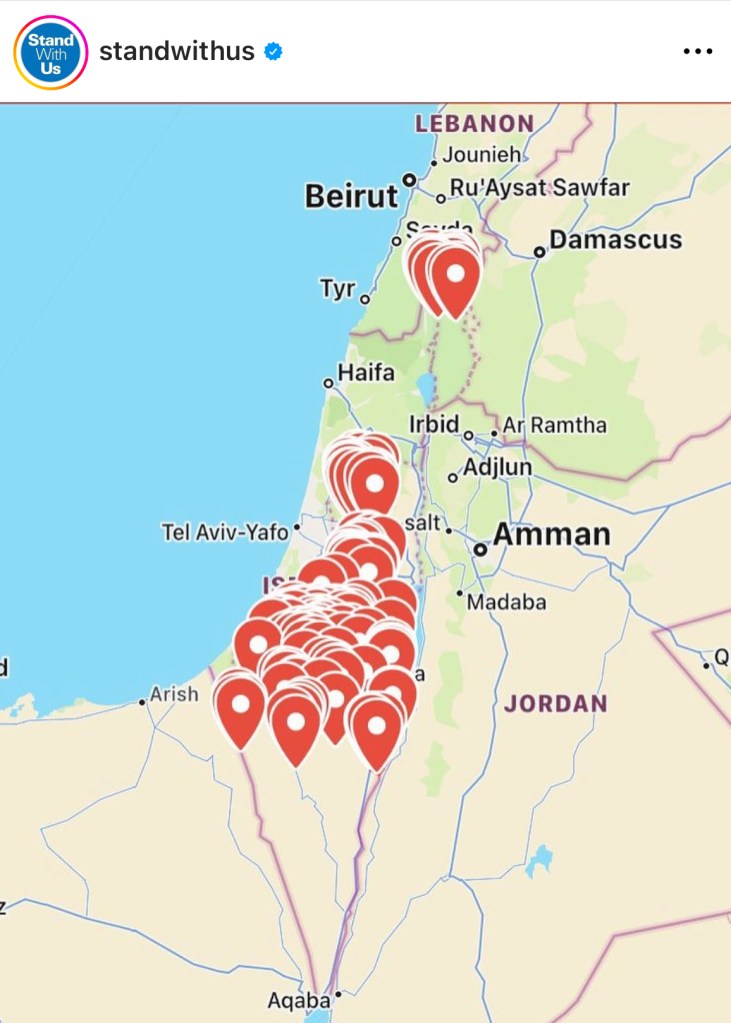
The ceasefire, rooted largely in the Iranian proposal, is conditional upon the opening of the Strait of Hormuz. It is, at best, a fragile ceasefire. Even afterthe ceasefire was announced, missile barrages from Iran and Hezbollah continued to target Israeli communities.
Central to the agreement is the reopening of the Strait of Hormuz. According to a public announcement by Iran, “For a period of two weeks, safe passage through the Strait of Hormuz will be possible via coordination with Iran’s Armed Forces and with due consideration of technical limitations.” As of this writing, this waterway has not been fully, or securely, reopened, nor will it return to normal free navigation, but will be subject, as stated, to “coordination” with Iran’s military.
And the core issues? They remain untouched – Iran’s nuclear program remains intact (more than 440 kilograms of uranium enriched to 60%); sanctions are still unresolved; proxy forces like Hezbollah remain active and Iran’s missile supply, while somewhat diminished, remains significant. This is not conflict resolution. It is conflict postponement. Stated more bluntly: nothing fundamental has been solved.
Let’s Be Honest: This Is About Money
If there is one factor that explains the sudden urgency for a ceasefire, particularly on the part of the Unite States, it definitely is not diplomacy. It is not even military success. It is cost.
Behind all the political hype, the financial and political pressure on Washington has been mounting rapidly. The war has disrupted global energy markets. Oil prices surged as the Strait of Hormuz became a chokepoint. Economic instability loomed – not just globally, but domestically in the United States. And, in an election-sensitive environment, all of that matters. Money talks, nobody walks (away)!
So let’s strip away the rhetoric: The United States is not stepping back because the mission is complete. It is stepping back because the bill is coming due. Markets stabilized almost immediately after the ceasefire announcement. That alone tells you what drove the decision. This was not a battlefield victory. It was a balance-sheet calculation.
And Israel? It is Left Holding the Line
While Washington breathes a sigh of relief, Israel is left in a far more precarious position. Israeli operations, particularly its present operations against Hezbollah in Lebanon, are still in progress. Not completed. Not even close.
And now? They are being slowed, pressured, or potentially frozen. This is where the divergence becomes impossible to ignore: The United States wants de-escalation; Israel still needs decisive threat removal.
Those goals are not the same. And when those goals collide, Israel does not get to dictate the outcome. Quite the opposite – it is being called upon to absorb it.
The consequences of the present announced, two-week respite are immediate: Hezbollah remains operational; northern Israel remains under threat and military momentum is lost at a critical moment. And, perhaps, most dangerously, Israel’s freedom of action may now be constrained by diplomatic realities imposed from outside.
This is the cost of the ceasefire and Israel is the one that will bear the brunt of having to pay it.
Iran’s Real Victory: Survival
Let’s also dispense with another illusion, namely, that Iran has somehow been strategically defeated.
Yes, it is true that Iran has taken hits and yes, Iran’s infrastructure has been slightly damaged. But, the core of its power remains. Iran still possesses enriched uranium at high levels dangerously close to weapons-grade. And, it retains the knowledge, the networks, and the ideological commitment to continue.
And perhaps most importantly – it has not been forced to concede. Instead, it has done what it has done before: It absorbed the pressure, endured the strikes, and waited out the storm.
From Tehran’s perspective, the message is simple: We were attacked . . . and we are still standing. That is not defeat. In the logic of the region of the Middle East – if you do not decisively lose, then, in effect, you are victorious.
The Gap Between Promise and Reality
At the start of this war, the objectives were ambitious, in fact, almost transformational: Stop Iran’s nuclear program; destroy its missile capabilities; break its proxy network and, possibly, even weaken or destabilize the regime itself. As regards the last of the above-mentioned goals, we should not allow ourselves to be fooled about the goal of regime change being a goal of Israel only and not of the United States. There was and, of necessity, had to be a tacit understanding that all of the financial concerns, generated by Iran, will remain as a sword of Damocles over the heads of the nations of the entire region – and the world – as long as Shiite fundamentalism continues Iran’s regime leadership.
Let’s compare the war’s original objectives to where things stand now: Iran still has a significant amount of enriched uranium; Hezbollah, the terrorist organization from Lebanon, is still active; the Iranian regime is still in power and can arguably be said to be more hardened than before and there is no binding agreement that would prevent future escalation.
So what has actually been achieved? Damage. Delay. Disruption. But not resolution. This is not the elimination of a threat. It is the management of one. And managed threats have a way of returning – often stronger than they were before.
Both President Donald Trump and Prime Minister Benjamin Netanyahu are at the center of this moment and are taking risks.
For Trump, the ceasefire offers short-term gains: lower oil prices, calmer markets, reduced political pressure. But it also opens him to a familiar line of attack: He blinked first. If Iran resumes its nuclear progress, or if conflict reignites, this ceasefire could quickly be reframed as weakness, not wisdom.
For Netanyahu, the challenge is even sharper: Israel’s security doctrine is built on decisive action . . . on finishing wars, not pausing them. A ceasefire that leaves Hezbollah intact and Iran’s capabilities only partially degraded is not an easy sell to a public that lives under those threats and that even suffered missile attacks around 03:00 Israel time this morning – well after the “pause” was announced.
This present exercise at restraint reminds me of the familiar story of the turtle and the scorpion a fable about inherent nature and the irrationality of destructive behavior and reveals that some individuals, or in our situation, some nations – cannot change their destructive behavior, regardless of the consequences – to others as well as to themselves.
Returning to the events of this morning, if the situation deteriorates again – and history suggests it will – this moment may be remembered not as strategic patience, but as forced restraint with lasting consequences.
A Pause Before the Next Round
So let’s call this what it is: Not peace. Not victory. Not even stability. This is a pause. It is a pause driven by economics. It is a pause shaped by politics. It is a pause that leaves the underlying conflict unresolved. The United States steps back. Iran regroups. Israel remains exposed.
And in the Middle East, that combination rarely leads to calm. It leads to the next round. The only question is when.
In pride the wicked hotly pursue the afflicted. Let them [the wicked] be caught in the plots which they have devised…For the wicked boasts of his heart’s desire…He says to himself, “I will not be moved…His mouth is full of curses and deceit and oppression. Under his tongue is mischief and wickedness.
They speak mere words, with worthless oaths they make covenants (Hosea 10:4)
Whatever your circumstances, bless, be blessed and be a blessing.
Marvin







 The Week That Was